
CONTENTS
- 1. Details of the Trademark Act Violation Case

- 2. Items of Assistance Provided in the Unfair Competition Prevention and Trade Secret Protection Act Violation Case
- - Preemptive Legal Review of Whether It Constituted Subject Matter Protected Under the Trademark Act
- - Application of Supreme Court Precedent Concerning Combined Business Marks
- - Argument That the Requirements for an Act of Unfair Competition Were Not Satisfied
- 3. Result of the Trademark Act Violation Case
- - Explanation of the Concepts of the Unfair Competition Prevention Act and the Trademark Act
- - Trademark Act and Unfair Competition Prevention Act: Main Types of Violations and Levels of Punishment
- - Trademark Act: Main Types of Violations and Levels of Punishment
- 4. Methods of Responding to Violations of the Trademark Act and the Unfair Competition Prevention and Trade Secret Protection Act
- - Daeryun Law Firm's One-Stop Response Assistance

1. Details of the Trademark Act Violation Case
The client, who had been the subject of charges of violating the Trademark Act and the Unfair Competition Prevention and Trade Secret Protection Act, was the representative of a corporation.
The client was running hashtag and search-media advertising using keywords that combined the name of the business sector that the client's company operated in with the regional name of the area where the business was located.
These keywords were part of an advertising strategy tailored to general consumer search behavior, and the client did not use them with the intent to imitate a particular company or to cause confusion.
However, another company already actually conducting business under the same or a similar name existed, and that company filed a criminal complaint on charges of violating the Unfair Competition Prevention and Trade Secret Protection Act and the Trademark Act, asserting that the client's advertising conduct infringed its trademark and business mark and caused confusion among consumers.
The client completely stopped the advertising that included the keywords and took steps to delete it, but, with the complaint already filed, the client felt a great burden over the possibility that criminal liability could arise, and sought the assistance of an attorney specializing in corporate matters at Daeryun Law Firm.

2. Items of Assistance Provided in the Unfair Competition Prevention and Trade Secret Protection Act Violation Case
In the case of the violation of the Unfair Competition Prevention and Trade Secret Protection Act, the attorney specializing in corporate matters provided the following assistance.
 Preemptive Legal Review of Whether It Constituted Subject Matter Protected Under the Trademark Act
The attorney specializing in corporate matters first closely reviewed whether the advertising keywords used by the client were marks that constituted subject matter protected under the Trademark Act.
Article 33, Paragraph 1 of the Trademark Act provides that a trademark consisting solely of the common name of the goods, a conspicuous geographical name, an abbreviation thereof, or a map cannot, in principle, be registered as a trademark.
In this matter, the keyword at issue corresponded to a conspicuous geographical name, namely the name of a particular city within the Republic of Korea, and the business sector name combined after it was no more than a common name found in the Korean dictionary.
Accordingly, the attorney specializing in corporate matters actively argued that the keyword used by the client could hardly be regarded as a trademark or business mark for which exclusive use is permitted, and that the client had no intent to violate the Trademark Act and no possibility of awareness of such a violation.
Application of Supreme Court Precedent Concerning Combined Business Marks
The attorney specializing in corporate matters presented Supreme Court Decision 99Hu1645 as the core legal principle.
That precedent holds that even if a trade name or business mark composed of a combination of letters, numbers, geographical names, and the like that have no or weak distinctiveness has come to be widely recognized within the country as a result of its use, because granting rights to a mark that originally cannot be monopolized is at issue, the standard for the determination must be interpreted and applied strictly.
It also states that this legal principle must be applied in the same way even where, in determining the similarity of combined business marks, similarity is recognized by treating part of the constituent elements as the essential part.
Accordingly, the attorney specializing in corporate matters demonstrated that the keyword used by the client could hardly be regarded as the mark of a particular company widely recognized within the country, and that, even if a general consumer encountered the keyword, the possibility of intuitively associating it with the complainant company or mistaking it as having the same source was extremely low.
Argument That the Requirements for an Act of Unfair Competition Were Not Satisfied
Under the Unfair Competition Prevention and Trade Secret Protection Act, in order for an act of unfair competition to be established, certain requirements must be satisfied, such as the likelihood of confusion with another party's business mark, damage to its reputation, and impairment of its distinctiveness.
However, the advertising keyword in this matter was no more than a combination of a common name and a geographical name, there was no fact of directly imitating the complainant company's trademark or business mark, and there was also no objective material showing that actual consumer confusion or transactional damage had occurred after the advertising was run.
In addition, the client promptly carried out subsequent measures, such as stopping and deleting the advertising as soon as the problem was recognized, and neither an intent to obtain an unfair business benefit nor an intent to harm the order of competition was confirmed.
Taking these points together, the attorney specializing in corporate matters substantiated at the investigation stage that the client's conduct did not satisfy the constituent requirements of an act of unfair competition under the Unfair Competition Prevention and Trade Secret Protection Act.


3. Result of the Trademark Act Violation Case
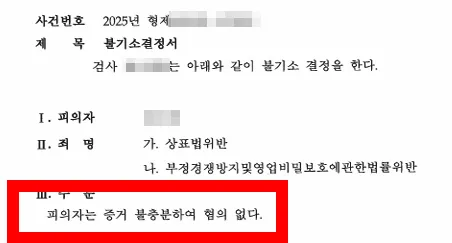
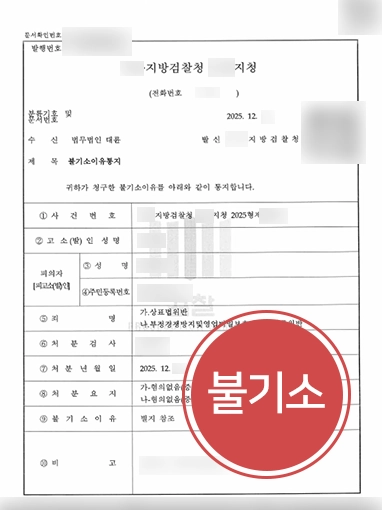
After comprehensively reviewing the legal review opinion and related materials submitted by the attorney specializing in corporate matters at Daeryun Law Firm, the prosecution rendered a non-prosecution (no suspicion of crime) decision on all of the charges of violating the Unfair Competition Prevention and Trade Secret Protection Act and the Trademark Act.
This was the result of a comprehensive recognition that the keyword did not constitute a protected trademark or business mark, that the likelihood of confusion and intent were not acknowledged, and that the conduct could hardly be regarded as an act of unfair competition under the precedents, an outcome that was possible because of the assistance of the attorney specializing in corporate matters.
Explanation of the Concepts of the Unfair Competition Prevention Act and the Trademark Act
The Unfair Competition Prevention and Trade Secret Protection Act is a law intended to regulate conduct that unfairly uses another party's achievements, reputation, or business interests, or that harms the order of fair competition.
The Trademark Act, in turn, aims to identify the source of goods or services through trademarks and to promote security in transactions by granting an exclusive right of use over registered trademarks.
A trademark refers to a mark, consisting of letters, figures, symbols, colors, three-dimensional shapes, or a combination thereof, that is used to distinguish one's own goods or services from those of others and that has the function of indicating the source in the trading community.
A registered trademark means a trademark that has been registered with the Korean Intellectual Property Office under the Trademark Act and for which the trademark holder is granted an exclusive and exclusionary right of use with respect to the designated goods or designated services, and if a third party uses an identical or similar trademark without authorization, an issue of trademark infringement may arise.
In the course of advertising, marketing, and the selection of online search keywords, a company must exercise particular caution, because even a general name or geographical name can lead to a criminal or civil dispute if the likelihood of confusion, distinctiveness, and the relationship with an existing business mark are not sufficiently reviewed.
Trademark Act and Unfair Competition Prevention Act: Main Types of Violations and Levels of Punishment
Main Type of Violation | Level of Criminal Punishment |
Unauthorized use of another party's trademark, name, trade name, or product mark | Imprisonment for not more than 3 years or a fine of not more than 30 million won
|
Use of a mark similar to another party's business mark | |
Conduct damaging another party's reputation or distinctiveness | |
False indication of the place of origin or place of production | |
Misleading indication of the quality, content, or method of manufacture of goods | |
Unauthorized use of a domain similar to another party's trademark or name | |
Acquisition, use, or disclosure of a trade secret | Imprisonment for not more than 10 years or a fine of not more than 500 million won |
Leakage of a trade secret abroad | Imprisonment for not more than 15 years or a fine of not more than 1.5 billion won |
Damage or destruction of a trade secret | Imprisonment for not more than 10 years or a fine of not more than 500 million won |
Trademark Act: Main Types of Violations and Levels of Punishment
Content of the Violation | Level of Criminal Punishment |
Using a trademark identical to another party's registered trademark on similar goods | Imprisonment for not more than 7 years or a fine of not more than 100 million won
|
Using a trademark similar to another party's registered trademark on identical or similar goods | |
Selling, transferring, or storing goods bearing an infringing trademark | |
Forging or counterfeiting a registered trademark or manufacturing tools for the purpose of forgery | |
Infringement of a trademark right or an exclusive license |
4. Methods of Responding to Violations of the Trademark Act and the Unfair Competition Prevention and Trade Secret Protection Act
If you are the subject of a criminal complaint on charges of violating the Unfair Competition Prevention and Trade Secret Protection Act or the Trademark Act, it is necessary to immediately conduct a legal review of whether the conduct at issue has been stopped, the distinctiveness of the mark, the likelihood of confusion, and the presence of intent, and then to establish a strategy that considers both the criminal response and the possibility of civil liability.
Response Stage | Matters to Confirm Immediately | Key Response Points |
Initial Awareness | Understanding the content of the complaint or warning | Accurately identifying the mark or keyword at issue |
Determination of Protected Subject Matter | Whether it constitutes a trademark or business mark | Reviewing whether it is a common name or geographical name |
Likelihood of Confusion | Likelihood of consumer confusion | Analysis centered on the advertising context and manner of use |
Determination of Intent | Whether awareness or intent existed | Emphasizing subsequent measures such as immediate cessation and deletion |
Legal Response | Application of precedents and statutory provisions | Presenting precedents related to combined marks and distinctiveness |
Investigation Response | Submission of a written opinion | Structuring a no-suspicion case centered on legal principles |
Risk of Expansion | Possibility of civil action | Establishing a strategy to prepare for damages and provisional injunctions |
Daeryun Law Firm's One-Stop Response Assistance

Daeryun Law Firm, centered on attorneys specializing in corporate matters, attorneys specializing in intellectual property, and attorneys specializing in fair trade, provides one-stop assistance with criminal and civil cases related to the Unfair Competition Prevention and Trade Secret Protection Act and the Trademark Act, from the initial response through the investigation stage to the trial stage.
Disputes that can arise in the course of advertising and marketing, even if they appear minor, can expand into criminal liability, so professional legal review and response are essential.
If you need legal assistance in a related matter, we recommend that you proceed with 🔗scheduling a legal consultation.
This content is based on actual case studies of Daeryun Law LLC with some adaptations, and the copyright belongs to our firm.
Unauthorized reproduction, duplication, or distribution and other copyright infringements may result in legal action under applicable laws.