
CONTENTS
- 1. A Client Charged With Violation of the Unfair Competition Prevention and Trade Secret Protection Act

- - A Client Who Requested a Consultation Regarding a Violation of the Trade Secret Protection Act
- 2. Legal Information Related to the Unfair Competition Prevention and Trade Secret Protection Act
- - What Is the Punishment for a Violation of the Trade Secret Protection Act?
- 3. The Unfair Competition Prevention and Trade Secret Protection Act Attorney's Assistance
- - Trade Secret Protection Act Violation Response Measure 1: Voluntary Cancellation of Transactions by Customers
- - Trade Secret Protection Act Violation Response Measure 2: No Leak of Customer Data
- - Trade Secret Protection Act Violation Response Measure 3: Insufficient Evidence
- 4. Insufficient Evidence of Violation of the Unfair Competition Prevention and Trade Secret Protection Act, “Non-Prosecution”
- - If You Are Charged With a Violation of the Trade Secret Protection Act

1. A Client Charged With Violation of the Unfair Competition Prevention and Trade Secret Protection Act

The client, who was the subject of a complaint on suspicion of violating the Unfair Competition Prevention and Trade Secret Protection Act, sought to respond with legal assistance, and through the attorney's assistance received a non-prosecution decision, successfully defending against punishment.
 A Client Who Requested a Consultation Regarding a Violation of the Trade Secret Protection Act
This is the background of the case as understood by the attorney.
The client found employment immediately upon becoming an adult and worked at one company for more than five years.
He held a sales position, so he frequently met and communicated with customers directly.
After the client left the company, however, customers who had placed deep trust in him began terminating transactions or canceling contracts.
The former employer's representative then reported the client for a violation of the Unfair Competition Prevention and Trade Secret Protection Act, alleging that the client had diverted the customer list and induced the cancellation of contracts.
Feeling that this was unfair, the client sought out an attorney with extensive experience in the fair trade field to obtain legal assistance and respond.
2. Legal Information Related to the Unfair Competition Prevention and Trade Secret Protection Act
The formal title of the Unfair Competition Prevention Act is 'the Unfair Competition Prevention and Trade Secret Protection Act,' and this statute also defines a 'trade secret.'
Trade secrets may include a wide range of things, from physical materials to business know-how and information.
Types of trade secrets
▶ Product recipes and ingredient mixing ratios, etc.
▶ Customer lists
▶ Major plans such as investment plans and new product development plans
▶ Management information such as client information, costs, and unit prices
If a person divulges a trade secret or commits an act of wrongful acquisition by using it, this is generally regarded as a violation of the 🔗Trade Secret Protection Act, and the person may bear criminal punishment or civil liability.
What Is the Punishment for a Violation of the Trade Secret Protection Act?
However, not all corporate information or internal materials are recognized as trade secrets; they may be recognized as trade secrets only when they satisfy the requirements for establishment, such as non-public status and economic usefulness.
If it is found that a person obtained an improper benefit using a trade secret or disclosed it without authorization, that person may be subject to criminal punishment under the Unfair Competition Prevention and Trade Secret Protection Act.
The relevant levels of punishment are as follows.
Type | Level of punishment |
Domestic violation of trade secret protection law | Imprisonment for up to 10 years or a fine of up to 500 million won |
Foreign violation of trade secret protection law | Imprisonment for up to 15 years or a fine of up to 1.5 billion won |


3. The Unfair Competition Prevention and Trade Secret Protection Act Attorney's Assistance

The attorney with expertise in the Unfair Competition Prevention and Trade Secret Protection Act conducted a careful examination of the client's allegations and gathered related evidence, then presented the following argument.
Trade Secret Protection Act Violation Response Measure 1: Voluntary Cancellation of Transactions by Customers
The cancellation of transactions by customers, which the opposing party took issue with, was not the result of inducement or persuasion by the client but rather the customers' voluntary choice.
The customers had conducted transactions because they had a deep trust in the client, so they cancelled the transactions when the client resigned.
The attorney collected and submitted statements from the customers and emphasized that the cancellation of transactions was the customers' voluntary choice.
Trade Secret Protection Act Violation Response Measure 2: No Leak of Customer Data
When the client resigned, they handed over all of the customer data they had managed to the company and left.
The customer data they had managed while employed was therefore not leaked outside the company at all.
The attorney collected and submitted statements from the employee who received the handover, among other materials, and emphasized that there had been no leak of the customer data.
Trade Secret Protection Act Violation Response Measure 3: Insufficient Evidence
The opposing party also claimed that the client had leaked customer data and solicited customers, but submitted no particular evidence.
There was no evidence other than the fact that customers had canceled their transactions after the client's resignation.
The attorney emphasized that there was no objective evidence to prove the client's charges.
4. Insufficient Evidence of Violation of the Unfair Competition Prevention and Trade Secret Protection Act, “Non-Prosecution”

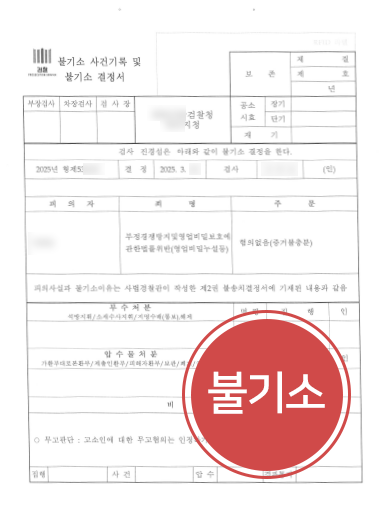
Accepting the arguments of the attorney with specialized knowledge of the Unfair Competition Prevention and Trade Secret Protection Act, the prosecution issued a non-prosecution decision, finding that there was insufficient evidence of the charges.
If You Are Charged With a Violation of the Trade Secret Protection Act
This was an account of a client who was unjustly accused of disclosing trade secrets and filed against, but received a non-prosecution decision with the attorney's help.
As shown here, when facing criminal charges for violating the Unfair Competition Prevention and Trade Secret Protection Act, properly identifying the scope of the trade secret and the unlawful act, and collecting evidence, can be important.
At Daeryun Law Firm, attorneys with expertise in the relevant law provide close assistance, actively collecting evidence and preparing a response from the early stage of the case.
If you are facing a similar issue, we hope you will obtain help through a 🔗legal consultation appointment.
This content is based on actual case studies of Daeryun Law LLC with some adaptations, and the copyright belongs to our firm.
Unauthorized reproduction, duplication, or distribution and other copyright infringements may result in legal action under applicable laws.