
CONTENTS
- 1. The Client Who Requested a Lawsuit for Return of Unjust Enrichment

- - Circumstances of the Case
- - Lawsuit for Return of Unjust Enrichment: The Assistance of the Civil Law Specialist Attorney
- - Lawsuit for Return of Unjust Enrichment: Grant of the Full 130 Million Won Claim
- 2. The Concept and Requirements for the Establishment of a Lawsuit for Return of Unjust Enrichment
- - Requirements for the Establishment of a Lawsuit for Return of Unjust Enrichment
- 3. Key Points for Responding to a Lawsuit for Return of Unjust Enrichment
- - Lawsuit for Return of Unjust Enrichment: The Assistance of the Civil Law Specialist Attorney

1. The Client Who Requested a Lawsuit for Return of Unjust Enrichment
This is the story of a client who came to a civil law specialist attorney for a lawsuit for return of unjust enrichment.
 Circumstances of the Case

The client was the representative of Personnel Agency A, which provided services to construction sites and received commissions from construction companies.
Employee B (hereinafter referred to as the defendant) worked at the client's company and had taken charge of recruiting construction sites.
One day, the client learned that funds that were to be paid by a certain construction company had not been paid.
Finding this suspicious, the client checked the facts and learned that the defendant had received the funds without authorization.
The client tried to locate the defendant but was unable to find his whereabouts.
Accordingly, the client filed a criminal complaint against the defendant through a police report and then sought to claim, through a civil lawsuit, the 130 million won that was to be paid by the construction company.
For this purpose, the client requested assistance with the lawsuit for return of unjust enrichment from a civil law specialist attorney at Daeryun Law Firm.
Lawsuit for Return of Unjust Enrichment: The Assistance of the Civil Law Specialist Attorney
1) Proving the Defendant's Tort
internal evidence investigation center, the attorney collected evidentiary materials to prove the defendant's tort.
The attorney collected work logs, email records with the construction company, payment statements, and the like, and confirmed the facts by comparing these against the client's records of fund payments.
In this process, the attorney was able to secure evidence that the defendant had received the funds by forging labor cost payment statements, proxy receipt acknowledgments, and the like.
The civil law specialist attorney used this as strong evidence of the defendant's tort and asserted that the defendant had an obligation to return the unjust enrichment.
2) Confirming the Absence of a Legal Cause for the Defendant
The civil law specialist attorney reviewed the employment contract concluded between the client and the defendant.
The contract expressly contained the following clause: "All commissions, brokerage profits, and funds equivalent thereto that arise from the defendant's recruitment or introduction of construction companies shall, regardless of their name or form of payment, belong entirely to the client."
Accordingly, the attorney made clear that the defendant's receipt of the commissions constituted nonperformance of the contract and that there was no legal cause with respect to the funds.
3) Emphasizing the Client's Mental Suffering and Property Damage
The attorney submitted a psychiatrist's medical opinion and psychological counseling logs to assert that the client was suffering serious mental distress as a result of the defendant's conduct.
The attorney also organized the client's business plan and emphasized that the unpaid funds had caused disruptions to the company's operating funds and made it difficult to conduct business normally.
Lawsuit for Return of Unjust Enrichment: Grant of the Full 130 Million Won Claim
The court recognized that the defendant had no legal cause for the funds and that the client had suffered substantial property damage as a result of that conduct.
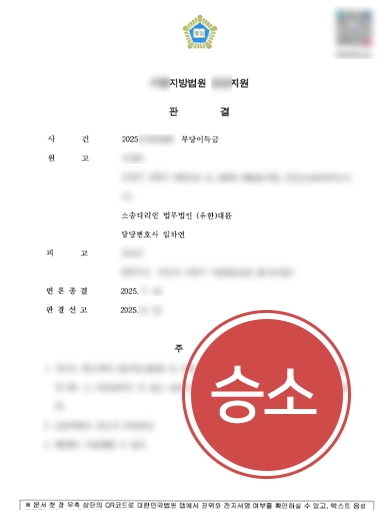
Accordingly, the court rendered a judgment ordering the defendant to pay 130 million won in unjust enrichment.


2. The Concept and Requirements for the Establishment of a Lawsuit for Return of Unjust Enrichment
A lawsuit for return of unjust enrichment is a civil procedure through which one may recover a benefit when another person has obtained that benefit without a legally legitimate reason.
The phrase "without a legally legitimate reason" here does not necessarily refer only to unlawful conduct.
If the other party has obtained an unjust benefit as a result of a mistake, an error, or unlawful conduct arising in a contract or transaction, a lawsuit for return of unjust enrichment may likewise be filed.
Requirements for the Establishment of a Lawsuit for Return of Unjust Enrichment
Category | Content |
Existence of a Benefit | The other party must have actually obtained a property benefit |
Occurrence of Damage | Damage equal to or corresponding to that benefit must have occurred on the claimant's side |
Causation | There must be a causal relationship between the other party's benefit and the claimant's damage |
Absence of a Legal Cause | There must be no legitimate legal basis for the other party's benefit |
When all of the above requirements are satisfied, a claim for return of unjust enrichment is recognized.
3. Key Points for Responding to a Lawsuit for Return of Unjust Enrichment
When pursuing a lawsuit for return of unjust enrichment, it is above all important to collect related materials and organize them systematically in order to prove that the defendant obtained an unjust benefit.
In addition, you must prepare a rebuttal logic in anticipation of the possibility that the defendant's side will assert a legal cause.
Lawsuit for Return of Unjust Enrichment: The Assistance of the Civil Law Specialist Attorney
The civil law specialist attorney identifies the core issues of the matter and establishes a strategy for the practical recovery of unjust enrichment.
collaborating with the internal evidence investigation center, the attorney secures materials such as work records, contracts, and amount calculation receipts to prove that the other party obtained an unjust benefit.
The attorney also reviews the contract together with an internal labor attorney and then strongly asserts the absence of a legal cause for the other party.
In a lawsuit for return of unjust enrichment, it is important to systematically organize the flow from the acquisition of the benefit to the occurrence of damage, the causation, and the absence of a legal cause.
The civil law specialist attorney reviews the case as a whole, organizes the issues, and organizes the order of arguments and proof so that the court can judge each requirement in sequence.
▶ Securing Evidentiary Materials
By collaborating with the internal evidence investigation center, the attorney secures related materials such as work records, contracts, remittance details, and receipts and proves with objective evidence that the other party actually obtained a property benefit.
▶ Constructing the Logic for the Absence of a Legal Cause
By comprehensively reviewing the contract terms and legal principles, the attorney prepares for defenses that the other party may raise, such as a contractual relationship, settlement of payment, or extinctive prescription, and asserts that there is no legitimate legal basis for the benefit.
▶ Responding to Follow-Up Procedures With Practical Recovery in Mind
The attorney establishes a response strategy that takes into account the possibility of conciliation and settlement, the joinder of a damages claim, and even compulsory execution, supporting the matter so that it can lead to the practical recovery of unjust enrichment.
Because it is important to first review the proof strategy and the practical benefit of litigation suited to the matter and then determine the direction of the response, we encourage you to receive a specific assessment through a 🔗legal consultation reservation with a civil law specialist attorney.
This content is based on actual case studies of Daeryun Law LLC with some adaptations, and the copyright belongs to our firm.
Unauthorized reproduction, duplication, or distribution and other copyright infringements may result in legal action under applicable laws.