CONTENTS
- 1. The Client Who Requested a Lawsuit for the Return of Unjust Enrichment

- - What Is a Lawsuit for the Return of Unjust Enrichment?
- 2. Strategy for the Lawsuit for the Return of Unjust Enrichment
- - Argument Regarding the Inheritance Share
- - Argument That the Defendant's Exclusive Receipt Constitutes Unjust Enrichment
- - Claim for Interest
- 3. Result of the Lawsuit for the Return of Unjust Enrichment: Successful Claim for the Return of KRW 600 Million in Unjust Enrichment
- - If You Are Preparing a Lawsuit for the Return of Unjust Enrichment

1. The Client Who Requested a Lawsuit for the Return of Unjust Enrichment
This is the account of a client who requested assistance with a lawsuit for the return of unjust enrichment.
The client (the plaintiff) had previously married the spouse (the defendant) and had a child, A, but the relationship had been concluded through divorce.
However, child A sustained serious injuries in a traffic accident, and the defendant, together with the child, filed a claim for damages against the company responsible.
Through that claim for damages, child A received approximately KRW 1.2 billion in compensation.
Unfortunately, however, the child passed away after undergoing treatment, and the right to claim the damages was jointly inherited by the parents, namely the client and the defendant.
Because the inheritance share was one-half each, the client also had the right to inherit an amount corresponding to KRW 600 million.
Nevertheless, the defendant received the entire amount of the damages from the party responsible into the defendant's own account and then exclusively spent it without informing the client.
The client came to our firm to ask whether it was possible to inherit the damages in question.
The attorney in charge at Daeryun Law Firm explained that the client had the right to receive a joint inheritance and that the defendant's act of withholding it constituted a clear tort, and proposed a lawsuit for the return of unjust enrichment.
The client wished to receive the rightful inheritance share, and attorneys with extensive experience in lawsuits for the return of unjust enrichment took the lead in handling the case.
 What Is a Lawsuit for the Return of Unjust Enrichment?
Article 741 of the Civil Act (Civil Code) provides that “a person who gains a benefit from another person's property or labor without legal cause and thereby causes loss to that other person shall return such benefit.”
In other words, a lawsuit for the return of unjust enrichment is an action in which a party who has had money rightfully belonging to them taken by the other party without legitimate cause seeks the return of that amount.
In order for a claim for the return of unjust enrichment to be acknowledged, the following requirements must be satisfied.
▶Existence of a benefit: the other party must have actually acquired a financial benefit
▶Occurrence of loss: the claimant must have suffered a loss equal to the benefit
▶Causation: there must be a causal relationship between the loss and the benefit
▶Absence of legal cause: there must be no legitimate legal basis for the other party's benefit
A lawsuit for the return of unjust enrichment follows the same procedure as an ordinary civil action and generally proceeds through the following stages.
Preparation and Filing of the Complaint
The fact that unjust enrichment occurred, the reasons for demanding its return, and the specific amount claimed are stated in the complaint and submitted to the court.
At this stage, it is very important to attach supporting evidence.
Filing of the Answer and Conduct of Pleadings
The defendant may submit an answer containing rebuttals to the complaint, after which the court sets a date for pleading and examines the arguments of both sides.
Allocation of the Burden of Proof
The plaintiff must prove the occurrence of unjust enrichment and the absence of a legal basis, while the defendant, conversely, may allege and prove that there was a legitimate reason to obtain the benefit.
The Court's Determination and Pronouncement of Judgment
If the court accepts the plaintiff's claim, it orders the defendant to return the amount in question; otherwise, the claim is dismissed.
Compulsory Execution After Judgment
If the defendant does not perform the obligation to return as ordered by the judgment, the plaintiff may apply for compulsory execution against the defendant's property, such as real estate, deposits, and wages.


2. Strategy for the Lawsuit for the Return of Unjust Enrichment

For the lawsuit for the return of unjust enrichment, the Daeryun attorney made the following arguments.
Argument Regarding the Inheritance Share
Because child A's claim for damages is a monetary claim and therefore a divisible claim, it was divided and vested in the statutory inheritance shares (one-half each) simultaneously with the commencement of inheritance.
The attorney in charge emphasized that, of the damages received by the defendant, KRW 600 million naturally belonged to the client.
Argument That the Defendant's Exclusive Receipt Constitutes Unjust Enrichment
Although the defendant was able to manage the money as the adult guardian of the child, the defendant disregarded the plaintiff's rights even after the commencement of inheritance and used the entire amount as if it were the defendant's own share.
This is clearly subject to the return of unjust enrichment.
The attorney in charge emphasized that, because the defendant's exclusive receipt constitutes unjust enrichment, the client's lawsuit for the return of unjust enrichment was well founded.
Claim for Interest
Because an obligation to return unjust enrichment is an obligation for which no due date is specifically set, the obligor bears liability for default only from the time the obligor receives a demand for performance from the other party.
In addition, under Article 749(2) of the Civil Act (Civil Code), where a beneficiary in good faith loses in a lawsuit, the beneficiary is deemed to be a beneficiary in bad faith from the time the lawsuit was filed and thus bears the responsibility for paying interest.
Here, ‘the time the lawsuit was filed’ means not simply the time the complaint was received by the court, but the time the complaint was served on the other party and the lawsuit became pending (Supreme Court Decision 2012Da95325, January 23, 2014).
The Daeryun attorney in charge emphasized that the defendant was obligated to pay not only the principal of the unjust enrichment but also delay damages at the statutory interest rate (12% per annum) from the date the duplicate of the complaint was served until the date of full payment.
3. Result of the Lawsuit for the Return of Unjust Enrichment: Successful Claim for the Return of KRW 600 Million in Unjust Enrichment
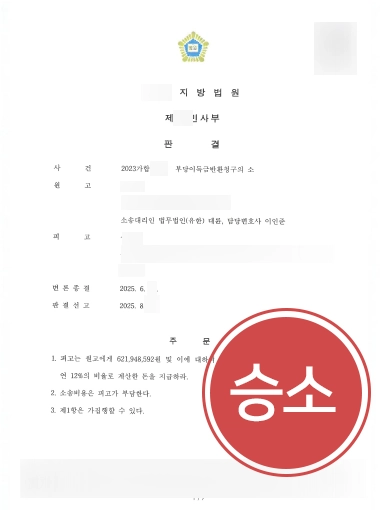
As a result of the lawsuit for the return of unjust enrichment, the client was able to obtain a judgment ordering the return of the full KRW 600 million in unjust enrichment that had been claimed.
This case clearly illustrates how a lawsuit for the return of unjust enrichment is used in practice.
If the other party has infringed your rights in matters such as inherited property, post-divorce property disputes, or money paid in error, you can recover your share through a claim for the return of unjust enrichment.
If You Are Preparing a Lawsuit for the Return of Unjust Enrichment
We will explain how to respond to a lawsuit for the return of unjust enrichment according to each party's position.
▶How the Plaintiff Should Respond
Organizing the Cause of the Claim
Organize on what legal basis, if any, the other party acquired money or a benefit.
Examples: receiving inherited property alone, refusing to return money deposited in error, refusing to return funds after termination of a contract, and the like.
Collecting Evidence
Prepare supporting materials such as remittance records, judgments, settlement agreements, and transaction records.
In particular, materials proving that it was a ‘benefit without legal cause’ are key.
Preparing the Complaint
State in detail the amount claimed, the interest (at the statutory interest rate), the circumstances of occurrence, and the legal basis.
Responding to the Court's Examination
Prepare rebuttal arguments in anticipation of the defendant's defenses (for example, an argument of a contributory portion or an argument that the money has already been spent).
If necessary, present precedents or similar cases as grounds.
▶How the Defendant Should Respond
Arguing the Existence of a Legal Cause
The defendant must prove that there was a legitimate legal basis for the benefit received.
Examples: an agreement on the division of inherited property, a settlement payment, legitimate repayment of a claim, and the like.
Arguing a Contributory Portion or Special Circumstances
In an inheritance case, the defendant may argue a contributory portion based on care or support provided to the decedent.
However, because this is acknowledged only where there is an adjudication or agreement of the family court, a mere assertion is insufficient.
At Daeryun Law Firm, attorneys with experience in numerous cases involving unjust enrichment take the lead in providing tailored legal services.
We invite you to turn to Daeryun Law Firm, which operates a consultation intake system 365 days a year, 24 hours a day, and is able to respond promptly to civil litigation.
See More
This content is based on actual case studies of Daeryun Law LLC with some adaptations, and the copyright belongs to our firm.
Unauthorized reproduction, duplication, or distribution and other copyright infringements may result in legal action under applicable laws.