
CONTENTS
- 1. Adult Guardianship | The Client's Story

- - What Is an Inheritance Guardian?
- 2. Adult Guardianship | Scope of Assistance
- 3. Adult Guardianship | Result of Assistance

1. Adult Guardianship | The Client's Story
The father of the client who came seeking adult guardianship missed his footing and fell while hiking, severely injuring his head, and although he underwent several surgeries after being rescued, he remained unconscious to date.
The problem was that, as the treatment was prolonged, the burden of hospital expenses kept growing.
The client was in fact paying the father's hospital expenses, but even when claiming on the indemnity insurance, the insurance proceeds were deposited only into an account in the father's name, making withdrawals and transfers impossible, and various financial transactions with the bank were also impossible.
Saying, “Because I do not know how long the coma will last, I must arrange the treatment expenses in a stable manner,” the client wished to be appointed as the inheritance guardian through the adult guardianship procedure so as to be able to handle the insurance and financial transactions on the father's behalf.

 What Is an Inheritance Guardian?
The adult guardianship system is a system under which the family court appoints a guardian in order to protect an adult who, due to illness, disability, old age, or similar causes, persistently lacks the capacity to handle his or her affairs.
Civil Act Article 9 (Adjudication of the Commencement of Adult Guardianship)
(1) With respect to a person who persistently lacks the capacity to handle his or her affairs because of a mental constraint resulting from illness, disability, old age, or any other cause, the family court shall, upon the request of the person himself or herself, his or her spouse, a relative within the fourth degree, a guardian of a minor, a supervisor of a guardian of a minor, a guardian of limited capacity, a supervisor of a guardian of limited capacity, a guardian of specified capacity, a supervisor of a guardian of specified capacity, a prosecutor, or the head of a local government, make an adjudication of the commencement of adult guardianship. (2) When making an adjudication of the commencement of adult guardianship, the family court shall consider the intention of the person himself or herself. |
Under Article 9 of the Civil Act, where decision-making is difficult on grounds such as dementia, developmental disability, or a brain disease, a person entitled to make the request may petition the family court to appoint an inheritance guardian.


2. Adult Guardianship | Scope of Assistance
In an adult guardianship case, the key is not merely to explain the family circumstances but to persuade the court, with supporting evidence, that the requirements the court reviews are satisfied.
1. Organizing the Comatose Condition and the Need for Guardianship
In this case, the central point was that the principal was currently unable to make decisions and that this condition was ongoing.
The inheritance attorney organized the circumstances of the accident and the condition after surgery on the basis of the certified copy of medical records and the general medical certificate, and clearly demonstrated that the father was unable to handle his own affairs.
2. Resolving the Treatment Cost and Insurance Proceeds Issues Legally
Even when the client filed a claim under the indemnity insurance, the insurance proceeds were deposited only into the father's account, so withdrawal was impossible, and the client was concerned that an attachment might proceed against the account, which could destabilize the payment of treatment costs.
The inheritance attorney structured the purpose of the petition so that, through the commencement of adult guardianship, the client could legally handle financial and insurance matters, and explained in concrete terms the need for financial transactions to pay treatment costs.
In addition, after the appointment of the inheritance guardian, the attorney provided guidance and assisted with preparations so that the insurance claim and the necessary insurance-related procedures (including whether changes were permitted under the policy terms) could proceed within the lawful scope.
3. Persuading the Court as to Why the Son Should Become the Guardian
The court determines not only the commencement of adult guardianship but also who is most appropriate to serve as the guardian.
The inheritance attorney persuaded the court that the client should become the inheritance guardian, on the grounds that the father was divorced from his former spouse and that the petitioner, as the son, had effectively borne the hospital expenses and undertaken his protection.
To this end, the attorney submitted the following documents in full and conducted the procedure in a stable manner.
An abridged resident registration record, a resident registration record, a family relation certificate, a basic certificate, a certificate of non-existence of guardianship registration, a copy of medical records (with certification of the copy), and a general medical certificate |
3. Adult Guardianship | Result of Assistance
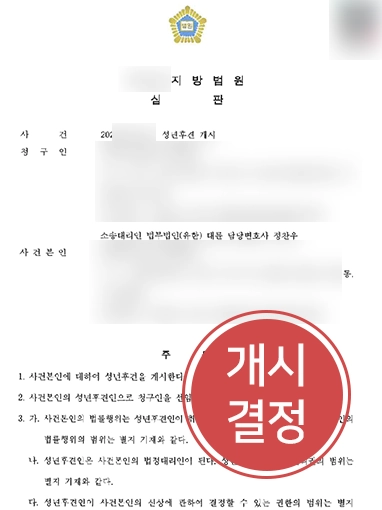
As a result of the assistance in this adult guardianship case, the court comprehensively reviewed the father's condition and the realities of his treatment, determined that the commencement of adult guardianship was necessary, and appointed the client as the inheritance guardian.
The client was thereafter able to carry out essential procedures on the father's behalf, such as financial transactions for the payment of treatment costs and insurance claims, from a legally legitimate position, and established a foundation for stably managing the cost issues that had been the greatest source of anxiety during the long course of treatment.
Where a family member must handle insurance and financial matters on behalf of a person who is comatose, has a severe brain injury, or requires long-term treatment, a review of adult guardianship may be necessary.
The key is to prove the loss of capacity to handle affairs through medical evidence and to organize the actual state of protection and the petitioner's eligibility in a structure that the court can readily understand.
In particular, in a matter where financial and insurance transactions for securing treatment costs and even the possibility of disposing of property are reviewed together, a strategic approach is required so that no gaps arise in the documents to be prepared and in the purpose of the petition.
If you require an application for an inheritance guardian or related advice, please feel free to request a consultation through the 🔗Legal Consultation Reservation page.
This content is based on actual case studies of Daeryun Law LLC with some adaptations, and the copyright belongs to our firm.
Unauthorized reproduction, duplication, or distribution and other copyright infringements may result in legal action under applicable laws.