
CONTENTS
- 1. Details of the Inheritance and Succession Attorney's Case

- - Daeryun's Assistance
- - Result of the Case
- 2. The Concept of an Inherited Debt as Explained by the Inheritance and Succession Attorney
- - The Concept of an Estate and Its Main Contents
- 3. Types of Inheritance Disputes and Methods of Response as Organized by the Inheritance and Succession Attorney
- - The One-Stop Assistance Provided by Daeryun Law Firm

1. Details of the Inheritance and Succession Attorney's Case
The clients who sought an inheritance and succession attorney were subjected to an unexpected lawsuit in the course of carrying out inheritance procedures following the sudden death of their father.
They received a complaint claiming an inherited debt, demanding payment of tens of millions of won in inherited debt from their father's siblings.
The plaintiffs argued that, in the course of the deceased acquiring and managing a particular piece of real estate during his lifetime, "there was an agreement to settle a certain amount if the relevant real estate were later disposed of," and they stated that, because the clients had disposed of the relevant real estate after the inheritance, the obligation to pay money under that agreement had been transferred to them through inheritance.
However, according to the clients, no such agreement had ever been put in writing between the deceased and the plaintiffs, and nothing had been specifically agreed regarding the settlement standard, the time of payment, or the method of calculating the amount.
Nevertheless, the plaintiffs would not yield from their position that "the agreement clearly existed, and now the heirs must bear that responsibility," relying on records of some past monetary transactions and on circumstances suggesting family discussions.
The clients, feeling great confusion and a sense of injustice as to "whether it could truly be just that, after the death of the deceased, an agreement that never existed was created belatedly and imposed on the heirs as a debt," came to Daeryun Law Firm.

 Daeryun's Assistance
The inheritance and succession attorneys of Daeryun Law Firm defended the case through the following key strategies.
First, the inheritance and succession attorney rebutted the point that the plaintiffs were distorting the clients' offer of monetary payment, which the plaintiffs treated as their core basis, into an "acknowledgment of debt."
In addition, the attorney made clear, through specific conversation contents and wording, that the monetary payment offered by the client was not an admission of the existence of a legal debt or a promise to perform it, but merely a conditional settlement offer to bring an end to the family dispute.
In particular, the inheritance and succession attorney argued, on the basis of the defendant's express expression of intention that "if the litigation continues, that amount will not be paid" and the structure of the conditional offer premised on the withdrawal of the lawsuit and the conclusion of the dispute, that the offer could not constitute an acknowledgment of debt under the Civil Act.
Next, with respect to the plaintiffs' argument of "awareness of the agreement" based on parts of the transcript submitted by the plaintiffs, the inheritance and succession attorney clarified, through the overall context of the conversation, that the relevant remarks did not acknowledge the existence of the agreement but merely acknowledged the fact that conversations had been held regarding matters such as past loan issues.
The inheritance and succession attorney, in cooperation with the evidence investigation center, analyzed the flow of the transcript before and after, the purpose of the questions, and the specific circumstances in which the remarks were made, one by one, and pointed out that the plaintiffs were extracting only particular expressions and interpreting them arbitrarily.
In addition, the attorney emphasized that nowhere in the numerous KakaoTalk conversation records continuing from before the dispute arose through afterward was there any content from which the existence of the "debt-bearing agreement" claimed by the plaintiffs could be inferred.
Result of the Case
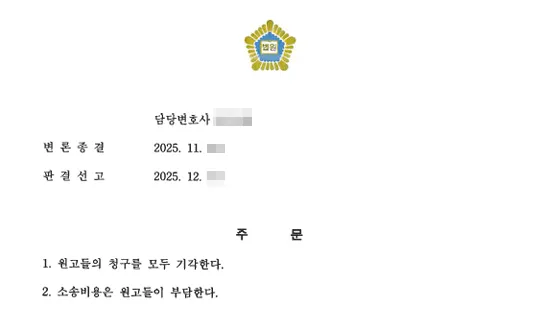
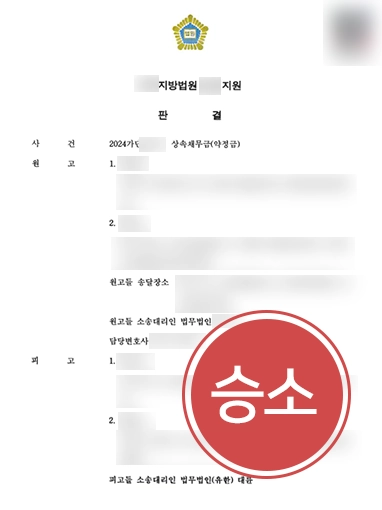
As a result, the court determined that the evidence was insufficient to recognize the existence of the agreement and that the plaintiffs' claim premised on it was without merit, and it dismissed the plaintiffs' claim in full and also ruled that the litigation costs were to be borne by the plaintiffs.
2. The Concept of an Inherited Debt as Explained by the Inheritance and Succession Attorney
An inherited debt (agreed sum) refers to a monetary debt that is claimed to have arisen under an agreement allegedly concluded by the deceased with a particular person during his lifetime and to have been transferred to the heirs through inheritance.
In general, the principle is that inheritance succeeds not only to the deceased's property but also to debts; however, not all debts are unconditionally recognized as inherited debts.
In particular, the agreed sums that become problematic in inheritance disputes have the following characteristics.
First, the very existence of the agreement is often unclear.
Monetary transactions among family members, oral agreements, and internal promises are in most cases made without a contract, and it is not uncommon for the argument that "there was an agreement" to be raised only in the course of a dispute after death.
Second, for an agreed sum to be recognized as an inherited debt, strict proof is required.
The court does not readily recognize the existence of an agreement on the basis of account transfer records or the statements of related persons alone, and it recognizes a debt only when the content of the agreement, the method of calculating the amount, the time of performance, and the party making payment are specifically identified.
Third, a "settlement-upon-disposal agreement" is a type that is especially prone to dispute.
The argument that "it was agreed to settle upon a later disposal" is raised merely because some amount was borne in the course of acquiring real estate, but this too is difficult to recognize as an inherited debt without evidence.
Fourth, an heir is under no obligation to bear even a debt that does not exist or is unclear.
Inheritance is a system that succeeds comprehensively to the rights and duties of the deceased, but its premise is limited to "debts that actually exist," and inherited debt cannot be expanded merely by arguments or presumptions created after death.
This case too was a claim for an agreed sum raised under the name of an inherited debt, but the court, finding that there was insufficient evidence to objectively recognize the existence of the agreement, determined that the debt could not be imposed on the heirs.
The Concept of an Estate and Its Main Contents
An estate means the entirety of the property, rights, and debts left by the deceased upon death, and inheritance refers to the transfer of such an estate to the heirs in accordance with the law.
However, not all debts are automatically inherited.
For a debt to be recognized as an inherited debt, the following requirements must be satisfied.
- It must be a debt that arose during the deceased's lifetime.
- The claim and debt relationship must be specifically identified.
- Provable evidence must exist.


3. Types of Inheritance Disputes and Methods of Response as Organized by the Inheritance and Succession Attorney
Type of Dispute | Main Issue | Response Strategy |
Claim for an inherited debt | Whether the agreement exists | Concentrated defense on the requirements for the formation of an agreement and the absence of evidence |
Estate division dispute | Contributory portion and special benefit | Securing materials on the property formation process |
Conflict over the disposal of real estate | Claim of arbitrary disposal | Review of disposal authority and legal basis |
Monetary dispute among family members | Gift vs. loan | Analysis of whether a loan certificate or interest agreement exists |
Claim of an oral agreement | Burden of proof | Requirement of objective documentary evidence |
The One-Stop Assistance Provided by Daeryun Law Firm

Throughout the entire process of an inheritance dispute, Daeryun Law Firm provides the following one-stop legal services through the collaboration of legal experts such as inheritance and succession attorneys, tax accountants, the evidence investigation center, and the digital forensics center.
- Preliminary diagnosis of whether inherited debt exists
- Precise analysis of the scope of the estate and debts
- Defense in civil litigation and establishment of strategy
- Comprehensive response to estate division, contributory portion, and special benefit
- Linked advisory on qualified acceptance of inheritance and renunciation of inheritance where necessary
- Designing a structure to prevent the recurrence of disputes after inheritance
If a claim of inherited debt, a dispute over an agreed sum, or a conflict over estate division has arisen, accurately organizing the scope of legal liability through the assistance of an inheritance and succession attorney is the safest response.
If you need help, please proceed with a Daeryun Law Firm 🔗legal consultation reservation.
This content is based on actual case studies of Daeryun Law LLC with some adaptations, and the copyright belongs to our firm.
Unauthorized reproduction, duplication, or distribution and other copyright infringements may result in legal action under applicable laws.