
CONTENTS
- 1. Cost of Retaining a School Violence Attorney | How the Case Arose

- 2. Cost of Retaining a School Violence Attorney | Matters of Assistance
- - Reconstructing the Case Structure on a Relationship Basis
- - Focused Proof of the Absence of Coercion and Intent
- - Juvenile Court Response Strategy and Mitigation of the Protective Disposition
- 3. Cost of Retaining a School Violence Attorney | Outcome of the Assistance
- - Standards for Protective Dispositions in the Juvenile Court
- - If You Need the Assistance of an Attorney Specializing in School Violence

1. Cost of Retaining a School Violence Attorney | How the Case Arose

The client, who visited to proceed with a consultation first because of concern about the cost of retaining a school violence attorney, was reported for school violence after sexual expressions and conduct became an issue during an exchange of messages and videos with a student at the same school.
In particular, the matter was treated as serious as it expanded on the assertion that some of the content caused sexual humiliation.
The victim not only captured the conversation and reported it as school violence but also filed a criminal complaint, so that the matter reached the point of facing trial as a juvenile protection case before the juvenile court.


2. Cost of Retaining a School Violence Attorney | Matters of Assistance
After the consultation on the cost of retaining a school violence attorney, the attorney specializing in school violence cases established a strategy centered on responding to the juvenile protection case before the juvenile court.
 Reconstructing the Case Structure on a Relationship Basis
The process of forming the relationship between the parties and the flow of the message exchange were rearranged in chronological order.
Through this, the matter was explained not as a one-sided act of harm but as a situation that arose within a mutual relationship, weakening the one-sided nature that is important to the standard for assessing school violence, while at the same time organizing the circumstances of the conduct and the relationship structure, which are considered in the juvenile court's assessment, in a direction favorable to the client.
Focused Proof of the Absence of Coercion and Intent
The logic was constructed with a focus on the point that the conduct at issue was not carried out through coercion or force.
By comprehensively analyzing the flow of the conversation and the reactions, the attorney emphasized that no clear expression of refusal by the other party was confirmed and that the client's conduct was difficult to view as intentional harm, and actively demonstrated that these were also key factors considered in the juvenile court's assessment of a protective disposition.
Juvenile Court Response Strategy and Mitigation of the Protective Disposition
After the case was referred to the juvenile court, the focus of the response was placed on lowering the level of the protective disposition.
By comprehensively organizing the client's attitude of remorse, the low likelihood of reoffending, and his living environment and potential for growth, the attorney emphasized that educational protection, rather than punishment, was needed.
The attorney also secured the consistency between the objective materials and the statements, and persuasively presented that the client was in a state with a high potential for social correction.
3. Cost of Retaining a School Violence Attorney | Outcome of the Assistance
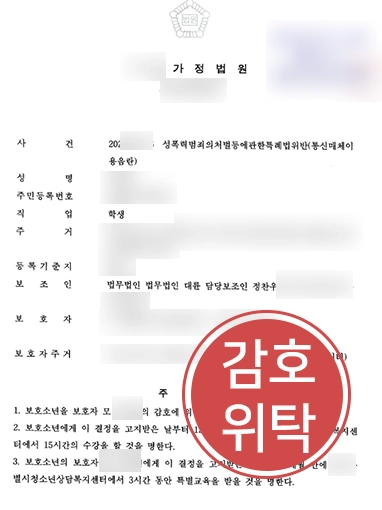
As a result of responding strategically after the consultation on the cost of retaining a school violence attorney, this matter, which proceeded as a juvenile protection case, was concluded with a disposition of entrustment to the guardian's protective custody.
Accordingly, the client did not proceed to a heavier disposition such as commitment to a juvenile reformatory, and the case was able to be concluded with a focus on educational protection.
Standards for Protective Dispositions in the Juvenile Court
School violence cases generally proceed through disciplinary procedures under the “School Violence Prevention Act,” but where sexual expressions, videos, physical contact, and the like are involved, the “Act on Special Cases concerning the Punishment of Sexual Crimes” applies, and depending on the gravity of the matter the case may be referred to the juvenile court as a juvenile protection case.
The protective dispositions that may be imposed by the juvenile court are as follows.
| Type of Protective Disposition | Period |
|---|---|---|
Disposition No. 1 | Entrustment to protective custody by a guardian or the like | 6 months (the total period may be extended up to 1 year) |
Disposition No. 2 | Attendance order | Within 100 hours |
Disposition No. 3 | Community service order | Within 200 hours |
Disposition No. 4 | Short-term probation by a probation officer | 1 year |
Disposition No. 5 | Long-term probation by a probation officer | 2 years (the total period may be extended up to 3 years) |
Disposition No. 6 | Entrustment to protective custody at a welfare facility or the like | 6 months (the total period may be extended up to 1 year) |
Disposition No. 7 | Entrustment to a juvenile medical protection facility | 6 months (the total period may be extended up to 1 year) |
Disposition No. 8 | Commitment to a juvenile reformatory for up to 1 month | Within 1 month |
Disposition No. 9 | Short-term commitment to a juvenile reformatory | Within 6 months |
Disposition No. 10 | Long-term commitment to a juvenile reformatory | Within 2 years |
The importance of an early response is further emphasized by the fact that, had the client been 14 years of age or older, the same conduct could have led to criminal punishment.
If You Need the Assistance of an Attorney Specializing in School Violence
The cost of retaining a school violence attorney may vary depending on the type of case and the procedure, and even in a school violence matter, where a sexual expression or video issue is involved, there is a possibility that it will expand into a juvenile protection case or criminal proceedings.
The firm provides a one-stop response system capable of connected response not only to school violence cases but also to juvenile protection cases.
• Review of the possibility of referral to the juvenile court and design of a response strategy
• Systematic organization of statements and written materials
• Strategy for mitigating the level of the protective disposition and managing the school record
• Connected response across administrative appeals, administrative litigation, and criminal proceedings
In particular, because school violence cases have a structure in which they may lead to the juvenile court or to criminal proceedings depending on the matter, it is important to accurately assess the nature of the case at the early stage and set the direction of the response.
A Checklist to Review Right Now
If any of the following situations apply, it may be a situation in which you must also consider the possibility of expansion into the juvenile court or criminal proceedings.
□ Where you have received a school violence report or notice of referral to the School Violence Committee
□ Where the other party is asserting sexual humiliation, violence, harassment, or the like
□ Where materials that could become problematic, such as messages, social media posts, or videos, exist
□ Where the case has been classified as a serious matter and there is a possibility of additional investigation
□ Where the content of the statements has not been organized, leaving the direction of the response unclear
If you are in a situation such as the above, you need to organize how the case arose objectively and to establish a strategy that considers both the school violence procedure and the possibility of a juvenile court response.
🔗Arrange a legal consultation to confirm the related consultation and a specific response strategy.
This content is based on actual case studies of Daeryun Law LLC with some adaptations, and the copyright belongs to our firm.
Unauthorized reproduction, duplication, or distribution and other copyright infringements may result in legal action under applicable laws.