
CONTENTS
- 1. The Case of the Client Who Requested a Consultation Seeking Driver's License Relief for Drunk Driving

- 2. Strategy for Disputing the Reliability of the Measured Reading for Driver's License Relief for Drunk Driving
- - Strategy for Disputing the Reliability of the Measured Reading
- - Proof of the Facts Based on Objective Materials
- - Argument of a Violation of the Principle of Proportionality
- 3. DUI License Relief: License Cancellation Disposition Revoked
- - Response Procedure
- - If You Need Assistance

1. The Case of the Client Who Requested a Consultation Seeking Driver's License Relief for Drunk Driving

The client who required driver's license relief for drunk driving received a driver's license cancellation disposition after an unusually high reading was confirmed in a breathalyzer test following his operation of a motorcycle.
Although the client had been drinking for only a short time, an exceptionally high reading that is generally difficult to encounter was produced, leading him to question the result.
In particular, when a reading at a level difficult to accept compared with a typical amount of drinking was measured, he came to suspect the possibility of an error in the measurement process, and this case was directly connected to his livelihood.
Because the client earned his income by operating a motorcycle, the cancellation of his license would inevitably have brought an immediate halt to his economic activity, and he therefore requested assistance.


2. Strategy for Disputing the Reliability of the Measured Reading for Driver's License Relief for Drunk Driving
In cases of driver's license relief for drunk driving, the key lies in simultaneously disputing the reliability of the measured reading and the appropriateness of the administrative disposition.
 Strategy for Disputing the Reliability of the Measured Reading
The key to this case was disputing the reliability of the unusually high reading.
The drunk driving attorney emphasized that the reading was at a level generally capable of posing a risk to life, and he established, as a matter of legal principle, that it was difficult to explain by the amount of drinking alone.
In particular, he emphasized that the reading was at a level difficult to manifest in an ordinary drinking situation and was a reading that was realistically difficult to occur when compared with bodily responses, thereby raising a question as to the reliability of the measurement result itself.
Proof of the Facts Based on Objective Materials
The drunk driving attorney comprehensively analyzed the CCTV footage, the route of movement, and the situation at the scene to reconstruct the actual state of driving.
In this way, he presented, through objective materials, circumstances that were difficult to regard as a state of high-concentration intoxication.
He also specifically proved, on the basis that the client had maintained normal behavior in the actual course of operation and the response at the scene, that it was difficult to regard the client as being in a state of intoxication corresponding to the measured reading.
Argument of a Violation of the Principle of Proportionality
The drunk driving attorney also disputed the point that the license cancellation disposition was excessive.
He emphasized that the disposition violated the principle against excessive restriction, taking into account such matters as the client's means of livelihood, his status as a first-time offender, the absence of an accident, and his cooperation with the investigation.
In particular, he constructed his argument around the principle that a license cancellation disposition under the Road Traffic Act constitutes an administrative disposition and that, under administrative law, whether the principle of proportionality has been observed and whether there has been a deviation from or abuse of discretionary power are important standards of judgment.
He emphasized that, when the operation of the motorcycle was directly connected to the client's livelihood, no accident had occurred, and the client was a first-time offender who had cooperated with the investigation are considered together, the license cancellation disposition constituted an excessive sanction.
3. DUI License Relief: License Cancellation Disposition Revoked
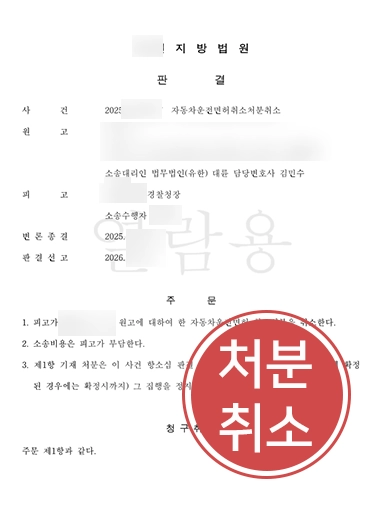
In a case concerning driver's license reinstatement after drunk driving, the court found the revocation of the driver's license to be unlawful and rendered a judgment cancelling that disposition.
In addition, the application for a stay of execution suspending the effect of the disposition until the pronouncement of the appellate judgment was also granted.
Response Procedure
Where the blood alcohol concentration is 0.08 percent or higher, revocation of the driver's license may, as a rule, follow.
Because such a license revocation constitutes an administrative disposition, its lawfulness and propriety may be contested through an administrative appeal or administrative litigation.
In actual disputes, however, whether the measured value is accurate and whether that accuracy can be proven serve as important criteria for the decision.
In particular, if upholding the license revocation would cause direct harm to one's livelihood, such as an inability to work or a loss of income, an application for a stay of execution should be considered separately from the action on the merits.
A stay of execution may be granted where leaving the disposition in place is likely to cause harm that is difficult to remedy and where there are grounds to recognize that the disposition may be erroneous.
In cases of this kind, not only whether the measured value is objectively provable but also the degree of harm arising from the disposition serves as an important criterion for the decision.
Stage | Key Point |
|---|---|
Stage 1: Review of the Measured Value | Verify whether the value contains errors |
Stage 2: Analysis of Evidence | Secure CCTV footage and route records |
Stage 3: Legal Review | Assess the propriety of the disposition criteria |
Stage 4: Submission of a Written Opinion | Argue the reliability of the measurement and the principle of proportionality |
Stage 5: Administrative Litigation Response | Pursue a stay of execution and a revocation lawsuit |
If You Need Assistance
The process of driver's license reinstatement after drunk driving proceeds on the basis of a comprehensive review of the reliability of the measured value, the lawfulness of the disposition, and the individual circumstances.
In particular, because the manner in which mitigating grounds, such as errors in the measurement process or the connection to one's livelihood, are organized may affect the outcome of the disposition, establishing the strategy for the response at an early stage is essential.
Daeryun, the ninth largest law firm in the Republic of Korea by value-added tax filings reported to the National Tax Service, draws on its proven scale and experience to review the entire process systematically in cases of driver's license reinstatement after drunk driving, from the analysis of the facts and the organization of evidence to the response in administrative appeals and litigation, and establishes a response strategy suited to each situation.
If you require a response in connection with driver's license reinstatement after drunk driving, please 🔗schedule a legal consultation to confirm the response best suited to your current situation.
This content is based on actual case studies of Daeryun Law LLC with some adaptations, and the copyright belongs to our firm.
Unauthorized reproduction, duplication, or distribution and other copyright infringements may result in legal action under applicable laws.