
CONTENTS
- 1. The Client Who Came to the Daegu Law Firm

- - The Circumstances That Led to Coming to the Daegu Law Firm
- 2. Statutes Related to the Case as Explained by the Daegu Law Firm
- 3. The Assistance Provided by the Daegu Law Firm
- - Argument 1: Defamation by Statement of False Facts Is Not Established
- - Argument 2: The Statements Amounted to No More Than Exaggerated Expressions
- - Argument 3: There Was No Intent
- 4. The Police's Decision on the Daegu Law Firm's Arguments
- 5. If You Need the Help of the Daegu Law Firm

1. The Client Who Came to the Daegu Law Firm

The client who came to the Daegu law firm sought to clear the charge of defamation with the help of a specialist attorney and held a consultation at Daeryun's Daegu office.
 The Circumstances That Led to Coming to the Daegu Law Firm
The circumstances of the client who came to the Daegu law firm are as follows.
The client had come to know the complainant at an emergency residents' meeting and worked together with the complainant as members of an emergency response committee.
One day, the client briefly used the complainant's computer in order to find materials needed for the emergency response committee.
The client found that materials that the client had not uploaded were stored on the complainant's computer.
The client thereupon concluded that the complainant had hacked the client's computer and taken the materials.
The client made a statement to another staff member serving as an advisory committee member to the effect that, ‘The complainant accessed the computer at my home, hacked it, and took the materials.’
Upon learning of this, the complainant filed a 🔗defamation complaint against the client.
The client came to the Daegu law firm in order to clear the defamation charge with the help of a specialist attorney.
2. Statutes Related to the Case as Explained by the Daegu Law Firm
Article 44 (Protection of Rights on Information and Communications Networks)
(1) No user shall circulate, through an information and communications network, information that infringes upon the rights of others, such as invasion of privacy or defamation.
(2) An information and communications service provider shall endeavor to ensure that the information referred to in paragraph (1) is not circulated on the information and communications network that it operates and manages.
Article 70 (Penalty Provisions)
(1) A person who defames another by disclosing a fact publicly through an information and communications network with the intent to defame the person shall be punished by imprisonment for not more than three years or by a fine not exceeding thirty million won.
(2) A person who defames another by disclosing a false fact publicly through an information and communications network with the intent to defame the person shall be punished by imprisonment for not more than seven years, suspension of qualifications for not more than ten years, or a fine not exceeding fifty million won.


3. The Assistance Provided by the Daegu Law Firm
The specialist attorney at the Daegu law firm systematically analyzed the case through a thorough consultation with the client.
On this basis, the attorney prepared an appropriate response and provided assistance to the client.
Argument 1: Defamation by Statement of False Facts Is Not Established
For defamation by the assertion of a false fact to be established, the client must have publicly asserted a fact.
The fact asserted must be one that lowers social reputation and must be false, and the client must have recognized that the fact in question was false.
In this case, the client emphasized that there had been no recognition whatsoever of falsity in relation to the defamation.
Argument 2: The Statements Amounted to No More Than Exaggerated Expressions
The client's statement in this case that the computer had been hacked arose from a serious lack of knowledge about computers.
The client emphasized that, upon seeing that the client's own materials were on the complainant's computer, the client became flustered and merely used a somewhat exaggerated expression, and that there had been no intent whatsoever to defame.
Argument 3: There Was No Intent
For defamation to be established, a person must have the intent to harm another's reputation.
In this case, the client's statement to the effect that the computer had been hacked was a remark made in the course of answering a question posed to the client by another staff member, and the client emphasized that it was difficult to find any intent to defame.
4. The Police's Decision on the Daegu Law Firm's Arguments
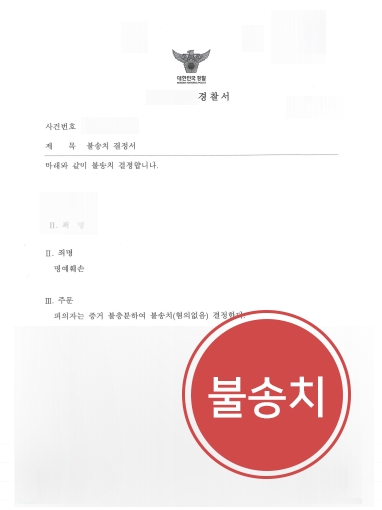
The police accepted the arguments of the Daegu law firm and issued a decision of ‘no-referral’.
Having brought the case to a swift conclusion with the no-referral decision, the client conveyed deep thanks to the Daegu attorney.
5. If You Need the Help of the Daegu Law Firm
This case was an instance in which the client, with the assistance of the Daegu law firm, obtained a no-referral decision in a defamation case.
In criminal cases, it can be said to be essential to obtain the assistance of a criminal law specialist attorney in order to secure the critical window of time at the early stage of the case.
Depending on the scale of the case, Daeryun LLC has criminal law specialist attorneys form a task force to present a reasonable and appropriate criminal case strategy.
In addition, we operate a system that provides consultation and rapid response 24 hours a day, 365 days a year, so if you need the assistance of a specialist attorney, we invite you to come to Daeryun LLC at any time.
See More
This content is based on actual case studies of Daeryun Law LLC with some adaptations, and the copyright belongs to our firm.
Unauthorized reproduction, duplication, or distribution and other copyright infringements may result in legal action under applicable laws.