
CONTENTS
- 1. The client who came to the Wonju law office

- - Circumstances of the case identified at the Wonju law office
- - The level of punishment for the case as explained at the Wonju law office
- 2. The Wonju law office's assistance for the violation of the National Land Planning Act litigation
- - Daeryun's Wonju Office: Application for an On-Site Inspection to Support the Argument
- - Daeryun's Wonju Office: Argument That It Was a Legitimate Act to Prevent a Disaster
- 3. A Fine Imposed Following the Litigation Defense by Daeryun's Wonju Office
- - Daeryun's Wonju Office: Concluding the Case With a Minor Fine

1. The client who came to the Wonju law office

The client who visited the Wonju law office was facing a 🔗violation of the National Land Planning Act lawsuit after carrying out land construction without the permission of the competent authority, and came to Daeryun's Wonju office to defend the case with the help of a Wonju attorney.
 Circumstances of the case identified at the Wonju law office
The client who visited the Wonju law office was facing a lawsuit on a charge of carrying out unpermitted land construction.
The client had been residing in a mountainous area and had previously suffered damage when his house collapsed in a landslide caused by heavy rain several years earlier.
After that incident, the client came to believe that he needed to prepare for the heavy rains of the coming rainy season.
The client carried out construction to cut away soil in order to level the land in the mountainous area at risk of a landslide.
After the construction, the competent authority asserted that he had changed the character of the land without its permission, and the client ended up being the subject of a complaint by the competent authority.
In this situation, the client visited the Wonju law office to prepare for the lawsuit with its help.
The level of punishment for the case as explained at the Wonju law office
Act on Planning and Use of National Territory
Under Article 56 of the National Land Planning Act, in order to engage in certain development activities, permission must be obtained from the competent Si mayor, Gun head, or the like.
Such development activities include the construction of a building or installation of a structure, a change of the character of land, the extraction of earth and stone, the division of land, or the stacking of objects for at least a certain period in a green-belt area, etc.
However, activities under an urban or Gun plan are recognized as exceptions.
In addition, where one intends to modify a development activity for which permission has already been obtained, permission must likewise be obtained, although no separate permission is required when modifying minor matters.
A person who engages in a development activity without permission or who obtains permission through improper means shall be punished by imprisonment for not more than three years or a fine not exceeding 30 million won.
2. The Wonju law office's assistance for the violation of the National Land Planning Act litigation
To defend the case of the client who had been the subject of a complaint over unpermitted land construction, the Wonju law office assembled a response team of Wonju attorneys with extensive experience in violation of the National Land Planning Act litigation to provide assistance.
Daeryun's Wonju Office: Application for an On-Site Inspection to Support the Argument
The attorney at Daeryun's Wonju office argued that the land construction work conducted by the client was not undertaken for economic gain.
The client sought to prevent in advance the serious harm that could befall the nearby residential houses through this construction work.
The purpose of the construction was solely disaster prevention, and there was no intention whatsoever to pursue the client's personal aims or any monetary benefit.
The case response team at Daeryun's Wonju office stated that it would apply for an on-site inspection in order to prove that, had the client not carried out the construction, a major disaster could not have been avoided.
Daeryun's Wonju Office: Argument That It Was a Legitimate Act to Prevent a Disaster
The response team at Daeryun's Wonju office emphasized that the client's actions made a significant contribution to preventing disasters such as landslides caused by heavy rainfall.
The client had experienced a major incident in which the house collapsed due to heavy rainfall during the rainy season, and thereafter, while distributing agricultural produce in the mountainous area, was aware of the hazardous terrain.
Accordingly, the client carried out the construction in order to prevent in advance a disaster caused by the heavy rains of the upcoming rainy season.
The Wonju attorney acknowledged that the client had not obtained permission from the competent authority, but argued that this construction constituted a legitimate act undertaken to address a disaster.
3. A Fine Imposed Following the Litigation Defense by Daeryun's Wonju Office
Daeryun's Wonju office formed a response team to defend the client's case and provided assistance throughout the entire process, from the initial consultation to the conclusion of the litigation, and as a result, the client received only a small fine.
Daeryun's Wonju Office: Concluding the Case With a Minor Fine
The client who came to Daeryun's Wonju office was facing litigation for a violation of the Act on Planning and Use of National Territory, and visited Daeryun's Wonju office to defend the case.
In response, Daeryun's Wonju office formed a response team of Wonju attorneys with deep knowledge of the Act on Planning and Use of National Territory to assist the client.
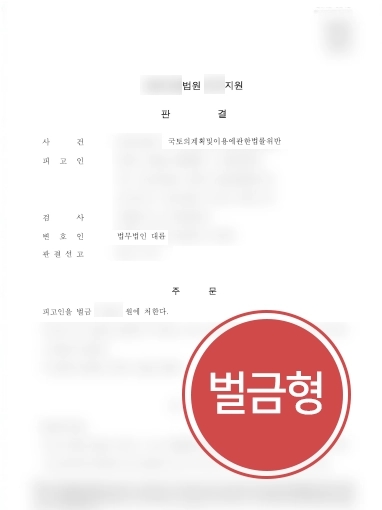
As a result, the court accepted the Wonju attorney's argument, and the client received a minor fine.
If you likewise need a defense in litigation for a violation of the Act on Planning and Use of National Territory, you are welcome at any time to consult with an 🔗attorney at Daeryun's Wonjuoffice.
This content is based on actual case studies of Daeryun Law LLC with some adaptations, and the copyright belongs to our firm.
Unauthorized reproduction, duplication, or distribution and other copyright infringements may result in legal action under applicable laws.