
CONTENTS
- 1. The Client Who Requested Assistance With an Insurance Proceeds Dispute

- - Insurance Proceeds Dispute, Can a Common-Law Spouse Also Receive Death Insurance Proceeds?
- 2. Insurance Proceeds Dispute, Assistance to Secure Payment of Insurance Proceeds
- - Insurance Proceeds Dispute, Asserting the Policyholder's Rights
- - Insurance Proceeds Dispute, Asserting the Existence of a Common-Law Marriage
- 3. Result of Assistance With the Insurance Proceeds Dispute, Payment of Insurance Proceeds and Recovery of Litigation Costs

1. The Client Who Requested Assistance With an Insurance Proceeds Dispute
This is a case in which assistance with an insurance proceeds dispute led to the successful recovery of the insurance proceeds and the litigation costs.
The client is the beneficiary of an insurance contract held by the late Mr. A, a non-party, and the defendant is the insurance company that entered into a non-participating whole life insurance contract of the standard type, with the late Mr. A and the beneficiary as the policyholders.
After Mr. A passed away, the client claimed payment of the insurance proceeds from the defendant, but the defendant refused payment on the ground that no death certificate had been submitted.
This was because the client and Mr. A had been in a common-law marriage for more than ten years but were not in a legally recognized marital relationship, so the client could not obtain a death certificate.
The client requested assistance with the insurance proceeds dispute against the insurance company, and the insurance attorney undertook to assist in securing payment of the insurance proceeds.
 Insurance Proceeds Dispute, Can a Common-Law Spouse Also Receive Death Insurance Proceeds?
As in the client's case, where a common-law spouse is designated as the beneficiary, receipt of the insurance proceeds is possible.
However, a death certificate, which must be submitted when claiming death insurance proceeds, can be issued only with the consent of the deceased's legal family. If the surviving family members who are the statutory heirs do not consent to the issuance of the deceased's death certificate, the common-law spouse is unable to receive the insurance proceeds.
In this case as well, because the late Mr. A had no next of kin and was in a common-law marriage, there was difficulty obtaining a death certificate, and the defendant relied on this very point in refusing payment of the insurance proceeds.
The insurance attorney undertook the 🔗litigation against the insurance company on behalf of the client.
2. Insurance Proceeds Dispute, Assistance to Secure Payment of Insurance Proceeds
For the insurance proceeds dispute, the attorney devised a strategy emphasizing the right to claim payment of the insurance proceeds and the common-law marriage.
Insurance Proceeds Dispute, Asserting the Policyholder's Rights
A policyholder has the right to claim insurance proceeds when an insured event occurs with respect to the death or survival of the insured, or the death and survival of the insured, or when a loss arises to the property of the insured as a result of an insured event.
The insurance attorney also emphasized that, where all or part of an insurance contract is void, the policyholder, the insured, and the beneficiary may claim a refund of all or part of the premiums from the insurance company if they acted in good faith and without gross negligence.
Insurance Proceeds Dispute, Asserting the Existence of a Common-Law Marriage
In support of the position on this insurance proceeds dispute, the insurance attorney argued that, if it is sufficiently recognized that the parties carried on a normal married life in accordance with the general social conception, the provision should be interpreted broadly to recognize the common-law marriage, and the insurance proceeds should be paid.
Although the civil law of Korea adopts the principle of legal marriage, where, for unavoidable personal reasons, the marriage registration is delayed or not completed, and a common-law marriage in fact exists, the law recognizes certain legal rights with respect to it as well.
The insurance policy terms of the contract entered into between the late Mr. A and the defendant define a spouse under a "spousal-type contract" as a spouse on the family register or the resident registration. This is a provision intended to verify the qualification of the insured and to prevent moral hazard.
The insurance attorney emphasized that, if a substantive marital relationship is recognized, refusing payment of the insurance proceeds is improper.
The insurance attorney argued that, based on the common-law marriage recognized under the civil law, where the parties carried on a normal married life, interpreting the above provision broadly to recognize the common-law marriage accords with the original purpose of insurance, so that payment of the insurance proceeds could be assured.
3. Result of Assistance With the Insurance Proceeds Dispute, Payment of Insurance Proceeds and Recovery of Litigation Costs
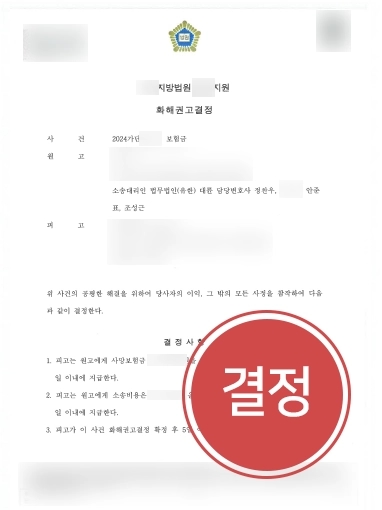
As a result of the assistance with the insurance proceeds dispute, the court decided that the defendant should pay the death insurance proceeds and the litigation costs.
If you become involved in an insurance proceeds dispute such as the one above, it is recommended to seek the assistance of an attorney to thoroughly analyze the insurance policy terms and the relevant law, and to review whether the insurance company's grounds for refusing payment are legally proper.
At Daeryun Law Firm, attorneys experienced in this area predict the course of a client's case based on the analysis of data from cases handled by Daeryun, and they make their best efforts on the client's behalf.
If you need the assistance of an attorney for an insurance proceeds dispute such as the one above, please obtain an 🔗attorney referral from Daeryun Law Firm.
This content is based on actual case studies of Daeryun Law LLC with some adaptations, and the copyright belongs to our firm.
Unauthorized reproduction, duplication, or distribution and other copyright infringements may result in legal action under applicable laws.