
CONTENTS
- 1. Client Facing Punishment for Refusal of a Breathalyzer Test

- 2. The Level of Punishment for Refusal of a Breathalyzer Test
- 3. The Defense of the Client Facing Punishment for Refusal of a Breathalyzer Test
- - Client Facing Punishment for Refusal of a Breathalyzer Test: “The Client Was Not in an Intoxicated State”
- - Client Facing Punishment for Refusal of a Breathalyzer Test: “There Are Favorable Mitigating Factors”
- 4. Judgment for a Client Facing Punishment for Refusing a Breathalyzer Test

1. Client Facing Punishment for Refusal of a Breathalyzer Test
This is the account of a client who sought an attorney, facing punishment for refusal of a breathalyzer test.
The client was on the way to a meeting place, excited at the thought of meeting a partner for a date after work,
when a supervisor from work suddenly called and insisted that the client come to a company dinner.
The client, facing punishment for refusal of a breathalyzer test, had no choice but to give up the date and attend the company dinner.
The client explained that, although they did not want to drink because of medication they were regularly taking, they ended up drinking about two glasses of beer out of deference to the supervisor.
After the company dinner ended, the client wanted to see the partner even briefly, and because the dinner venue and the partner's home were close, the client drove the vehicle.
While driving, the client could not properly keep watch on the road ahead in the rain that had begun to pour, and ultimately struck a guardrail.
Afterward, the police were dispatched to handle the accident and requested a breathalyzer test of the client.
The client, facing punishment for refusal of a breathalyzer test, explained that, fearing that even two glasses of beer might register an alcohol reading, the client committed the offense of refusing the breathalyzer test.
2. The Level of Punishment for Refusal of a Breathalyzer Test

This is the account of a client who sought an attorney, facing punishment for refusal of a breathalyzer test.
Under the Road Traffic Act, a police officer may conduct a breathalyzer test if there are reasonable grounds to find that a person has driven under the influence.
Article 44 of the Road Traffic Act (Prohibition of Driving While Intoxicated)
(2) If it is deemed necessary for traffic safety and the prevention of danger, or where there are reasonable grounds to find that a person has driven a motor vehicle, etc., a tram, or a bicycle while intoxicated in violation of paragraph (1), a police officer may measure by a breath test whether the driver is intoxicated. In such cases, the driver shall comply with the police officer's measurement.
A person who refuses a police officer's breathalyzer test is punishable under the Road Traffic Act at the following level.
Article 148-2 of the Road Traffic Act (Penal Provisions)
3. The Defense of the Client Facing Punishment for Refusal of a Breathalyzer Test
For the client facing punishment for refusal of a breathalyzer test, the attorney conducted the defense as follows.
 Client Facing Punishment for Refusal of a Breathalyzer Test: “The Client Was Not in an Intoxicated State”
The attorney emphasized that the client facing punishment for refusal of a breathalyzer test was not in an intoxicated state at the time of the offense.
The client had drunk about two glasses of beer, and because the driving took place roughly one hour after drinking, it can be inferred that, taking the rate of alcohol metabolism into account, the client was likely not in an intoxicated state.
As for the point regarding refusal of the breathalyzer test, the client fully admits the offense and shows remorse.
Client Facing Punishment for Refusal of a Breathalyzer Test: “There Are Favorable Mitigating Factors”
The attorney emphasized that the client facing punishment for refusal of a breathalyzer test had favorable mitigating factors under the sentencing guidelines.
Under the sentencing guidelines, in cases of drunk driving or driving without a license, factors such as a very low risk to road traffic from the driving, clear social ties, and the defendant's detention entailing excessive hardship for dependents are cited as favorable mitigating factors.
The client supports an elderly mother, so the client's detention would entail excessive hardship for the elderly mother.
On this basis, the attorney requested leniency in the form of a suspended sentence, as the client falls under all of the favorable mitigating factors above.
4. Judgment for a Client Facing Punishment for Refusing a Breathalyzer Test
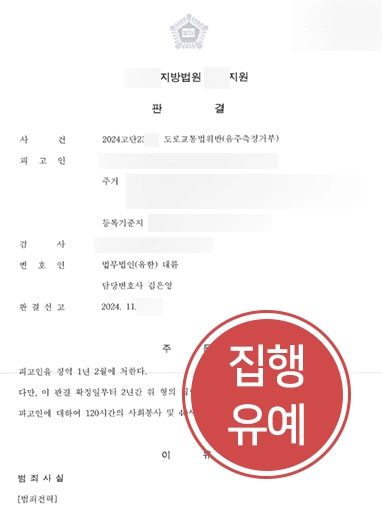
After reviewing the attorney's argument, the court issued a suspended sentence to the client, who faced punishment for refusing a breathalyzer test.
The client had driven under the influence and then refused the breathalyzer test, so an actual custodial sentence appeared unavoidable.
With the attorney's assistance, the client was able to avoid an actual custodial sentence and receive a suspended sentence instead.
If, like this client, you face punishment for refusing a breathalyzer test, please feel free to request an 🔗attorney referral and entrust your case to us.
This content is based on actual case studies of Daeryun Law LLC with some adaptations, and the copyright belongs to our firm.
Unauthorized reproduction, duplication, or distribution and other copyright infringements may result in legal action under applicable laws.