
CONTENTS
- 1. Jeonju Criminal Attorney | Details of the Case

- - Jeonju Criminal Attorney | Accused by the Victim's Daughter
- - Jeonju Criminal Attorney | The Client's Alleged Misappropriation
- - Jeonju Criminal Attorney | The Client
- 2. Jeonju Criminal Attorney | Jeonju Attorney Reviews the Client's Specific Allegation
- - Jeonju Criminal Attorney | What Is Quasi-Fraud?
- 3. Jeonju Criminal Attorney | Details of the Assistance
- - Jeonju Criminal Attorney | Alleged Misappropriation of an Apartment, a Vehicle, an Expensive Watch, and More
- - Jeonju Criminal Attorney | The Victim, Whose Cognitive Capacity Was Sound at the Time the Property Was Handed Over
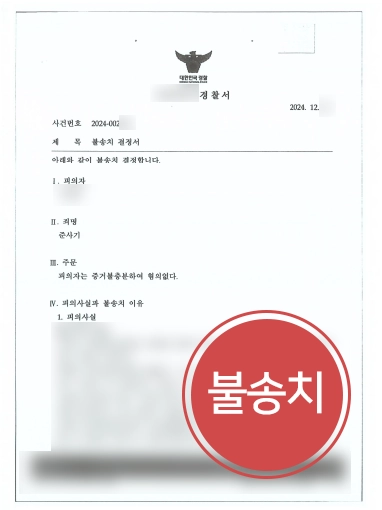
- 4. Jeonju Criminal Attorney | Case Result: Non-Referral Decision on the Quasi-Fraud Allegation

1. Jeonju Criminal Attorney | Details of the Case

The client argued that the complaint filed by the complainant (the alleged victim's daughter) was unjustified and that he had not acquired any goods or real estate by unlawful means.
In response, the Jeonju criminal attorney actively responded in order to ascertain the facts of the case and defend against the client's allegation.
 Jeonju Criminal Attorney | Accused by the Victim's Daughter
The client had been in an affair with the alleged victim and received various goods and real estate from him as gifts.
However, after the affair, the complainant's mother's condition worsened and she passed away, and the complainant filed a complaint claiming that the client had acquired the mother's property fraudulently and for an improper purpose.
When the alleged victim developed dementia, the client ended the affair with him, but the complainant subsequently filed a complaint against the client for fraud.
Jeonju Criminal Attorney | The Client's Alleged Misappropriation
In this case, the complainant claimed that the client had deliberately targeted the deceased mother's property, asked the alleged victim to make a gift of it, and unlawfully acquired the property, and accused the client of fraud.
The complaint stated that the client had misappropriated the property through a tacit arrangement while maintaining the affair with the alleged victim, and that fraud occurred in the process.
It also stated that the client had committed the offense for the purpose of misappropriating the property by taking advantage of the alleged victim's state of dementia.
In response, the client fully denied the allegation, stating that it was contrary to the facts, and requested legal action.
Jeonju Criminal Attorney | The Client
The client stated that the property he had received from the alleged victim had been gifted lawfully and that he had certainly not received the gifts through any tacit arrangement.
The client explained that, after the affair, the alleged victim had made the gift out of a desire to repair the relationship, and that the property was simply a gift.
He also emphasized that, because his relationship with the alleged victim had grown distant after the affair became known, he had not even known that the complainant's mother (the alleged victim's wife) had passed away.
The client maintained that the complaint was unjustified and pleaded that he had been wronged, requesting legal action on the case.
The Jeonju criminal attorney thoroughly reviewed the client's position and prepared a defense strategy in an effort to clear the client of the false suspicion he had unfairly faced.
2. Jeonju Criminal Attorney | Jeonju Attorney Reviews the Client's Specific Allegation
The Jeonju criminal attorney reviewed the allegation against the client as follows.
Jeonju Criminal Attorney | What Is Quasi-Fraud?
The Jeonju criminal attorney explained what quasi-fraud, the offense alleged against the client, is and how it differs from the crime of fraud.
Article 348 of the Criminal Act (Quasi-Fraud)
Quasi-fraud is an offense that, even where deception is not used as the means of taking property or obtaining a pecuniary advantage by exploiting a person's state of mental disability, has a nature similar to the crime of fraud committed through deception and is therefore treated in a manner equivalent to fraud.
So what, then, is the crime of fraud?
Under Article 347 of the Criminal Act, a person who deceives another and takes property or obtains a pecuniary advantage shall be punished by imprisonment for not more than 10 years or by a fine not exceeding 20 million won. The same applies where a third party is made to take property or obtain a pecuniary advantage.
The crime of fraud requires that the client's deception cause a mistaken belief in the victim.
In this case, however, because the alleged victim was a dementia patient in a state of mental disability and was therefore already regarded as being under a mistaken belief, the matter was charged as quasi-fraud.
3. Jeonju Criminal Attorney | Details of the Assistance
The Jeonju criminal attorney fully rebutted the allegation as follows so that the client could be cleared of it.
Jeonju Criminal Attorney | Alleged Misappropriation of an Apartment, a Vehicle, an Expensive Watch, and More
In this case, the complainant claimed that the client had unlawfully misappropriated from the alleged victim an apartment, a vehicle, an expensive watch, and other items.
However, the Jeonju criminal attorney proved through transaction records and contracts that the client had lawfully received these items as gifts.
This served as important evidence that the client had acquired the property through proper means and without any fraud.
Jeonju Criminal Attorney | The Victim, Whose Cognitive Capacity Was Sound at the Time the Property Was Handed Over
The client explained that, at the time the alleged victim handed over the property, the victim was capable of normal communication and could hardly be regarded as a dementia patient.
This was proved by the statement of an acquaintance who knew both the alleged victim and the client.
According to the acquaintance's testimony, the client had been on close terms with the alleged victim when no one knew he had dementia, and the acquaintance personally witnessed their relationship deteriorate sharply after the dementia came to light.
4. Jeonju Criminal Attorney | Case Result: Non-Referral Decision on the Quasi-Fraud Allegation
The Jeonju criminal attorney emphasized that the evidence presented by the complainant could not prove that the client had committed a crime.
In particular, he argued for a no-charge decision on the ground that the fraud alleged by the complainant was entirely untrue and that there was insufficient evidence against the client.
In the end, the investigative authority decided on a non-referral disposition because there was insufficient evidence to prove the allegation against the client.
If, as in this case, you are being unfairly suspected of fraud over property you received as a gift, 🔗a Jeonju attorney can be consulted for legal advice.
This content is based on actual case studies of Daeryun Law LLC with some adaptations, and the copyright belongs to our firm.
Unauthorized reproduction, duplication, or distribution and other copyright infringements may result in legal action under applicable laws.