
CONTENTS
- 1. Seoul Criminal Attorney | Background of the Case

- 2. Seoul Criminal Attorney | The Attorney's Review of the Case
- 3. Seoul Criminal Attorney | The Assistance Provided
- 4. Seoul Criminal Attorney | Client Cleared of the Defamation of a Deceased Person Charge and Receives a No-Charge Disposition

1. Seoul Criminal Attorney | Background of the Case

The attorney resolved the client's grievance on the charge of defamation of a deceased person and obtained a no-charge disposition.
The case drew public attention, as it sparked social controversy over whether it had crossed the limits of the freedom to mourn and of expression.
 Mourning the Victims of the Traffic Accident
This was a tragic case in which two people died in a wrong-way traffic accident in a city in Gyeonggi-do.
A few days later, the client visited a memorial space set up near the scene of the accident and left a note he had written in mourning for the victims.
Reported for Defamation of a Deceased Person
The note left by the client was reported in the media on the ground that it had caused serious offense to the bereaved family, and a police investigation began into the act as one that defamed the deceased through false statements.
Accordingly, the client came to be investigated on the charge of defamation of a deceased person.
A Client Gripped by Fear
The client stated that he had written the wording solely to emphasize the tragedy of the traffic accident and to convey the importance of punishing the perpetrator.
Contrary to his intention, however, the matter escalated into a legal problem, and the client felt extreme anxiety and fear.
In these circumstances, he sought the attorney's help.


2. Seoul Criminal Attorney | The Attorney's Review of the Case
The attorney reviewed the facts of the case.
What Is Defamation of a Deceased Person?
What is defamation of a deceased person, the offense alleged against the client?
Under Article 308 of the Criminal Act, a person who defames the reputation of a deceased person by publicly alleging a false fact may be punished by imprisonment or imprisonment without labor for up to two years or a fine of up to five million won. The ‘public allegation of a fact or false fact,’ an element of defamation of a deceased person, requires that the defamatory expression made by the client be such that an unspecified number of people could perceive it. Under Supreme Court precedent (Judgment of June 15, 2018, 2018Do4200), even where a fact or false fact is alleged to a single individual, the requirement of publicity is satisfied if there is a possibility that it could spread to an unspecified number of people. In addition, the actor must be aware of this possibility of dissemination and must have an internal intent that accepts that risk.What is defamation of a deceased person?
What are the 🔗
The Issues in This Case
The attorney identified the main issues in this case as whether the client's expression amounted to an allegation of fact and whether he was aware that he was alleging a false fact.
The attorney explained that an allegation of fact, as a concept contrasted with an expression of opinion that conveys a value judgment or evaluation, means a report or statement concerning a specific past or present factual relationship in terms of time and space.
For this reason, there is a judicial holding that the purpose of the provision is not to prohibit expression whose content can be proven by evidence, nor mere exaggeration or figurative expression.
The attorney explained that, although the content the client wrote in the note was indeed inappropriate, it was a figurative expression made by way of comparison and therefore did not appear to satisfy the subjective element of defamation.
3. Seoul Criminal Attorney | The Assistance Provided
The attorney assisted the client by handling the settlement with the bereaved family on his behalf, conveying his sincere apology and seeking their forgiveness for him.
The attorney also argued the substance of the case as follows and obtained a no-charge disposition.
Defamation Is Not Established
Based on Supreme Court precedent, the attorney emphasized that the client's expression was not so much an allegation of a specific fact as it was an opinion that figuratively expressed the tragedy of the accident.
In particular, the attorney argued persuasively that the wording was not a false report or an intentional distortion of the facts, but rather an expression based on the subjective feelings the client had upon seeing the accident.
No Right to Prosecute Because the Requirements for a Complaint-Based Offense Were Not Met
The attorney argued that defamation of a deceased person is a crime requiring a complaint to prosecute, so that punishment is possible only if the victim's bereaved family files an express complaint.
In this case, the bereaved family all withdrew their intent to file a complaint, and it was accordingly determined that there was no right to prosecute.
4. Seoul Criminal Attorney | Client Cleared of the Defamation of a Deceased Person Charge and Receives a No-Charge Disposition
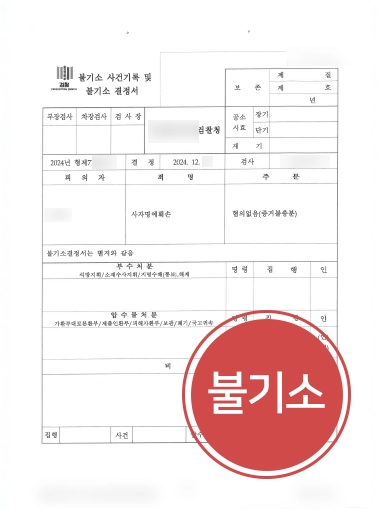
The attorney assisted the client so that he was cleared of the charge of defamation of a deceased person and received a no-charge disposition.
The investigative authority stated that, although the expression was one that caused the bereaved family great emotional pain that was hard to bear, it was no more than an expression of opinion reflecting what the client felt upon seeing the bodies of the traffic accident victims, and it was therefore difficult to regard it as an allegation of fact.
The client expressed his remorse, saying that he had mourned and left the note with good intentions, but that he was deeply sorry for having hurt many people with an inappropriate expression.
If you, like this client, have been booked for insult or defamation without intending it, the attorney advised that you visit the 🔗Seoul attorney office in Yongsan and respond promptly.
This content is based on actual case studies of Daeryun Law LLC with some adaptations, and the copyright belongs to our firm.
Unauthorized reproduction, duplication, or distribution and other copyright infringements may result in legal action under applicable laws.