
CONTENTS
- 1. Daejeon Attorney | Case Details

- 2. Daejeon Attorney | Case Analysis
- 3. Daejeon Attorney | Assistance Provided
- 4. Daejeon Attorney | Concluded With Non-Prosecution

1. Daejeon Attorney | Case Details

The Daejeon attorney analyzed this case promptly and accurately and spared no effort in assisting the client in establishing the client's innocence.
 The Client Who Searched the Temple
The case originated a month earlier, when the client attempted to search the interior of a temple he owned in order to recover ownership of it.
Having obtained information that there would be important evidence inside the temple capable of proving his rights, the client sought to confirm this.
However, attempting the search without prior consultation with the temple's administrator or the monk, he was unsuccessful.
The Dispute With the Monk
On the day of the incident, the client entered the temple again together with four co-suspects.
At the temple, they sought to recover the land contract the client claimed and documents capable of proving rights to the temple.
However, they encountered the temple's resident monk, and a verbal argument and minor conflict ensued.
In the end, the monk tried to block the client's entry, which led to a physical confrontation.
While the client and the co-suspects were grappling with the monk, they pushed him into a room, and two of the co-suspects held the monk back.
Booked on Charges of Intrusion Upon Habitation and Unlawful Confinement Causing Injury
In the end, following the report by the resident monk, the client and the co-suspects were booked by the police on charges of intrusion upon habitation and unlawful confinement causing injury.
The temple was regarded as the monk's residence, so the charge of intrusion upon habitation was applied on the basis that the client and the co-suspects had entered the temple without authorization.
In addition, the monk claimed that he had suffered an abrasion to his right shoulder while being confined by the client, and a charge of unlawful confinement causing injury was also raised.
2. Daejeon Attorney | Case Analysis
The Daejeon criminal attorney analyzed the case in depth and resolved it through specific rebuttals of the charges against the client.
What Were the Charges Against the Client?
Attorney, how is the client responding to the charges?
Attorney: Yes, the client was charged with intrusion upon habitation for entering the temple without authorization, but he denied the charges on the ground that he had no intent to confine or injure anyone. The client argued that he entered the temple solely to recover ownership, and that the physical confrontation with the monk that arose in the process was an unavoidable situation. He also stated that, although he was not entirely aware of the matter relating to the injury because it was something the co-suspects had done, he had absolutely no intent to injure the monk.
Attorney, what was the most important issue in this case?
Attorney: Yes, the issues in this case were the charges of intrusion upon habitation and unlawful confinement causing injury. The intrusion upon habitation was a problem that arose because the temple was regarded as a residence, and for the charge of unlawful confinement causing injury, the key point was whether the client had confined or injured the monk.
Grounds for Punishment
Intrusion upon habitation and unlawful confinement causing injury fall under Article 319 of the Criminal Act (intrusion upon habitation) and Article 281 of the Criminal Act (unlawful confinement causing injury), respectively.
First, the charge of intrusion upon habitation
Intrusion upon habitation is committed when a person enters another's residence without authorization. However, if it can be proven that there was a legitimate reason or no intent to intrude, the charge of intrusion upon habitation may be excused.
For example, if it can be proven that the defendant entered for the purpose of recovering ownership of the temple and therefore had no intent to intrude, the offense of intrusion upon habitation may not be constituted.
Second, unlawful confinement causing injury
Unlawful confinement is punishable on the premise of an intentional deprivation of liberty. However, if there was no intent to deprive someone of liberty, or if the injury occurred in an accidental situation, unlawful confinement is not constituted, and only the offense of bodily injury may apply. The client maintains that he had no intent to confine or injure the monk in their physical confrontation. Accordingly, if the injury occurred in an accidental situation, the charge of unlawful confinement causing injury may not be constituted.
Accordingly, the Daejeon criminal attorney denied the client's charges of intrusion upon habitation and unlawful confinement causing injury by arguing that the visit was for the legitimate purpose of recovering ownership and that there had been no intent to injure.


3. Daejeon Attorney | Assistance Provided
The Daejeon attorney provided assistance to establish the client's innocence and obtain a non-prosecution decision through a close analysis of the case and a thorough defense of the client's arguments.
No Injury Inflicted After Confinement
The client argued that, in the course of the confrontation with the monk, he had absolutely no intent to confine and then injure him.
The injury arose from an accidental physical confrontation, and the client did not intend to injure the victim; rather, it was the result of the situation unfolding unavoidably.
Not Amounting to Intrusion Upon Habitation
The place the client went to was the temple's administrative office.
That location is where the temple's affairs are handled and is a place anyone is permitted to enter.
Accordingly, it is not regarded as a residence, and the client visited the location for the legitimate purpose of recovering ownership.
On this basis, the attorney argued that the client's conduct does not amount to intrusion upon habitation.
4. Daejeon Attorney | Concluded With Non-Prosecution
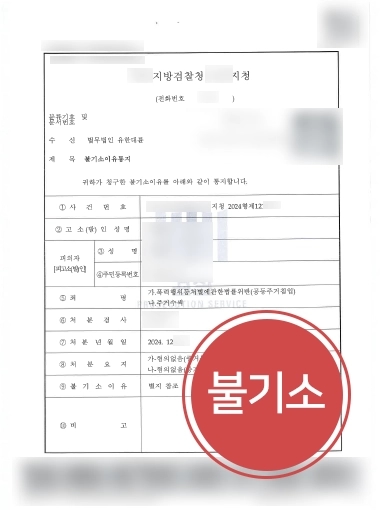
Thanks to the Daejeon attorney's thorough legal analysis and strategic response, the client was able to clear the charges of intrusion upon habitation and unlawful confinement causing injury.
After closely reviewing the facts of the case, the prosecution issued a non-prosecution decision for the client.
Through this case, the Daejeon criminal attorney played an important role in establishing the client's innocence and protecting the client's legal rights.
This content is based on actual case studies of Daeryun Law LLC with some adaptations, and the copyright belongs to our firm.
Unauthorized reproduction, duplication, or distribution and other copyright infringements may result in legal action under applicable laws.