
CONTENTS
- 1. Client Requesting a Response to a Lawsuit for Return of Unjust Enrichment

- - Client Sued by Employees for Return of Unjust Enrichment
- - What Is a Lawsuit for Return of Unjust Enrichment?
- 2. Assistance in Responding to a Lawsuit for Return of Unjust Enrichment
- - Plaintiffs: There Was No Prior Consent to the Wage Deductions
- - Plaintiffs: The Use of the Deducted Amount Is Unclear
- - Plaintiffs: The Deduction Was Coerced
- 3. Result of the Assistance in the Unjust Enrichment Return Lawsuit: Successful Dismissal of the Claim

1. Client Requesting a Response to a Lawsuit for Return of Unjust Enrichment

This is the account of a client who requested assistance in responding to a lawsuit for the return of unjust enrichment.
The client explained that employees had recently filed a lawsuit against the company for the return of unjust enrichment, and requested assistance.
An attorney experienced in numerous unjust enrichment matters held a detailed consultation with the client.
 Client Sued by Employees for Return of Unjust Enrichment
The plaintiffs who filed the lawsuit for the return of unjust enrichment against the client were the client's own employees.
The plaintiffs (the employees) claimed that the amount the company deducted from their monthly wages under a particular heading was unjust, and they filed a lawsuit seeking the return of that amount.
What Is a Lawsuit for Return of Unjust Enrichment?
🔗A lawsuit for the return of unjust enrichment is a lawsuit that legally seeks the return of a benefit from a person who has gained a benefit by using another's property or labor without any legal cause.
The important point in a lawsuit for the return of unjust enrichment is that the plaintiff must prove that a loss has arisen from the other party's use of the plaintiff's goods or real estate, beyond the mere fact that the other party gained a benefit.
If another person used the plaintiff's goods or real estate to gain a benefit but no loss arose to the plaintiff, the fact of having gained unjust enrichment may not be established.
In other words, to file a lawsuit for the return of unjust enrichment, the following requirements must be met: ▲there is no legal cause, ▲a loss arises to the plaintiff, ▲the other party gains a benefit, and ▲there is a causal relationship between the two.


2. Assistance in Responding to a Lawsuit for Return of Unjust Enrichment
Preparations began to respond to the lawsuit for the return of unjust enrichment.
The attorney in charge closely examined the plaintiffs' claims and devised a strategy for gathering evidence to rebut them and for oral argument.
Plaintiffs: There Was No Prior Consent to the Wage Deductions
The plaintiffs claimed that they had not received a sufficient explanation in advance regarding the wage deductions, and that a certain amount had been deducted from their monthly wages arbitrarily without their consent.
The attorney rebutted that this was not true and that the wage deductions were clearly specified in the employment contract.
To prove that every employee had reviewed and signed the employment contract and the rules of employment upon being hired, the attorney in charge submitted the employment contracts signed by the plaintiffs as evidence.
Plaintiffs: The Use of the Deducted Amount Is Unclear
The plaintiffs claimed that they had been told the deducted amount was for employee welfare, but that how it was actually used was not disclosed transparently.
The plaintiffs stated that, with no clear records of where the deducted money was used, it was highly likely an unlawful deduction.
The attorney rebutted that the deducted amount had been used transparently for employee welfare and operating expenses.
In fact, the deductions were used for the benefit of the employees, such as an employee welfare fund and workshops.
The attorney in charge submitted to the court records prepared on the deduction details and their use, proving that the amount had never been unlawfully misappropriated.
Plaintiffs: The Deduction Was Coerced
The plaintiffs claimed that they had been given no choice regarding the deduction, and that they had been coerced as if there would be a disadvantage if they refused.
In other words, they argued that the amount deducted without free consent constituted unjust enrichment and had to be returned.
The attorney raised doubts about the plaintiffs' claims.
The plaintiffs had not taken issue with the deduction for years, and only raised it and filed the lawsuit for its return after leaving the company.
The attorney in charge pointed out that it was contradictory for the plaintiffs to demand the return after leaving the company, when they had accepted the deduction and fully enjoyed the related benefits while employed there.
3. Result of the Assistance in the Unjust Enrichment Return Lawsuit: Successful Dismissal of the Claim
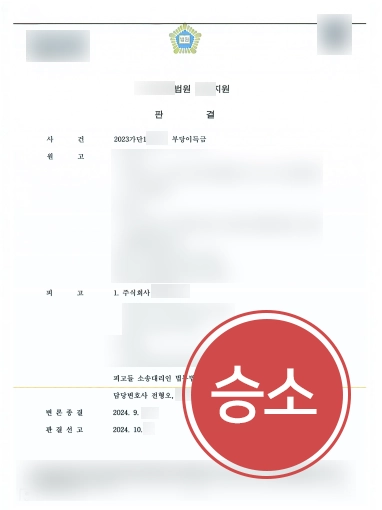
As a result of the lawsuit for the return of unjust enrichment, the court issued a judgment dismissing all of the plaintiffs' claims.
The court accepted the evidence that the deduction items were specified in the employment contract and the rules of employment, and that the employees had signed them.
It also accepted the argument of the attorney in charge that the deducted amount had been used for employee welfare and that there were no circumstances indicating it had become unjust.
The success or failure of a lawsuit for the return of unjust enrichment turns on the determination of whether unjust enrichment exists.
It is recommended to carefully review with an attorney whether the requirements for filing the lawsuit have been met, to explore the possibility that the suit may be dismissed, and to argue that the plaintiff's claim is without merit by securing objective evidence.
At Daeryun Law Firm, attorneys experienced in numerous unjust enrichment matters assist clients from the consultation stage onward and provide response strategies tailored to the situation.
If you are seeking a 🔗attorney referral for a situation like the one above, we invite you to reach out to Daeryun Law Firm.
This content is based on actual case studies of Daeryun Law LLC with some adaptations, and the copyright belongs to our firm.
Unauthorized reproduction, duplication, or distribution and other copyright infringements may result in legal action under applicable laws.