
CONTENTS
- 1. The Client Who Sought Out the Suwon Law Firm

- - The Client Who Did Not Recover the Jeonse Deposit
- 2. Debt Collection Explained by the Suwon Law Firm
- - Statutes on Attachment of Claim and Collection Order
- - Property Subject to Attachment Held by a Garnishee
- 3. The Suwon Law Firm's Assistance
- - Four Forms of Assistance for the Attachment of Claim and Collection Order
- 4. The Court's Decision on the Suwon Law Firm's Arguments
- - If You Have Not Recovered Your Jeonse Deposit

1. The Client Who Sought Out the Suwon Law Firm

The client sought out a Suwon attorney, wishing to work with the firm to obtain an attachment of claim and a collection order for a jeonse deposit that had not been returned.
 The Client Who Did Not Recover the Jeonse Deposit
The account of the client who requested a consultation is as follows.
After the jeonse contract expired, the client had not recovered the deposit from the landlord.
The client attempted to contact the landlord several times to recover the deposit, but the landlord intentionally avoided contact and kept delaying payment of the deposit.
When the matter was not resolved amicably, the client decided to take legal action.
The client learned that the matter could be resolved through an attachment of claim and a collection order.
🔗Debt Collection The client sought out the Suwon law firm to obtain advice and a consultation and to resolve the matter promptly.
2. Debt Collection Explained by the Suwon Law Firm
An attachment of claim and a collection order attach a claim held by the debtor in order to realize a monetary claim, and then grant the creditor the authority to collect the attached claim.
※ Attachment : compulsory execution in which the disposal of specific property of the debtor is restricted by an enforcement agency
※ Collection : locating and taking or receiving the amount owed
Statutes on Attachment of Claim and Collection Order
The statutory basis for an attachment of claim and a collection order is as follows.
Civil Execution Act Article 236 (Report of Collection)
① A creditor shall report the collected amount of the claim to the court.
② If another attachment, provisional attachment, or demand for distribution existed before the report under paragraph (1), the creditor shall immediately deposit the collected amount with an official depository and report the grounds therefor.
Property Subject to Attachment Held by a Garnishee
A bank holding the debtor's deposits, savings, and housing subscription account funds, a lessor who must pay a jeonse or monthly rent deposit, a card company that must pay credit card sales proceeds, and a company that pays wages all qualify as garnishees.
We will review the property that may be attached through a garnishee.
Account Attachment | Has the advantage of no refusal of payment, but the benefit is limited because recovery is made only from the amount remaining after the minimum cost of living is excluded |
Lease Deposit Attachment | Because the jeonse or deposit amount for a residence or place of business most often exceeds ten million won, this can be effective for recovering a smaller claim rather than a large one |
Credit Card Sales Attachment | Tends to offer a relatively high benefit in the case of a retailer, with the advantage that there is no limit on the amount attached |
Wage Attachment | Because the debtor may face a disadvantage in ordinary employment at the workplace, the debtor's side may request a settlement for repayment |


3. The Suwon Law Firm's Assistance
Drawing on the know-how built up from handling attachment of claim and collection order cases, the Suwon law firm established a strategy. It made the following arguments.
Four Forms of Assistance for the Attachment of Claim and Collection Order
To obtain an attachment of claim and collection order of approximately 110 million won, the Suwon law firm advanced the following four arguments.
The Suwon law firm argued that the lessor had a duty to return the jeonse deposit and that the creditor had the right to secure it
▶ Presentation of Grounds for the Possibility of Attachment
Relying on the Civil Act and related statutes under which a creditor may recover a claim through attachment, the firm argued that it could apply for an attachment order in accordance with the legal procedure
▶ Investigation and Identification of the Debtor's Assets
The Suwon law firm identified the debtor's list of property and argued that, among those assets, the amount corresponding to the jeonse deposit could be attached
▶ Selection of the Property to Be Attached
After closely reviewing the client's situation, the firm applied to attach the defendant's bank account and wages for the deposit claim
4. The Court's Decision on the Suwon Law Firm's Arguments
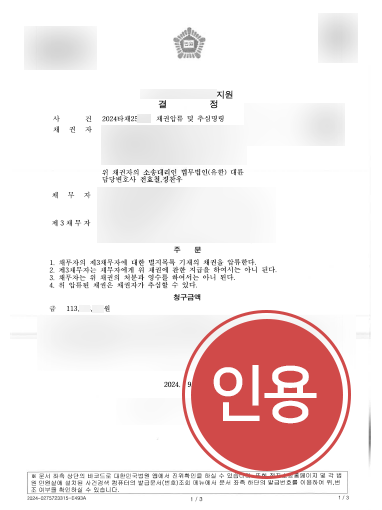
Accepting the Suwon law firm's arguments, the court issued a decision stating, ‘The debtor's claim against the garnishee is attached. The creditor may collect the attached claim above.’
The client, whose application for an attachment of claim and collection order of approximately 110 million won was granted, expressed deep gratitude to the Suwon law firm.
If You Have Not Recovered Your Jeonse Deposit
If you have not recovered your jeonse deposit, you can protect your rights through an application for an attachment of claim and a collection order.
If a creditor attempts to collect a claim through unlawful means, the creditor may instead face legal disadvantages, so consulting an attorney can be helpful.
At Daeryun, 🔗civil attorneys with extensive practical experience establish multifaceted strategies and resolve cases in complex and demanding civil litigation.
If you need the assistance of an attorney in a situation similar to the case above, please request a consultation through the Suwon law firm's 🔗legal consultation booking.
Related News
This content is based on actual case studies of Daeryun Law LLC with some adaptations, and the copyright belongs to our firm.
Unauthorized reproduction, duplication, or distribution and other copyright infringements may result in legal action under applicable laws.