
CONTENTS
- 1. Unfair Dismissal Settlement Money | Case Background

- - Case Timeline Summary
- - Plaintiff vs. Client (Defendant)
- 2. Unfair Dismissal Settlement Money | Case Review
- - The Issues
- - Precedents Related to the Case
- 3. Unfair Dismissal Settlement Money | Details of the Assistance
- 4. Unfair Dismissal Settlement Money | Full Defense of the Confirmation of Nullity of Dismissal Suit

1. Unfair Dismissal Settlement Money | Case Background

The client, who requested a consultation regarding a wrongful dismissal settlement issue, was the representative of a corporation.
The plaintiff had worked at the company for about 20 years and, after being wrongfully removed from the representative position, believed that all relations with the company had ended.
That is, the plaintiff (the former representative director) claimed that such dismissal was wrongful and that the plaintiff still held the status of a worker, and filed a dismissal nullity confirmation lawsuit, asserting that the plaintiff had been processed as retired without due procedure.
In particular, the plaintiff attempted negotiations several times during the wrongful dismissal lawsuit and demanded a settlement sum in the hundreds of millions of won.
In response, to counter the plaintiff's excessive claim, the client came to a Daeryun LLC attorney and began to mount a legal response.
 Case Timeline Summary
Timeline |
The plaintiff took office and worked as the representative director (chief executive officer) of the client's company ↓ The plaintiff voluntarily submitted a letter of resignation to the client's side ↓ At this time, at the client's company, Mr./Ms. A took office as the new representative director and took over the entire management ↓ After the new representative director took office, the client's side formally notified the plaintiff of dismissal ↓ The plaintiff filed a lawsuit for confirmation of nullity of dismissal against the client's side |
In other words, whether it was the plaintiff's voluntary resignation or the client's side's 🔗unfair dismissal, and whether the status of an employee could be recognized during the period when the plaintiff was the representative director, became the key issues in this case.
Plaintiff vs. Client (Defendant)
Plaintiff's Argument | Client's (Defendant's) Argument |
Because the plaintiff was wrongfully dismissed, his status as an employee is maintained Claim for the full amount of unpaid wages | The plaintiff had no employee status at the time of leaving Because a letter of resignation was submitted, the subsequent dismissal is not a 🔗wrongful dismissal |
Because the employment relationship continued thereafter, a claim for 25 months of the monthly wage of 7 million won received while working as representative director | Because the plaintiff is no longer an employee, there is no obligation to pay wages |
Claim for retirement pay of more than 100 million won and delay damages at 20% per annum | During the period as director and representative director, he was not an employee The claim for retirement pay for that period is barred by the extinctive prescription |
2. Unfair Dismissal Settlement Money | Case Review

After examining the case concerning the claim for the unfair dismissal settlement amount and the lawsuit for confirmation of invalidity of dismissal, Daeryun's attorney identified the key issues and sought to defend against the plaintiff's side's arguments.
The Issues
▷ Need to confirm whether the plaintiff voluntarily submitted a resignation letter or was dismissed
▷ The client's side argued that it was a voluntary resignation, whereas the plaintiff argued that the resignation letter had not taken effect and that it was therefore an unfair dismissal
▷ Because the plaintiff retained employee status even after the dismissal, there is an obligation to pay wages and retirement pay
▷ The client maintained that the plaintiff was no longer an employee, so there was no obligation to pay wages and retirement pay
Precedents Related to the Case
The attorney at Daeryun Law Firm cited the following precedents to argue that all of the plaintiff's claims were without effect.
Item | Content |
Whether a representative director is an employee (2006Da54637, 2006Da54644) | A representative director generally does not qualify as an employee under the Labor Standards Act However, under special circumstances, the person may be recognized as an employee
▶ As the plaintiff is a representative director and does not qualify as an employee, there is insufficient evidence of an employment relationship |
Extinctive prescription of severance pay (2001Da24051) | A claim for severance pay must be filed within 3 years from the date of retirement, and it is extinguished after 3 years have passed
|
A director's claim for remuneration (2017Da17436) | A director's remuneration must be determined by a resolution of the general meeting of shareholders, and without such a resolution, a director cannot exercise a claim for remuneration (see Article 388 of the Commercial Act)
▶ As there was no resolution of the general meeting of shareholders regarding the plaintiff, the plaintiff cannot exercise a claim for remuneration or severance pay as a director |
3. Unfair Dismissal Settlement Money | Details of the Assistance
To establish that both the unfair dismissal settlement money and the action for confirmation of invalidity of dismissal were without merit, the Daeryun attorney mounted a determined defense, asserting the following.
Argument | Content |
The plaintiff's voluntary resignation | Emphasizing that the plaintiff voluntarily submitted a letter of resignation, this was a voluntary retirement rather than a dismissal Upon submission of the letter of resignation, the status of an employee was no longer maintained |
Denial of employee status (🔗violation of the Labor Standards Act denied) | Argued that, because the plaintiff held the position of representative director, the plaintiff did not have the status of an employee and did not constitute an employee under the Labor Standards Act Emphasized, through Supreme Court precedents (2006Da54637, 2006Da54644), that a representative director is generally not an employee |
Extinguishment of the claim for retirement pay | Because the plaintiff did not bring the claim for retirement pay within three years, the claim for retirement pay had been extinguished |
Denial of the plaintiff's claim for remuneration | On the ground that there had been no resolution of the general meeting of shareholders, the claim for remuneration could not be recognized |
4. Unfair Dismissal Settlement Money | Full Defense of the Confirmation of Nullity of Dismissal Suit

The client, who made a 🔗legal consultation reservation to inquire about an unfair dismissal settlement and then ended up in a defense trial, was ultimately able to resolve the matter by having all of the plaintiff's claims dismissed.
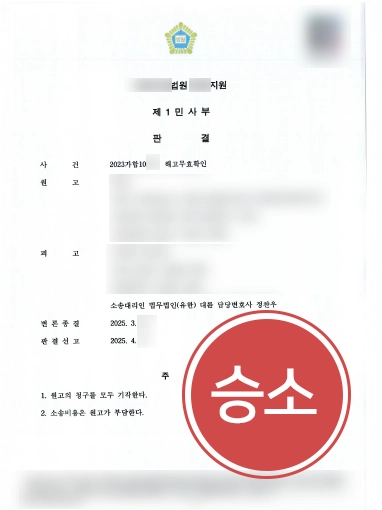
The court that heard the case held that the plaintiff's status as an employee had ended entirely upon his resignation as representative director, and that no circumstances existed thereafter that would warrant regarding the dismissal as an unfair dismissal.
As a result, the claim for confirmation of nullity of dismissal, as well as the claims for damages relating to wages until retirement age, retirement pay, and the possibility of reemployment, were all dismissed.
Even the litigation costs were ruled to be borne by the plaintiff, and the client was able to be completely relieved of the legal and financial burden.
As shown here, a dispute over a nullity of dismissal lawsuit can be highly complex, as company rules, various circumstances, and legal principles are intertwined.
If you suddenly 🔗unfair dismissal lawsuit find yourself in a difficult situation because of a filed unfair dismissal lawsuit, you may visit a Law Firm Daeryun attorney and 🔗unfair dismissal administrative litigation and similar matters.
This content is based on actual case studies of Daeryun Law LLC with some adaptations, and the copyright belongs to our firm.
Unauthorized reproduction, duplication, or distribution and other copyright infringements may result in legal action under applicable laws.