
CONTENTS
- 1. The Client Who Requested Help on a Charge of Violation of the Child Welfare Act

- - The Child Abuse Specialist Attorney Conducting a Thorough Consultation with the Client
- 2. Violation of the Child Welfare Act: A Look at the Penalties and the Statutes
- 3. Establishing a Defense Strategy for a Client Charged with Violation of the Child Welfare Act
- - Analyzing CCTV Footage and Securing Witness Statements
- - No Repetition or Intent Rising to the Level of Abuse
- 4. Concluding the Case with Non-Prosecution for a Client Charged with Violation of the Child Welfare Act

1. The Client Who Requested Help on a Charge of Violation of the Child Welfare Act

This is the story of a client who requested help on a charge of violation of the Child Welfare Act.
The client, who had been working at a child welfare facility in Seoul, was accused, on the ground that the client had inflicted emotional abuse on a child under care, of a charge of violation of the Act on Special Cases concerning the Punishment of Child Abuse Crimes.
The case began when A, one of the children at the facility, confided to a school counseling teacher that the client had given isolating instructions, such as confining A to a separate room and preventing A from associating with friends.
 The Child Abuse Specialist Attorney Conducting a Thorough Consultation with the Client
The client was greatly shocked by the mere fact of being investigated as a suspect.
While emphasizing that his words and conduct were not for the purpose of abuse, he felt severe fear about the criminal punishment and social stigma he would face if the suspicion were recognized.
The specialist attorney, who had handled numerous 🔗violation of the Child Welfare Act cases, deeply empathized with the client's anxiety and guided him through the overall criminal procedure systematically and carefully.
In particular, through cooperation with the evidence investigation center, the attorney presented methods for securing evidence that could prove the client's assertions and began establishing a specific defense strategy.


2. Violation of the Child Welfare Act: A Look at the Penalties and the Statutes
Examining the level of punishment and the relevant statutes for violation of the Child Welfare Act, the specialized attorney set about legal interpretation and the establishment of a defense strategy.
The Child Welfare Act has the purpose of ensuring the welfare of children so that they may be born healthy and grow up happily and safely.
At the time of its enactment in 1981, it viewed children as objects of protection and regulated matters centered on the establishment of welfare facilities and the administrative system, but it has since developed into an integrated human rights protection legal system that recognizes children as subjects of rights and encompasses the prevention and punishment of child abuse as well as the protection of victimized children.
The client was facing a police investigation on suspicion of emotional abuse, and emotional abuse means verbal insults, emotional threats, confinement, restraint, and other sadistic acts committed against a child by an adult, including a guardian.
The representative types are as follows.
-The act of not allowing the child to sleep
-The act of comparing, discriminating against, or favoring the child relative to siblings, friends, or others
-The act of isolating the child within the family
-The act of having the child directly witness domestic violence
If emotional child abuse is recognized, the offender is subject to imprisonment for not more than 5 years or a fine not exceeding 50 million won, and if a mandatory reporter, such as a worker at a child welfare facility, commits a child abuse crime, the offender may receive aggravated punishment of up to one-half of the statutory penalty.
3. Establishing a Defense Strategy for a Client Charged with Violation of the Child Welfare Act

For a client facing questioning on a charge of violating the Child Welfare Act, an experienced attorney, in cooperation with the evidence investigation center, set out to undertake 🔗evidence collection that could rebut the charge and to establish a defense strategy.
Analyzing CCTV Footage and Securing Witness Statements
As a result of the child abuse specialist attorney and the evidence investigation center collecting and analyzing the CCTV footage within the facility, no scene in which the client inflicted emotional harm on the victimized child was confirmed at all.
In addition, statements from two social workers who had worked together were secured, and it was submitted as evidence that the client had ordinarily been devoted to the children and had worked diligently.
No Repetition or Intent Rising to the Level of Abuse
The victimized child claimed that the client deliberately and repeatedly separated the child and prevented the child from associating with other children.
However, the client explained that the child had unilaterally hit another child and the like, so the client had separated the child only once as an unavoidable disciplinary measure.
The specialized attorney, relying on CCTV records, work logs, teacher meeting minutes, and behavioral guidance records, proved that the measure was a one-time response for the purpose of discipline.
4. Concluding the Case with Non-Prosecution for a Client Charged with Violation of the Child Welfare Act
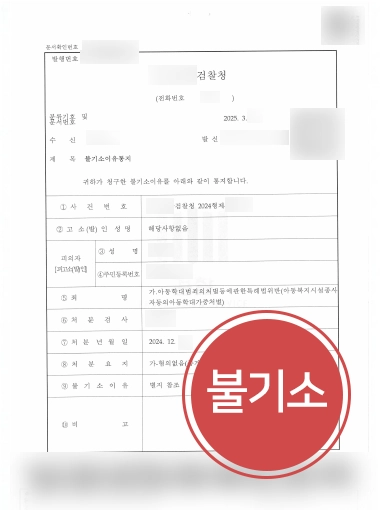
As a result of the defense counsel's strategic assistance, the prosecution issued a decision of 'no suspicion' (non-prosecution) on the grounds of a lack of recognized intent and insufficient evidence.
In the client's case, because the client was an employee at a child welfare facility, a thorough response was necessary.
The client said, "If I had been criminally punished for a violation of the Child Welfare Act, I could have lost my job. Thanks to the Daeryun attorney's thorough defense, I was able to prove my innocence and protect my means of livelihood."
Unlike physical violence, emotional child abuse is a very ambiguous area in which there is no clear external evidence, so the interpretation may vary depending on the intent, situation, and context of the remarks.
Whether the same words constitute discipline or abuse is greatly dependent on the interpretation of investigative agencies and the court.
Therefore, there is a risk of being treated as a perpetrator regardless of intent, and it is very important to establish accurate legal standards and a strategy through the assistance of a specialist attorney from the early stage.
Daeryun LLC, through collaboration between specialist attorneys who have handled numerous violations of the Child Welfare Act and the evidence investigation center, comprehensively explains the intent of discipline, the situational circumstances, the relationship with the child, and the like, and provides a tailored defense strategy for the client.


Watch related video content
for this case study.

How will the daycare teacher who kicked a 13-month-old baby be punished?
This content is based on actual case studies of Daeryun Law LLC with some adaptations, and the copyright belongs to our firm.
Unauthorized reproduction, duplication, or distribution and other copyright infringements may result in legal action under applicable laws.