
CONTENTS
- 1. The Workers Alleging Unfair Dismissal and the Corporate Client Who Requested Assistance

- - What Is Unfair Dismissal?
- - What Is the Revocation of a Decision on the Remedy Against Unfair Dismissal?
- 2. Assistance for the Revocation of the Reexamination Decision on the Remedy Against Unfair Dismissal
- - Rebuttal of the Argument That No Specific Grounds for Dismissal Were Stated
- - Rebuttal of the Argument That It Was Not a Ground for Automatic Termination of the Employment Relationship
- 3. Result of the Assistance for the Revocation of the Reexamination Decision on the Remedy Against Unfair Dismissal: All of the Plaintiffs' Appeals Dismissed

1. The Workers Alleging Unfair Dismissal and the Corporate Client Who Requested Assistance

This is the account of a corporate client who wished to have a lawsuit dismissed in response to a lawsuit by workers claiming unfair dismissal.
The workers (hereinafter the "plaintiffs") claimed that this dismissal disposition lacked procedural and substantive legitimacy and therefore constituted an unfair dismissal.
In the first instance, the dismissal disposition was found to be lawful and the plaintiffs' claims were dismissed, but the plaintiffs had filed an appeal.
The client wished to uphold the first-instance judgment and have the appeal dismissed, and an experienced attorney who had handled numerous unfair dismissal cases closely analyzed the client's situation and the original judgment, then proceeded to respond to the appellate proceedings.
 What Is Unfair Dismissal?
🔗Unfair dismissal means an employer dismissing an employee without justifiable grounds.
An employee who has been unfairly dismissed may apply for a remedy procedure for the unfair dismissal through the Labor Relations Commission.
When dismissing an employee, an employer must have justifiable grounds prescribed by law, and otherwise the dismissal constitutes an unfair dismissal, for which the employee may obtain a legal remedy.
∙When the dismissal was carried out without justifiable grounds
∙When the requirements restricting dismissal for managerial reasons were not met
∙When the dismissal was carried out in violation of a specific ground prohibiting dismissal prescribed in the Labor Standards Act, the Act on Equal Employment and Support for Work-Family Balance, the Trade Union and Labor Relations Adjustment Act, etc.
∙When the dismissal was carried out by excessively assessing the disciplinary measure even though the ground was not one warranting dismissal
∙When the dismissal was carried out in violation of the dismissal procedure prescribed in statutes or in a collective agreement or rules of employment
∙When the dismissal was carried out during a period in which dismissal is not permitted
What Is the Revocation of a Decision on the Remedy Against Unfair Dismissal?
A lawsuit to revoke a remedy retrial ruling for unfair dismissal is an administrative litigation in which a party, dissatisfied with the retrial ruling on a remedy for unfair dismissal by the National Labor Relations Commission, requests the court to revoke that ruling.
Where a worker has received a ruling from the National Labor Relations Commission ordering reinstatement or compensation, the employer may, being dissatisfied with it, file a lawsuit to revoke the remedy retrial ruling for unfair dismissal with the high court.
This lawsuit is heard by the high court, and if a party is dissatisfied thereafter, they may file a final appeal with the Supreme Court.
The Supreme Court judges primarily whether the high court’s judgment is sound as a matter of law.


2. Assistance for the Revocation of the Reexamination Decision on the Remedy Against Unfair Dismissal

The attorney undertook assistance for the revocation of the reexamination decision on remedy against unfair dismissal.
The attorney in charge responded by constructing arguments to rebut the plaintiffs' grounds of appeal.
1. The dismissal notice did not state specific grounds for dismissal
2. The plaintiffs' receipt of a suspended sentence cannot be regarded as a ground for automatic termination of the employment relationship
Rebuttal of the Argument That No Specific Grounds for Dismissal Were Stated
The plaintiffs claimed that the dismissal pre-notice document merely listed the personnel regulations and did not state a specific ground for dismissal.
However, the client company's personnel regulations specify ‘confirmation of a sentence of imprisonment without labor or heavier’ as a ground for removal, and the plaintiffs actually received a suspended sentence of imprisonment with labor in their criminal trial, which falls under that ground.
The unfair dismissal specialist attorney therefore argued that, because the ground could be specifically ascertained, it could not be said that a valid dismissal notice required the criminal case number or the gist of the judgment to be stated.
Where the rules of employment or the like provide separately for a removal disposition and a disciplinary disposition, yet provide no procedural rules at all for the removal disposition, unlike for an ordinary disciplinary disposition, and the grounds for removal are not provided identically as grounds for discipline, it cannot be said that the employer must go through the ordinary disciplinary procedure in making a removal disposition, and this is not to be construed differently even where the grounds for removal appear in substance to be grounds for discipline. (Supreme Court Judgment of June 23, 2000, 99Du4235)
Rebuttal of the Argument That It Was Not a Ground for Automatic Termination of the Employment Relationship
The plaintiffs argued that criminal punishment is not a ground for automatic termination of the employment relationship.
However, the client’s personnel regulations provide that a person ‘for whom 3 years have not passed since the sentence of imprisonment or heavier was completed or it was finally determined that the sentence would not be executed’ may not be appointed as an employee, and that the person shall be dismissed if such a ground arises or is discovered.
The specialist attorney emphasized that, as long as such a regulation clearly exists and is difficult to regard as particularly unjust under social conventions, its purpose should be respected.
3. Result of the Assistance for the Revocation of the Reexamination Decision on the Remedy Against Unfair Dismissal: All of the Plaintiffs' Appeals Dismissed
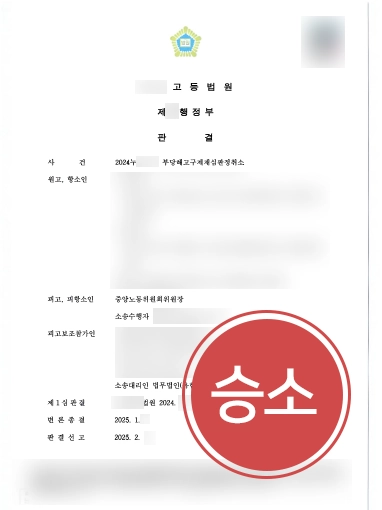
As a result of assistance with the revocation of the retrial decision on the remedy for unfair dismissal, the court dismissed all of the plaintiffs' appeals.
The court held, “Although the grounds for dismissal must be conveyed specifically and clearly, if the person subject to dismissal already knew those grounds, it is difficult to regard the notice of dismissal as one in violation of the Labor Standards Act even if the grounds are not described in detail.”
A lawsuit for revocation of a retrial decision on a remedy for unfair dismissal is a complex 🔗administrative litigation filed as a challenge to a retrial decision of the National Labor Relations Commission, and it requires in-depth examination of the legal principles concerning the legitimacy of the dismissal and the propriety of its procedure.
At Daeryun Law Firm, attorneys with extensive experience in unfair dismissal cases collaborate with the firm's labor attorneys to minimize a company's legal risk through the systematic establishment of litigation strategy, the organization of key evidence, and response to the determination of procedural illegality.
This content is based on actual case studies of Daeryun Law LLC with some adaptations, and the copyright belongs to our firm.
Unauthorized reproduction, duplication, or distribution and other copyright infringements may result in legal action under applicable laws.