
CONTENTS
- 1. The Client Subject to an Application for a Provisional Injunction for Trademark Infringement

- - The Story of the Client Involved in a Trademark Infringement Lawsuit
- - A Look at the Concepts of Trademark Rights and a Provisional Injunction for Trademark Infringement
- 2. Assistance for the Client Subject to an Application for a Provisional Injunction for Trademark Infringement
- - Proving the Trademark Similarity and the Absence of Distinctiveness
- - Explaining the Absence of a Need for Preservation
- 3. Result of Responding to the Provisional Injunction Prohibiting Trademark Infringement: Successful Dismissal of the Creditor's Application

1. The Client Subject to an Application for a Provisional Injunction for Trademark Infringement

This is a case assisting a client who received a provisional injunction application for trademark infringement.
The client who came to the trademark attorney at Daeryun Law Firm stated that the client was in a bewildering situation, having recently received a provisional injunction application for trademark infringement.
Daeryun Law Firm explained that, because the firm also has a patent attorney on staff, it can respond to trademark infringement provisional injunction cases by organically combining legal analysis with technical assessment, and it proceeded with a joint response.
 The Story of the Client Involved in a Trademark Infringement Lawsuit
The client operated a food distribution business and had sold products through online and offline distribution channels using a self-developed brand name and logo.
One day, a competing company, Company A (hereinafter the creditor), filed an application for a provisional injunction prohibiting trademark infringement.
The creditor submitted to the court an application for a provisional injunction demanding the immediate cessation of all production, sale, and advertising of the products, claiming that the client was using, without authorization, a name and design similar to the trademark registered in the creditor's name.
Accordingly, the client was placed in a situation where, even before the result of a separate suit on the merits, if the court granted the application for a provisional injunction, the client would have to immediately change the trademark and product name and completely halt marketing.
A Look at the Concepts of Trademark Rights and a Provisional Injunction for Trademark Infringement
▶🔗What is a trademark?
It refers to a mark used to distinguish one's own goods from the goods of another.
▶What is a mark?
It refers to all indications used to identify the source of goods, regardless of their composition or method of expression, such as signs, letters, figures, sounds, smells, three-dimensional shapes, holograms, motions, or colors.
▶What is the prohibition of trademark infringement?
It refers to a measure that prohibits the use of a registered trademark by another party where, without legitimate authority, that party uses the registered trademark or uses a trademark so similar as to cause confusion, thereby infringing the rights of the trademark holder.
▶What is an application for a provisional injunction prohibiting infringement?
It is a temporary measure processed more quickly than a suit on the merits, the purpose of which is to temporarily halt the infringing act, thereby preventing harm to the rights holder and preserving the right.
▶What is a provisional injunction?
A provisional injunction is a system that temporarily protects a right or situation in advance so that a court judgment can later be enforced by compulsory means.
It is frequently used in legal disputes other than monetary matters, and is broadly divided into two types.
1. Provisional injunction concerning the subject matter of the dispute
Example: where the other party is prevented from disposing of the subject matter of the dispute itself, such as real estate or a trademark
2. Provisional injunction to determine a provisional status
Example: where the rights and obligations between the parties are temporarily determined until a judgment on the merits is rendered


2. Assistance for the Client Subject to an Application for a Provisional Injunction for Trademark Infringement

For the client who was subject to a trademark infringement provisional injunction application, a specialized attorney with experience in numerous trademark-related cases took up the response.
Proving the Trademark Similarity and the Absence of Distinctiveness
The most important point in this application for a provisional injunction over a trademark right violation was to concretely prove that the trademark used by the client and the creditor's registered trademark are not substantially similar.
At Daeryun LLC, a patent attorney and a specialized attorney rebutted the creditor's claims on the following grounds.
▶Differences in the composition of letters: the two trademarks may share some similar words or syllables. However, their overall lexical composition and phonological structure differ, so they are clearly distinguishable aurally
▶Visual differences in design and logo: the client's trademark differs markedly in its graphic elements, color combinations, and the formative characteristics of its font, so from the standpoint of an ordinary consumer the likelihood of confusion is low
▶Distinctiveness of product categories and distribution channels: the principal product categories and main sales channels of the two companies differ significantly, so the possibility of confusion in the market is substantially low
Explaining the Absence of a Need for Preservation
For an application for a provisional injunction to be granted, there must be a concern that irreparable harm will arise if the infringing act continues.
The attorney specializing in trademark violations argued for the dismissal of the application for a provisional injunction with the following strategy.
▶The creditor had not distributed products using the trademark in question for the past six months
▶There was no evidence that the client's use of the trademark had caused specific and direct sales losses or market confusion
▶On the contrary, if the client were prohibited from using the trademark, the client would suffer irreparable harm such as brand withdrawal and cessation of marketing
3. Result of Responding to the Provisional Injunction Prohibiting Trademark Infringement: Successful Dismissal of the Creditor's Application
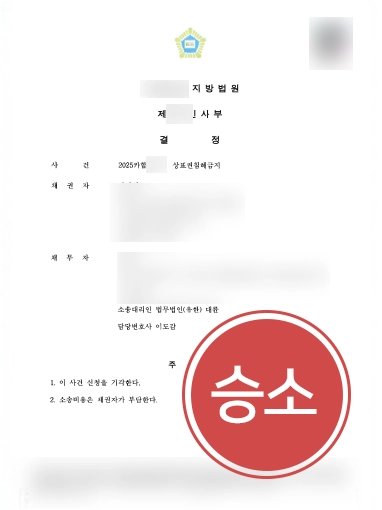
As a result of the response to the provisional injunction prohibiting trademark infringement, the court issued a ruling dismissing the creditor's application.
The client stated, "I was really worried that, if the application for a provisional injunction were granted, it would cause a major disruption to sales. Thanks to the attorney, I was able to have the application for a provisional injunction dismissed without issue."
This case demonstrated that, where an application for a provisional injunction is abused in a trademark dispute, the legal requirements must be thoroughly reviewed.
In particular, the specific analysis of trademark similarity and the establishment of the loss the client would suffer if the provisional injunction were granted became the key issues.
🔗Trademark infringement prohibition provisional injunction applications are a legal measure that can restrict business activities within a short period, so a prompt and strategic response by a specialist attorney well-versed in the Trademark Act is necessary.
Daeryun LLC provides comprehensive legal services across the entire process of trademark disputes, from analysis of trademark similarity, determination of whether infringement exists, and preparation of provisional injunction response briefs and trial response, to the establishment of registered trademark strategy in collaboration with a patent attorney.


Watch related video content
for this case study.

What do I need to know before consulting with a lawyer?
This content is based on actual case studies of Daeryun Law LLC with some adaptations, and the copyright belongs to our firm.
Unauthorized reproduction, duplication, or distribution and other copyright infringements may result in legal action under applicable laws.