
CONTENTS
- 1. The Client Who Requested a Consultation on Labor Relations Law

- - The Circumstances of the Client's Report of Unpaid Wages
- 2. What Is Labor Relations Law?
- - Statutes Related to Unpaid Wages
- 3. Logical Arguments Based on Labor Relations Law
- - Labor Attorney, Proving the Client's Employment
- - Labor Attorney, Claiming Wages and Delay Damages
- - Labor Attorney, Emphasizing That a Criminal Case Was in Progress
- 4. Outcome of Realizing Rights Under Labor Relations Law, Fully Granted
- - Unpaid Wages, If It Is Difficult to Resolve Alone

1. The Client Who Requested a Consultation on Labor Relations Law
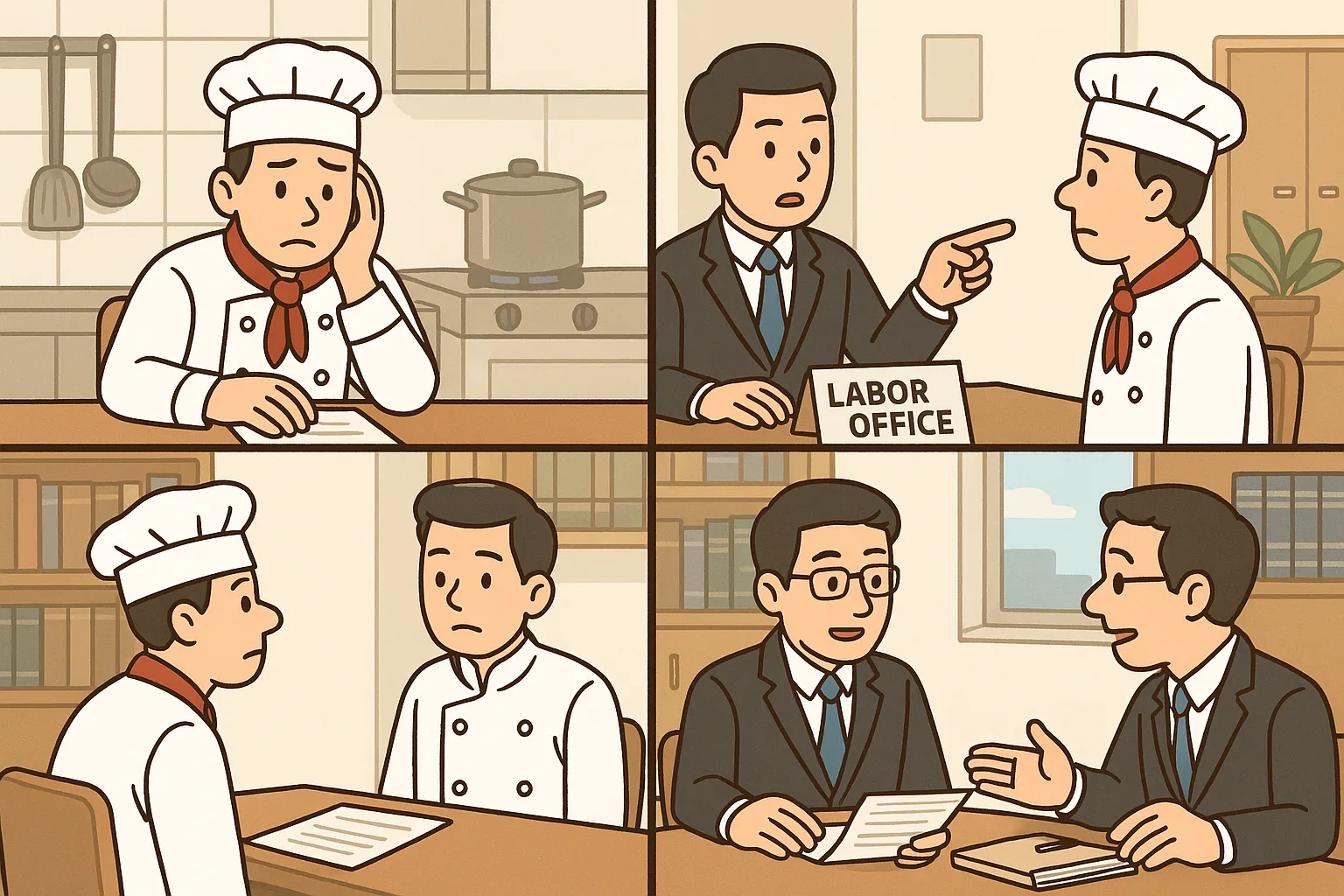
This is a case in which a client who requested a consultation regarding labor relations law was able to safely recover tens of millions of won in wages, owing to the assistance of a labor attorney.
 The Circumstances of the Client's Report of Unpaid Wages
The client, who worked as a head chef at a restaurant, had not been paid wages for several months despite working diligently.
To resolve this, the client filed a report of unpaid wages, but received an answer from the Ministry of Labor that, in order to actually recover the wages, he should consult an attorney.
The client therefore requested a consultation with an attorney well versed in labor relations law.
The labor attorney specifically guided the client on the method of filing a wage claim lawsuit and explained the method of calculating the unpaid wages and the preparation of the relevant documents.


2. What Is Labor Relations Law?
Labor relations law refers to the body of law that governs the protection and guarantee of workers' rights and interests, the relationship with employers, working conditions, and similar matters.
In the case of our country, content concerning labor is contained in various statutes.
Examples of labor relations law
∙ Industrial Accident Compensation Insurance Act
∙ Employment Insurance Act
∙ Minimum Wage Act
∙ Trade Union and Labor Relations Adjustment Act
Statutes Related to Unpaid Wages
Among them, the client’s wage arrears case was a matter closely related to the Labor Standards Act.
Wage arrears refers to the failure to pay, without the worker’s consent, wages, compensation, and any and all other money and valuables provided as consideration for labor.
This means a violation of the obligation to settle money and valuables under Article 36 of the Labor Standards Act or the obligation to pay wages under Article 43 of the same Act.
Article 36 of the Labor Standards Act (Settlement of Money and Valuables)
Article 43 of the Labor Standards Act (Payment of Wages)
(2) Wages shall be paid at least once a month on a fixed date. However, this shall not apply to wages paid temporarily, allowances, other equivalent payments, or wages prescribed by Presidential Decree.
Accordingly, in a wage arrears case, merely reporting the matter to the Ministry of Employment and Labor does not mean that wages can be received immediately.
In the client’s case as well, although the employer was under investigation by the Ministry of Employment and Labor for violating the Labor Standards Act, the client was informed that a civil lawsuit was necessary to actually recover the wages.
For this reason, the client requested the assistance of a labor attorney.
3. Logical Arguments Based on Labor Relations Law
In accordance with labor relations law, the labor attorney calculated the unpaid wages and organized practical issues such as the payment criteria, the extinctive prescription, and the calculation of delay damages.
Then, based on the employment contract and evidence of the wage non-payment, the attorney made the following arguments.
Labor Attorney, Proving the Client's Employment
The fact that the client had actually worked for a certain period was a situation that could be sufficiently proven through the employment contract, personnel documents, and work records.
In addition, because there were materials confirming that part of the wages had not been paid even after the client's retirement, the lawyer emphasized the employer's violation of the obligation to pay wages.
Labor Attorney, Claiming Wages and Delay Damages
Pursuant to Article 36 of the Labor Standards Act, the employer must pay unpaid wages within 14 days from the date of retirement, yet the employer violated this.
The labor attorney made this a key issue of the lawsuit and, concurrently asserting a claim for delay damages under Article 750 of the Civil Act and Article 37 of the Labor Standards Act, argued for the application of statutory interest of 20% per annum.
A person who causes loss to another by an unlawful act, intentionally or negligently, shall be liable to compensate for such loss.
① Where an employer fails to pay all or part of the wages to be paid under Article 36 and the benefits (limited to lump-sum payments) under Article 2, subparagraph 5 of the Employee Retirement Benefit Security Act within 14 days from the date on which the cause for payment arose, the employer shall pay delay interest, for the number of days of delay from the following day until the date of payment, at a rate prescribed by Presidential Decree within the range of 40 percent per annum, taking into account economic conditions such as the overdue interest rate applied by banks under the Banking Act.
② Paragraph 1 shall not apply, for the period during which the cause continues, where the employer delays the payment of wages due to a natural disaster, an incident, or other causes prescribed by Presidential Decree.
Labor Attorney, Emphasizing That a Criminal Case Was in Progress
Following the client's report of unpaid wages, the employer was at that time under criminal investigation on an allegation of violating the Labor Standards Act.
The labor attorney actively used this point to emphasize that the employer's side was in violation of its legal obligations and could not evade that responsibility in the civil lawsuit either.
4. Outcome of Realizing Rights Under Labor Relations Law, Fully Granted
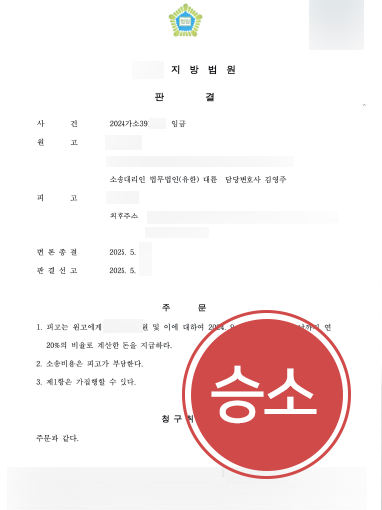
The court, accepting the logical arguments of the labor attorney based on labor laws, accepted the client's claim in full and rendered a judgment granting in full the entire amount of unpaid wages and the 20% damages for delay thereon.
Unpaid Wages, If It Is Difficult to Resolve Alone
The problem of unpaid wages frequently does not end with a simple administrative complaint.
In particular, where the structure involving the corporate business operator and the actual operator is complex, there are many cases in which a substantive resolution is difficult by means other than litigation.
Daeryun LLC has many attorneys with legal knowledge related to labor law.
Moreover, with experts in each field, such as civil, criminal, and administrative matters, the firm can provide a comprehensive response from the criminal complaint to derivative cases.
If you need legal assistance regarding unpaid wages, please entrust your case at any time through a 🔗legal consultation booking.
Related News

This content is based on actual case studies of Daeryun Law LLC with some adaptations, and the copyright belongs to our firm.
Unauthorized reproduction, duplication, or distribution and other copyright infringements may result in legal action under applicable laws.