
CONTENTS
- 1. The Story of the Client Charged with Violation of the Special Act on Prevention of Insurance Fraud

- - The Client's Charges
- 2. Explanation of the Concept of Violation of the Special Act on Prevention of Insurance Fraud
- 3. Responding to the Charge of Violation of the Special Act on Prevention of Insurance Fraud
- - Emphasizing That the Client Was Driving His Own Vehicle at the Time of the Incident
- - Emphasizing That the Client Did Not File an Insurance Claim
- - Emphasizing That the Client, Having a Prior Record, Settled with the Victim Out of Fear
- 4. Result of Responding to the Charge of Violation of the Special Act on Prevention of Insurance Fraud

1. The Story of the Client Charged with Violation of the Special Act on Prevention of Insurance Fraud

This is the story of a client who sought the assistance of a specialized attorney, stating that he was suspected of violating the Special Act on Prevention of Insurance Fraud.
The client said that on the day of the incident he had driven his own vehicle for an hour to conduct a secondhand transaction.
However, around the time he arrived at the meeting place for the secondhand transaction, the person who had said he would buy the client's item closed his account and disappeared.
Upset by this, the client searched for a nearby cafe on his navigation system in order to calm down and return home.
As he was driving straight ahead with insufficient attention to the road, he belatedly noticed the other vehicle coming from the front and immediately applied the brake, but by mistake he pressed the accelerator, and this traffic accident occurred.
 The Client's Charges
The owner of the damaged vehicle in this case continuously demanded an excessive settlement amount from the client.
However, the client refused to settle at the unreasonable amount, and the owner of the damaged vehicle proceeded with a complaint for insurance fraud, claiming that the client had caused the accident intentionally.
The client came to be suspected of having attempted to obtain insurance proceeds by intentionally causing a traffic accident so that the driver of the damaged vehicle would report the traffic accident to the insurance company, but having failed in the attempt.
The charge applied to the client was the crime of attempted insurance fraud under the Special Act on Prevention of Insurance Fraud.
2. Explanation of the Concept of Violation of the Special Act on Prevention of Insurance Fraud
The Special Act on Prevention of Insurance Fraud is a statute that sets out matters concerning the investigation, prevention, and punishment of insurance fraud.
Under the Special Act on Prevention of Insurance Fraud, the act of claiming insurance proceeds by deceiving the insurer as to the occurrence, cause, or content of an insured event is deemed an act of insurance fraud and becomes subject to punishment.
🔗Insurance fraud may give rise to a charge of violation of the Special Act on Prevention of Insurance Fraud, punishable by imprisonment for not more than 10 years or a fine not exceeding 50 million won.
In the case of a habitual offender, the punishment may be aggravated up to imprisonment for not more than 15 years or a fine not exceeding 75 million won.
In addition, an attempt is also subject to punishment, so caution is required.
Moreover, where the value of the insurance proceeds obtained through insurance fraud is 500 million won or more but less than 5 billion won, imprisonment for a definite term of at least 3 years applies, and where it is 5 billion won or more, the punishment is aggravated to life imprisonment or imprisonment for at least 5 years
Because a high level of punishment is provided for a violation of the Special Act on Prevention of Insurance Fraud in this way, anyone under suspicion should prepare a response strategy at an early stage.


3. Responding to the Charge of Violation of the Special Act on Prevention of Insurance Fraud
The specialized attorney provided the following assistance in order to respond to the client’s charge of violating the Special Act on Prevention of Insurance Fraud.
Emphasizing That the Client Was Driving His Own Vehicle at the Time of the Incident
The attorney argued that the insurance fraud charge was not true, emphasizing that the client was operating his own vehicle at the time this incident occurred.
In typical insurance fraud crimes, a rental vehicle is usually used in order to avoid an increase in insurance premiums.
In the client's case, however, the accident occurred while he was operating his own vehicle.
Moreover, in typical insurance fraud crimes, the offender causes a traffic accident by taking advantage of the fault of the other party's vehicle and then claims insurance proceeds.
In the client's case, however, he did not take advantage of the fault of the other party's vehicle, and on this basis the attorney argued that the charge of violation of the Special Act on Prevention of Insurance Fraud against the client was not true.
Emphasizing That the Client Did Not File an Insurance Claim
The specialized attorney emphasized that the client did not claim insurance proceeds for the traffic accident in this case.
It is true that the client and the owner of the damaged vehicle reported the accident to the insurance company at the time the traffic accident occurred in order to handle it.
However, the attorney argued that the client's charge of violating the Special Act on Prevention of Insurance Fraud should be cleared, on the ground that, even though the client actually received hospital treatment, the client did not separately claim insurance proceeds.
Emphasizing That the Client, Having a Prior Record, Settled with the Victim Out of Fear
The attorney emphasized that the client had a prior record, including a past history of detention.
Because of this, the client held the belief that even if he argued he had no intent regarding the insurance fraud charge, he would not be believed.
Moreover, the owner of the damaged vehicle sent the client text messages on several occasions, to the effect that the police suspected insurance fraud and that he would not withdraw the complaint unless settlement money was sent quickly.
Out of fear of being detained again, the client hurriedly paid the settlement money.
On these grounds, the attorney emphasized that this accident occurred merely because the client failed to fulfill the duty to keep a proper lookout ahead, and not because of any intent to commit insurance fraud, and requested that a non-prosecution disposition be issued.
4. Result of Responding to the Charge of Violation of the Special Act on Prevention of Insurance Fraud

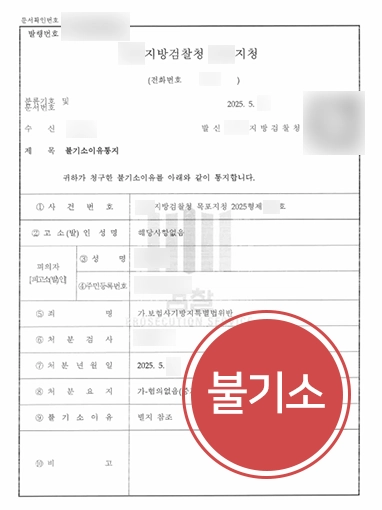
As a result of the specialized attorney's response to the client's charge of violating the Special Act on Prevention of Insurance Fraud, the client was able to conclude the case by receiving a non-prosecution decision from the prosecution.
Although the client had merely caused a traffic accident through simple negligence, the client was unfairly suspected of insurance fraud and faced a situation in which an actual custodial sentence could have been imposed.
However, because a response strategy had been prepared based on the specialized attorney's case-handling data, the case was concluded at the prosecution stage.
In the case of a charge of violating the Special Act on Prevention of Insurance Fraud, it is treated as a crime of poor character and severe punishment is being imposed.
Therefore, if the charge is not true, one should respond quickly by retaining a specialized attorney.
If you make a 🔗legal consultation reservation with this firm, we will work toward a favorable result through a strategy tailored to the client.
This content is based on actual case studies of Daeryun Law LLC with some adaptations, and the copyright belongs to our firm.
Unauthorized reproduction, duplication, or distribution and other copyright infringements may result in legal action under applicable laws.