
CONTENTS
- 1. The Client Who Requested Issuance of a B1/B2 Visa

- - Obtaining a U.S. Visa
- - U.S. B1/B2 Visa
- 2. Assistance for B1/B2 Visa Issuance
- - Pre-Application Assessment for the Visa
- - The Application Drafting Stage
- - Scheduling the Interview and Preparing for It
- - Document Preparation
- 3. Successful Issuance of the B1/B2 Visa

1. The Client Who Requested Issuance of a B1/B2 Visa
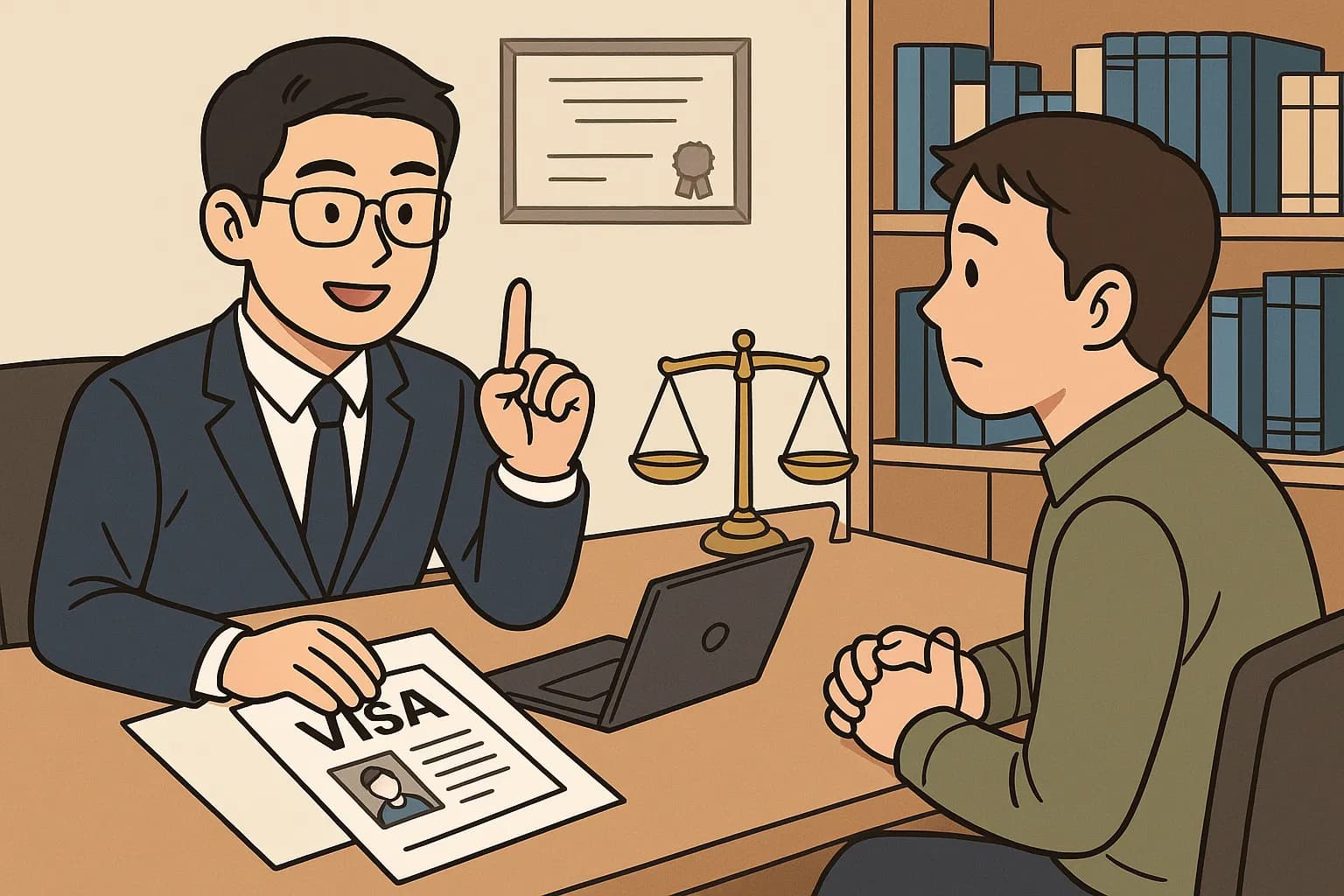
This is the story of a client who requested a B1/B2 visa issuance.
A self-employed Korean national in his forties, he was planning a short business trip at the invitation of a business partner in the United States.
The client needed a U.S. B1/B2 visa issuance for the purpose of business meetings.
In particular, the client intended to enter the United States alone, without accompanying family, and because he did not have substantial domestic real estate or financial assets, there was a high possibility that he could be mistaken for having immigrant intent.
Accordingly, the client requested the assistance of a specialized attorney in the course of the U.S. B1/B2 visa issuance.
 Obtaining a U.S. Visa
For a Korean national to enter the United States for tourism purposes, there are largely two methods.
These are visa-free entry through the Electronic System for Travel Authorization (ESTA) and visa entry through a B2 tourist visa.
The two systems have similar purposes of entry, but they differ greatly in their application procedures, period of stay, and conditions of use, so it is important to refer to the information below and choose the method that suits your situation.
1. U.S. Electronic System for Travel Authorization (ESTA)
ESTA (Electronic System for Travel Authorization) is a system under which, pursuant to the U.S. Visa Waiver Program (VWP), Korean nationals obtain advance approval to enter the United States without a visa.
▶Eligibility to Apply
-Nationals of VWP member countries, including the Republic of Korea
-Holders of an electronic passport
-Purposes such as tourism, transit, short-term business, attending an event, or short-term education
-A planned stay within 90 days
▶Main Features
-Permitted period of stay: up to 90 days (no extension)
-Method of application: online
-Interview: not required
-Processing time: approval within 1 to 2 days
-Multiple entry: possible (valid for 2 years or until the passport expires)
-Required documents: electronic passport, return airline ticket information, and others
-Applicable areas: the 50 states of the United States and U.S. territories including Puerto Rico, Guam, and Saipan
▶Points to Note
-The application must be submitted on the U.S. Department of Homeland Security ESTA website at least 72 hours before departure.
-Even if approved, entry is not guaranteed: upon entering the United States, entry is finally permitted after screening by U.S. Customs and Border Protection (CBP).
-When the passport is renewed, ESTA must also be reapplied for.
-ESTA cannot be used in the following cases:
Persons who, on or after March 1, 2011, visited North Korea, Iran, Iraq, Sudan, Syria, Yemen, or similar countries
Persons who visited Cuba on or after January 12, 2021
Nationals of the above countries
Persons with a history of past denial of entry to, or deportation from, the United States
Persons with a criminal record


U.S. B1/B2 Visa
When you apply for a visa at a U.S. embassy or consulate, a B1/B2 visa is generally issued.
This is a combined form of two types, divided according to the following purposes.
Visa type | Purpose | Marking on the arrival record at entry |
B-1 visa | Business purposes such as business trips and meetings | B1 |
B-2 visa | Travel purposes such as tourism and visiting relatives | B2 |
▶B-1 visa (business visa)
✅ In what cases is it needed?
-When visiting the United States for business purposes such as business trips, business meetings, or contract negotiations
-Preliminary research for establishing a branch office, attending exhibitions, participating in specific training or seminars, and similar activities
✅ Period of stay and characteristics
-Generally a stay of up to 3 months is possible
-If necessary, an application to extend the stay may be filed within the United States
-Work is possible to the extent that no remuneration (salary) is received in the United States
(for example, attending meetings, technical inspections, and the like)
▶B-2 visa (tourist visa)
✅ In what cases is it needed?
-Short-term stays in the United States for tourism, vacation, or visiting relatives
-Medical treatment, participation in short-term recreation programs, and similar purposes
✅ Period of stay and characteristics
-Usually a stay of up to 6 months is possible
-The actual period granted is determined at immigration screening
-If necessary, an application for an additional 6-month extension may be filed within the United States
▶If an extension of the tourist visa (B-2) is needed
After entering the United States, if an additional stay is needed before the 6-month period of stay ends, an extension application (EOS: Extension of Status) may be filed with the immigration authorities (USCIS).
However, the following requirements must be met:
-A specific reason for the extension
An application is not approved simply on the ground that one wishes to travel more.
For example, a clear itinerary with a defined purpose, schedule, and location, such as a building photography project, is needed.
-Proof of finances
It must be proven that economic self-sufficiency is possible during the stay in the United States.
→ A certificate of bank balance in the United States held in the applicant's own name must be submitted
-Securing a return ticket
A record of the return ticket reservation for after the stay in the United States ends must be submitted.
-Possibility of restrictions for frequent entry
If entry into the United States is repeated, markings such as NO COS (change of status not allowed) or NO EOS (extension not allowed) may appear on the arrival record (I-94), and in that case the extension application itself becomes impossible.
▶Points to note regarding the B2 visa
✅ Approach a change of status (Change of Status) with caution
To enter on a tourist visa and then change to another visa within the United States (for example, the F-1 student visa), an application may be filed only after at least 60 days have passed since entry.
If a change of status is applied for within 60 days, the original purpose of entry may be regarded as false, so it is preferable to apply for the change 90 days or more after entry.
✅ Children's education
Even if one enters with a child on a tourist visa, enrollment in a regular educational institution such as a public school is not allowed.
→ Participation in non-regular programs such as short-term English camps or summer camps is permitted
✅ Is language study possible?
Short-term language programs of fewer than 18 hours per week may be taken on a tourist visa.
However, enrollment in a regular language-study course (which requires an F-1 visa) is not allowed.
Category | B1 visa (business) | B2 visa (tourism) |
Purpose of entry | Business trips, meetings, research | Tourism, visiting relatives, medical treatment |
Period of stay | Usually 3 months (extendable) | Usually 6 months (extendable) |
Activity restrictions | Some unpaid work possible | Income-generating activity and education not allowed |
Validity period | Usually 10 years | Usually 10 years |
When accompanied by children | Education not allowed | Regular education not allowed |
-When you plan to stay in the United States for more than 90 days
-When you need to visit the United States frequently
-When you do not meet the ESTA eligibility requirements (for example, visitors from certain countries)
-When you have plans for a long-term stay (visiting family, medical treatment, and the like)
-When you have a history of a U.S. visa denial or entry denial
See More
2. Assistance for B1/B2 Visa Issuance
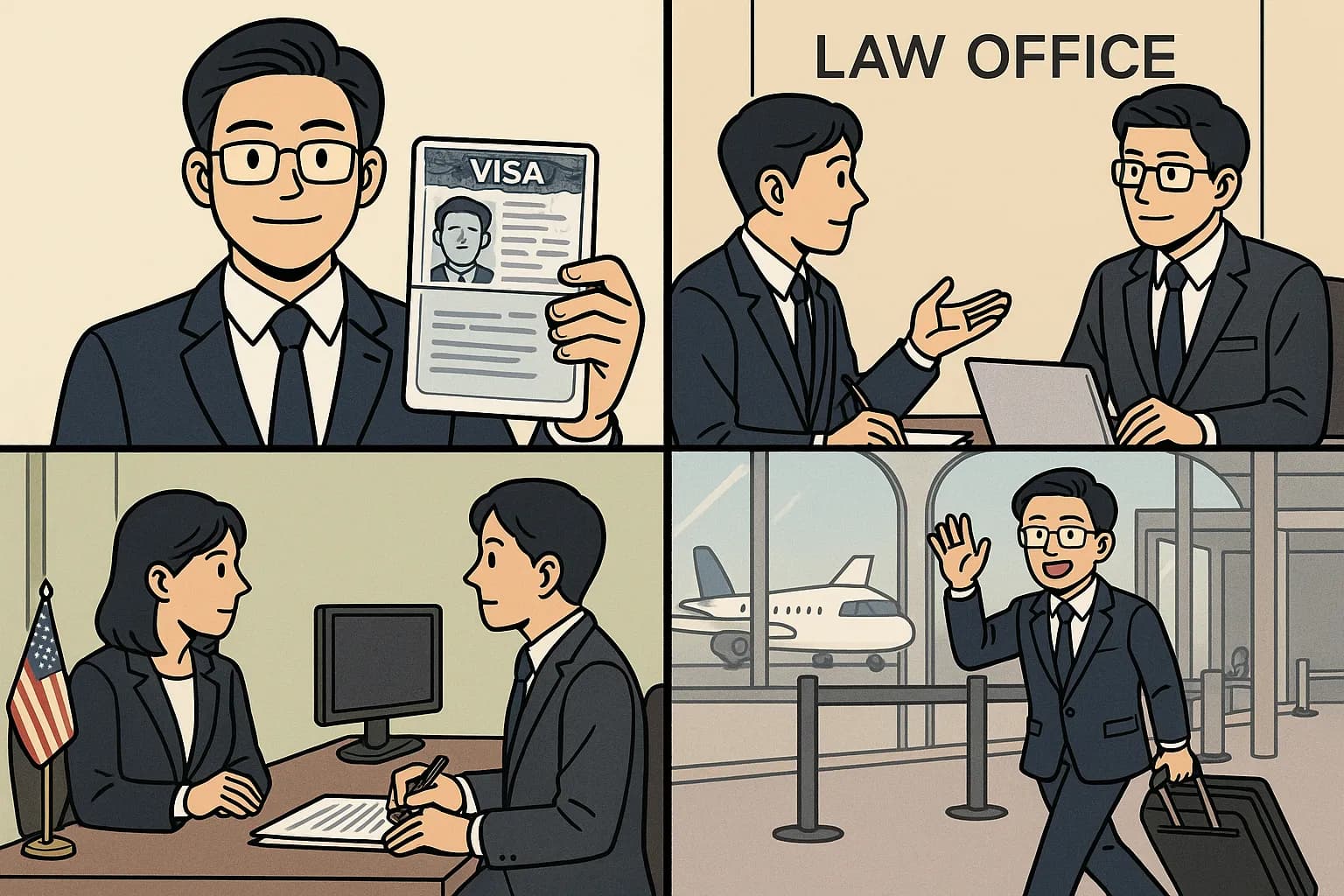
The firm proceeded to provide assistance for a B1/B2 visa issuance.
Pre-Application Assessment for the Visa
-Analyzing whether there are sufficient grounds for the client to choose a B1/B2 visa rather than ESTA
-Confirming the lawfulness of the purpose of visit, such as a business trip, attending an event, treatment, or visiting relatives, and reviewing the possibility of proving it
-Analyzing advance risks based on factors such as the past history of entry to the United States, prior denials, and whether particular countries were visited
-Deciding whether to apply for a B1 or B2 visa and, if necessary, recommending a combined-purpose (combined B1/B2) application
The Application Drafting Stage
-Analysis of risk factors for each entry item of the DS-160 form and support for strategic completion
-Prevention of inconsistencies between past U.S. visit history and the purpose of the application
-Guidance on the possibility of future entry-ban sanctions if false facts are entered by mistake
Scheduling the Interview and Preparing for It
- Establishing a strategy to adjust the interview schedule to suit the individual's circumstances and the purpose of the application
- Preparing a written statement of reasons for an expedited appointment request where there is an urgent schedule, such as an urgent business trip
- Coordinating in parallel with the planned schedule, taking into account the embassy waiting period due to public holidays and seasonal factors
- Conducting a mock interview based on the manner in which the U.S. embassy conducts interviews
- Preparing in advance for key questions such as the likelihood of returning home, the purpose of the visit, financial status, and current employment
- Coaching on how to avoid unfavorable statements and on the flow of answers so as not to become flustered in the actual interview
Document Preparation
- Documents proving employment: certificate of employment, business registration certificate, salary statement, tax return, etc.
- Documents proving the likelihood of returning home: family relationship certificate, real estate holdings, domestic financial status
- Additional documents by purpose of visit: invitation letter, business trip itinerary, event invitation, medical records, appointment confirmation, etc.
- Financial proof documents: bank balance certificate, copy of bankbook, etc. (proof of self-sufficiency for U.S. stay expenses)
3. Successful Issuance of the B1/B2 Visa
As a result of the assistance for the issuance of the B1/B2 visa, the client successfully obtained the visa.
At a time when screening for nonimmigrant visas is becoming increasingly strict, this case was a representative example showing how important thorough proof of the grounds for entry, a specific demonstration of the purpose of the visit, and an interview strategy are.
A U.S. B1/B2 visa is difficult to obtain simply by preparing the basic documents, and in practice the key is how persuasively the applicant can prove the likelihood of returning home.
Because a thorough strategy is needed from the visa screening stage, it is very important to receive the assistance of a specialist in order to avoid a denial caused by a minor mistake.
Daeryun LLC provides a one-stop response service through related legal specialists, including specialized attorneys well versed in U.S. law and immigration law.
This content is based on actual case studies of Daeryun Law LLC with some adaptations, and the copyright belongs to our firm.
Unauthorized reproduction, duplication, or distribution and other copyright infringements may result in legal action under applicable laws.