
CONTENTS
- 1. The Client Who Sought Help With a Construction Dispute

- - What Is a Construction Dispute?
- - What Is a Construction Payment Claim Lawsuit
- 2. Pursuing a Construction Payment Return Lawsuit to Resolve the Construction Dispute
- - Proving the Existence and Terms of the Contract
- - Proving That the Payment Was Made
- - The Absence of Performance of the Construction Work
- - Rescission of the Contract Due to Delay in Performance
- - Claim for Return of the Payment as Restitution
- 3. Construction Dispute Outcome: Full Recovery of 200 Million Won in Construction Payment

1. The Client Who Sought Help With a Construction Dispute
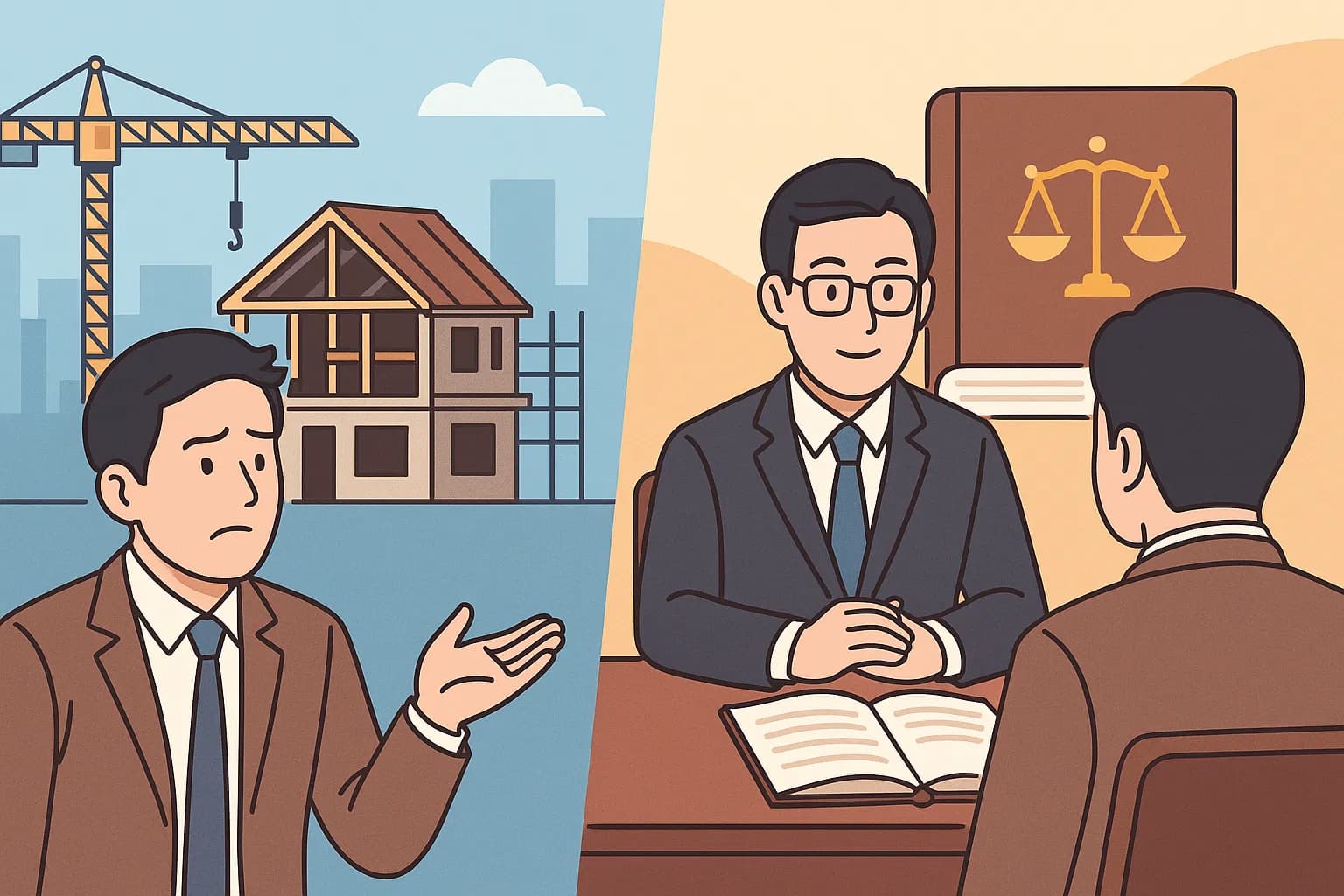
This is the story of a client who requested help with a construction dispute.
The client was the owner of a building undergoing remodeling and concluded a contract with the defendant for the remodeling and extension work on the building.
At the time the contract was concluded, oral and written agreements were mixed, and the client successively remitted to the defendant a down payment of 100 million won before the work began and another 100 million won at the defendant’s request for additional material costs, for a total of 200 million won.
However, even after the agreed start date had passed, the defendant did not proceed with the work at all and did not commence any substantive construction other than simple demolition work.
The defendant kept only delaying the construction period, and because a large sum of 200 million won had been put in, the client continued to grant extensions of the deadline.
Then, upon learning that the paid amount could be recovered through a lawsuit for the return of the construction payment, the client sought out a specialized attorney with experience in numerous construction dispute cases and requested help from Daeryun LLC.
Specialized attorneys with experience in numerous construction dispute, construction payment, and real estate cases formed a TF for the client and undertook the response.
 What Is a Construction Dispute?
A construction dispute refers to a legal dispute arising between parties in connection with the conclusion, performance, interpretation, modification, rescission, and the like of a construction-related contract.
It mainly arises between a contractor and an orderer, or between a prime contractor and a subcontractor, over issues such as construction payment, construction delay, defects, liquidated damages for delay, and design changes, and the principal issue is one party's nonperformance or incomplete performance of obligations related to performance of the contract.
▶Representative Types of Construction Disputes
In the construction field, the following types of disputes frequently arise.
-Disputes over nonpayment or underpayment of construction payment
-Claims for construction delay and liquidated damages for delay
-Claims for defect repair and damages
-Increase or decrease of payment due to design changes and contract changes
-Restitution issues related to rescission or termination of a contract
-Liability for damages due to illegal subcontracting
Among these, this case is one falling under a claim for return of construction payment due to rescission of the contract.


What Is a Construction Payment Claim Lawsuit
A lawsuit claiming construction payment is a type of litigation that frequently escalates from construction disputes.
Typically, it is a lawsuit in which a contractor claims payment of construction costs from the court when the contractor has not received payment from the ordering party after completing the work.
Construction payment, as performance under a contract for work under the Civil Act, must be returned in accordance with the principle of restitution when the contract has been lawfully rescinded.
Moreover, when rescission of the contract results from the obligor's delay in performance, an obligation to return the money received arises at the same time as the notice of rescission, and this is attributed not to unjust enrichment but to the right to claim restitution under the Civil Act.
① When one of the parties has rescinded a contract, each party has an obligation of restitution toward the other party.
Civil Act Article 543 (Right of Termination and Rescission)
① When one or both of the parties have the right of termination or rescission under a contract or by provision of law, such termination or rescission shall be effected by a manifestation of intention to the other party.
Lawsuits related to construction payment are generally divided as follows.
-Where the work has not been commenced or only partially performed
-Where the defects are serious enough to allow rescission of the contract
-Where payment for completed work has not been made
-A claim for the prime contractor's liability for subcontracted work
2. Pursuing a Construction Payment Return Lawsuit to Resolve the Construction Dispute

To resolve the construction dispute, a lawsuit for return of the construction payment was promptly filed.
Specialized attorneys with extensive experience in construction payment lawsuits structured the claim of the lawsuit on the basis of the following facts and legal principles.
Proving the Existence and Terms of the Contract
▶A copy of the building construction contract and the commencement date and completion date stated in the contract
▶Detailed substantiation of the oral agreement before the contract and the subsequent conclusion of a written contract
Proving That the Payment Was Made
▶Submission of the account transfer records and deposit records
▶Submission of the defendant's messages requesting additional payment for additional materials, and the deposit records
The Absence of Performance of the Construction Work
▶Submission of on-site photographs and text messages proving that no substantive construction work other than demolition was carried out at all
▶Attachment of conversation histories that can prove the content of the defendant’s verbal promise (delay of the construction timing)
Rescission of the Contract Due to Delay in Performance
▶Constituting legitimate grounds for rescission of the contract under Article 544 of the Civil Act
▶Emphasizing that the defendant failed to perform for several months after the construction start date
Claim for Return of the Payment as Restitution
▶Asserting the right to claim restitution to the original state on the basis of Article 548(1) of the Civil Act
3. Construction Dispute Outcome: Full Recovery of 200 Million Won in Construction Payment
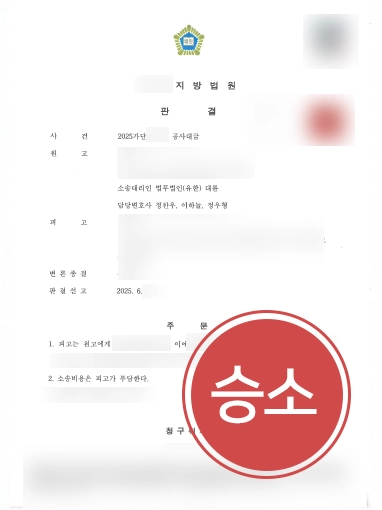
As a result of the construction dispute, the court rendered a judgment ordering that the client recover the full 200 million won in construction payment that the client had claimed.
A construction payment lawsuit may appear to be a simple matter of payment, but in reality it involves multilayered legal issues, including the existence of the contract and the lawfulness of its rescission, proof of the facts regarding performance, analysis of the nature of the payment (down payment, interim payment, advance payment, and so on), and the method of calculating delay interest.
In particular, where the contract is a mix of oral and written terms, proving the contents of the contract can be difficult, and the assessment of the progress of the construction also requires legal evaluation together with technical fact-finding.
To accurately organize such complex procedures and legal principles and present them persuasively to the court, the legal advisory and litigation strategy of a specialist attorney are crucial.
In this case as well, even though the client had sufficient evidence, Daeryun's assistance played a decisive role in precisely constructing the legal reasoning and presenting it in a structure favorable to the client in the litigation.
At Daeryun Law Firm, specialist attorneys who have handled numerous construction payment lawsuits provide one-stop legal response services, from grasping the facts to conducting the firm's own evidence collection through collaboration with the Evidence Investigation Center.
This content is based on actual case studies of Daeryun Law LLC with some adaptations, and the copyright belongs to our firm.
Unauthorized reproduction, duplication, or distribution and other copyright infringements may result in legal action under applicable laws.