
CONTENTS
- 1. Construction Payment Lawsuit | Definition and Limitation Period for Claims

- - Limitation Period for Claims
- 2. Construction Payment Lawsuit | Tips for Drafting the Complaint
- - Key Required Entries in the Complaint
- - Drafting the Purport of the Claim
- - Drafting the Cause of Action
- - Preparing Supporting Evidence
- - List of Attached Documents
- 3. Construction Payment Lawsuit | Litigation Procedure and Finality of Judgment
- - Filing and Service of the Complaint
- - Submission of the Answer and Briefs
- - Submission of Evidence and Examination of Evidence
- - Hearing Date for Oral Argument and Concentrated Evidence Examination Date
- - Pronouncement and Finality of Judgment
- - The Procedure at a Glance
- 4. Construction Payment Lawsuit | Method of Compulsory Execution
- - What Is Compulsory Execution
- - Summary of Required Documents
- 5. Construction Payment Lawsuit | Checklist
- - Contractor (Plaintiff) Response Checklist
- - Owner (Defendant) Defense Checklist
- - Construction Specialist Attorney Assistance System

1. Construction Payment Lawsuit | Definition and Limitation Period for Claims
A construction payment lawsuit is a civil lawsuit in which the contractor brings a claim to the court when the owner fails to pay the price due under a construction contract.
Here, the construction payment refers to the consideration that the contractor is to receive after the work has been completed in whole or in part, under the construction contract concluded between the owner and the contractor.
A construction payment claim lawsuit is not a simple civil claim dispute; because it requires proving the content of contract performance, the assessment of the degree of completion, and the conditions for payment, professional legal handling is required.
 Limitation Period for Claims
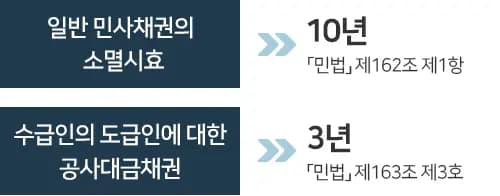
Under Article 163, Item 3 of the Civil Act, a construction payment claim is subject to a short three-year extinctive prescription.
That is, if the contractor does not make a legal claim within three years from the date the work was completed or the date the construction payment could be claimed, the right is extinguished.
Points to Note
To interrupt the prescription of the claim, measures such as sending a certified mail (content-certified mail), filing an application for a payment order, or filing a lawsuit are required


2. Construction Payment Lawsuit | Tips for Drafting the Complaint

To file a construction payment lawsuit, it is important to properly meet the form and content of the complaint.
In particular, clearly stating the purport of the claim and the cause of action, and thoroughly preparing the supporting evidence, are what increase the likelihood that the claim will be upheld.
Key Required Entries in the Complaint
Item | Description |
Identification of the Parties | Clearly state the names, business names, and addresses of the plaintiff and defendant |
Identification of the Representative | Include the name and address if there is a representative |
Contact Information | Telephone number, fax number, email, etc. |
Purport of the Claim | State concisely and clearly the amount claimed and whether interest is claimed |
Cause of Action | Draft based on supporting evidence such as the construction contract, completion of the work, and the fact of nonpayment |
Identification of Attached Documents | Specify the evidentiary documents attached and the items |
Date of Drafting | The date on which the complaint is drafted |
Name of the Court | Accurately state the court with jurisdiction |
Signature of the Drafter | Signature or seal required |
Drafting the Purport of the Claim
The purport of the claim is the core that contains the conclusion of the lawsuit, and it must clearly reveal what determination the plaintiff seeks from the court.
Example of the Purport of the Claim
In this manner, the amount, interest rate, and period must be drafted specifically.
Furthermore, even if the judge determines that there is an obligation to pay KRW 50 million, if the plaintiff seeks payment of KRW 10 million in the purport of the claim, the judgment will order payment of KRW 10 million.
Therefore, the purport of the claim must be stated accurately.
Drafting the Cause of Action
The cause of action is the part that explains in detail the legal grounds and the factual circumstances on which the plaintiff bases the claim.
It must be drafted clearly in accordance with the Five Ws and One H (when, where, who, what, how, why).
Example of the Cause of Action
2. The total construction payment was set at KRW X0,000,000, and the defendant agreed to pay the amount by XX XX, 20XX.
3. However, the defendant has not paid the above amount to this day, and the plaintiff therefore brings this lawsuit.
Preparing Supporting Evidence
In a construction payment claim lawsuit, the documents capable of proving the actual performance of the work and the fact of nonpayment are the core.
Key Supporting Materials
∙ Estimate and statement of material purchases
∙ Construction design drawings and specifications
∙ Statement of work progress and statement of the degree of completion
∙ Certificate of completion of the work and certificate of delivery of the building
∙ Appraisal report (an appraisal may be requested if necessary)
The above materials are organized and submitted in the form of Plaintiff's Exhibit No. 1, Plaintiff's Exhibit No. 2, and so on, and when copies are submitted, a statement that they are identical to the originals must be entered.
List of Attached Documents
The documents that must be submitted together with the complaint are as follows.
∙ Power of attorney for litigation and application for permission to act as litigation representative
∙ Receipt for payment of stamp duty and service fees (may be omitted in the case of electronic submission)
∙ Duplicate of the complaint (at least one copy in the case of paper submission)
Since the complaint may be returned if attached documents are missing, it must be carefully checked in advance.
3. Construction Payment Lawsuit | Litigation Procedure and Finality of Judgment

A construction payment lawsuit begins with the filing of the complaint and goes through numerous legal procedures until the judgment becomes final.
The following are the representative stages experienced in the actual litigation process.
Filing and Service of the Complaint
A lawsuit begins with the filing of the complaint.
After examining the submitted complaint, the court, if there are no defects, serves a ‘duplicate of the complaint’ on the defendant.
If the defendant does not respond even after receiving the complaint, the likelihood of a judgment for the plaintiff increases through a ‘judgment without oral argument.’
Submission of the Answer and Briefs
The defendant must submit an answer ordinarily within 30 days from the date of service of the complaint.
In addition, both parties may submit briefs to the court before trial to organize their arguments and evidence.
Document Name | Description |
Answer | The defendant rebuts or partially admits the plaintiff's arguments |
Brief | A summary organizing the evidence and arguments |
List of Evidence | A table organizing the supporting evidence to be submitted |
Submission of Evidence and Examination of Evidence
In civil litigation, the burden of assertion and proof lies with the parties, so proof is very important.
There are various types of evidence, including documentary evidence, witnesses, appraisal, inspection, inquiry into facts, and transcripts.
Type of Evidence | Content and Characteristics |
Documentary Evidence | Documentary materials such as contracts, tax invoices, and transaction statements |
Witness Examination | Having third parties such as construction-related persons or cooperating companies appear in court to give testimony |
Inquiry into Facts | Requesting materials from third parties such as government offices and companies in the name of the court |
Order to Submit Documents | Requesting that documents held by the other party be compulsorily submitted to the court |
Hearing Date for Oral Argument and Concentrated Evidence Examination Date
A trial is generally conducted through hearing dates for oral argument.
At the first hearing date for oral argument, the parties appear, organize the issues, and state their positions.
Where the issues are complex or there is much dispute, the court organizes the case through ‘preparatory proceedings’ and then conducts witness examination, examination of the parties, and the like intensively on a ‘concentrated evidence examination date.’
Points to Note
=> Failure to appear may lead to a judgment without oral argument or a judgment of loss
∙ Where a change of the date is necessary
=> An application to change the date must be submitted in advance, together with materials substantiating the grounds
Pronouncement and Finality of Judgment
Once the examination of evidence and oral argument are concluded, the court finally sets the date for pronouncement of judgment and discloses the result.
If no appeal is filed within two weeks after the judgment is pronounced, the judgment becomes final and acquires legal binding force.
Measures Available After the Judgment Becomes Final
▷ Recovery through provisional attachment of real estate, attachment of claims, attachment of wages, etc.
The Procedure at a Glance
Name of Procedure | Summary of Key Content |
Filing and Service of the Complaint | The plaintiff submits the complaint to the court → The complaint is served on the defendant |
Submission of the Answer and Briefs | The defendant submits an answer to the complaint → Both sides organize their arguments in writing |
Submission of Evidence and Examination of Evidence | Supporting evidence is submitted through documents, witnesses, etc. → The court admits the evidence |
Hearing Date for Oral Argument and Concentrated Evidence Examination | Full trial proceedings are conducted based on both sides' arguments and evidence |
Pronouncement and Finality of Judgment | The judge pronounces the judgment → If there is no appeal, it becomes final after two weeks |
Compulsory Execution (if necessary) | If the other party fails to pay, the claim recovery procedure is conducted based on the written judgment |
4. Construction Payment Lawsuit | Method of Compulsory Execution

Even if the plaintiff prevails in a construction payment lawsuit, if the other party does not voluntarily pay the money, the creditor must recover the price through a legal compulsory execution procedure based on the written judgment.
What Is Compulsory Execution
Compulsory execution is a procedure in which, based on a title of execution such as a final court judgment or a payment order, the debtor's property is compulsorily disposed of through state authority so that the creditor recovers the money.
Summary of Required Documents
Name of Document | Description |
Authenticated Copy of the Title of Execution | Written judgment, protocol, notarial deed, etc. |
Execution Clause | A certification that the court grants stating that execution is possible; an application is required |
Certificate of Service | Proves that the written judgment was delivered to the other party |
Certificate of Finality | A document proving that the judgment has become final |
Resident Registration Number / Business Registration Number, etc. | Information identifying the parties to the execution is required (in the case of a corporation, the register / business registration certificate, etc.) |
If the written judgment includes a declaration of provisional execution stating that provisional execution is possible, a certificate of finality need not be obtained.
5. Construction Payment Lawsuit | Checklist

In a construction payment lawsuit, the outcome may turn on the contractual relationship, the performance of the work, and whether evidence has been secured.
It is very important to check in advance the matters appropriate to one's own position before and after the lawsuit.
Contractor (Plaintiff) Response Checklist
▷ Have you organized the statement of work up to the point of completion or mid-term termination of the work?
▷ Do you have evidentiary materials such as photographs, text messages, and messenger conversations regarding the progress of the work?
▷ Is there a history of payment demands (requests for account transfer, certified mail, etc.)?
▷ Are the conditions for payment by degree of completion under the contract and the basis for calculating the amount clear?
▷ Have you reviewed whether the other party's (the owner's) grounds for nonpayment of the balance are reasonable?
▷ Have you ascertained the other party's address and property status? (in preparation for compulsory execution)
▷ Have you secured supporting documents that can be submitted to the court, such as settlement statements and tax invoices?
▷ Have you conducted your own check for defects in preparation for potential disputes over defects?
Owner (Defendant) Defense Checklist
▷ Are there breaches of contract by the contractor (delay, defective construction, etc.)?
▷ Is there evidence of discrepancies between the work actually performed and the estimate or the contract content?
▷ Have you secured a history of requests for defect repair (text messages, email, messenger, etc.)?
▷ Is there a reason the work was halted before or during completion of construction?
▷ Are you preparing or have you secured a request for a defect appraisal or an appraiser's diagnosis report?
▷ Have you organized the amounts paid to the contractor and the details of progress payments, advance payments, and the balance?
▷ Have you secured on-site photographs, communication records, and statements that can be submitted to the court?
▷ If any payment has already been made, is there a receipt or account transfer record for it?
Construction Specialist Attorney Assistance System
This law firm includes a substantial number of construction specialist attorneys registered with the Korean Bar Association and specialist attorneys with an average of more than 10 years of experience.
Accordingly, comprehensive legal support is available, from determining whether the work has been completed, calculating progress payments, and assessing breach of contract and the existence of defects, to sending certified mail, filing a construction payment claim lawsuit, and carrying out compulsory execution.
If handling all of the procedures alone is difficult, we encourage you to proceed more accurately and promptly with the assistance of a construction specialist attorney.


Watch related video content
for this case study.

What are the solutions and response strategies for compensation for construction defects?