
CONTENTS
- 1. Forgery of Private Documents | The Client Who Sought Help

- - What Is Forgery of Private Documents?
- 2. Forgery of Private Documents | Developing a Defense Strategy to Counter the Charges
- - Rebuttal 1. The Document Was Not Handwritten
- - Rebuttal 2. Regarding the Registered Seal
- - Rebuttal 3. Regarding the Failure to Notarize
- - Rebuttal 4. Regarding the Non-Existence of the Claim
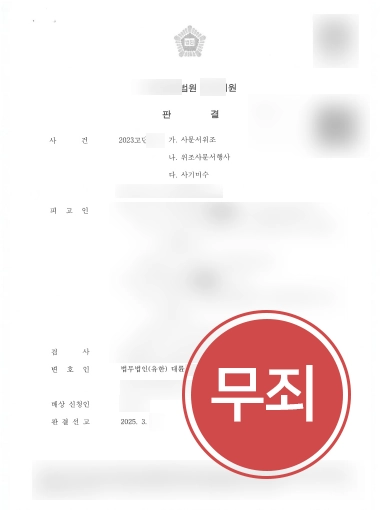
- 3. Forgery of Private Documents | The Charged Client, Acquittal
- - If You Are Involved in Forgery of Private Documents Charges

1. Forgery of Private Documents | The Client Who Sought Help

This is the story of a client who requested help on suspicion of forgery of private documents, uttering of forged private documents, and attempted fraud.
The client, who had had monetary dealings with an acquaintance over a long period, filed a civil suit concerning a monetary claim against the heirs after the acquaintance’s death.
However, the heirs denied the very existence of the claim and instead filed a criminal complaint against the client.
The heirs asserted that the client had misappropriated the deceased’s identity to arbitrarily prepare 2 loan certificates and 1 written promise to pay interest, that he had uttered them by submitting them to the court, and that through these documents he had attempted to obtain money improperly.
Accordingly, the client was criminally charged with forgery of private documents, uttering of forged private documents, and attempted fraud.
 What Is Forgery of Private Documents?
The crime of forgery of private documents means that a person without authority prepares a private document or, without the permission of the owner of the private document, arbitrarily manipulates the contents of the private document.
Simply put, it means preparing a document while pretending to be another person.
For the crime of forgery of private documents to be established, the following requirements must be met.
▶Use of another person's name
-Another person's name, signature, seal, or similar identifier must be used without authorization.
-The document must be made to appear as though that person prepared it, even though the person did not actually prepare it.
▶Preparation of a document
-It must be a document with legal effect.
-Examples: a loan certificate, a contract, a receipt, and similar documents
▶Purpose of uttering
-There must be an intent to actually use the forged document.
-Acts such as submitting it to a court or showing it to the other party fall under this.
The Supreme Court held that entering a false name and occupation on a roll for a politician's support signature campaign does not constitute the crime of forgery of private documents.
The reason was that a support signature roll is merely a means of political expression and is difficult to regard as a document affecting changes in rights or duties or legal relations.
Accordingly, the first-instance conviction was overturned, and an acquittal was ultimately confirmed.
Issues:
-The scope of a "document" that can be the object of the crime of forgery of private documents
-Where a document is not related to legal rights or duties or to facts important in transactions, forging it involves no illegality
-A political support signature is no more than an expression of opinion and cannot be regarded as a document protected under the Criminal Act



Watch related video content
for this case study.

2. Forgery of Private Documents | Developing a Defense Strategy to Counter the Charges
We set about establishing a defense strategy for the client implicated in charges such as forgery of private documents.
▶Summary of the complainant’s assertions
-The bodies of the documents were not written in the deceased’s own handwriting
-The seals were not made with the deceased’s registered seal
-These documents were not notarized
-No financial claim existed between the deceased and the client
Rebuttal 1. The Document Was Not Handwritten
The complainant claims that, because the documents were not written in the deceased's own handwriting, the deceased did not prepare them and that the client forged the documents.
However, the reality today is that most private documents are prepared with a word processor rather than by hand.
In addition, the Civil Procedure Act provides that ‘a private document is presumed to be authentic when it bears the signature, seal, or thumbprint of the principal or an agent’.
The attorney in charge therefore emphasized that the fact that the documents the complainant claims were forged were not written in the deceased's own handwriting cannot be deemed unlawful, and that this circumstance alone cannot lead to a finding that the documents were forged.
Rebuttal 2. Regarding the Registered Seal
A registered seal stamp is not a means of identity verification that is necessarily used, except when carrying out important legal acts such as a real estate sale.
Today, many private documents are prepared through a signature rather than a seal, and even if a stamp other than a registered seal stamp is affixed, as long as that stamp belongs to the person named as the author, it has no effect whatsoever on the validity of the document.
The attorney in charge argued that the complainant's assertion that the conduct constituted forgery of a private document because a registered seal stamp was not used was without merit.
Rebuttal 3. Regarding the Failure to Notarize
Where a private document has been authentically prepared, it is already, in itself, a means capable of validly proving rights and obligations.
In other words, notarization is not a mandatory step.
The attorney in charge emphasized that notarization entails additional inconvenience, and that the failure to go through such a procedure cannot serve as a ground for finding that the document was forged.
Rebuttal 4. Regarding the Non-Existence of the Claim
The complainant claims that there were no transfer records in the bankbook transactions between the client and the deceased, and on this basis asserts that there was no claim between the two.
However, the client lent money by handing cash to the deceased.
In addition, the deceased was of advanced age and was not familiar with electronic financial transactions or deposit and withdrawal transactions using cards.
The attorney in charge submitted as evidence a ledger recording the cash the client had lent to the deceased, as well as records showing that the client had visited the hospital where the deceased was admitted before passing away on several occasions to urge repayment of the debt.
3. Forgery of Private Documents | The Charged Client, Acquittal
As a result of assisting the client charged with offenses such as forgery of private documents, the client was able to obtain a judgment of acquittal on each charge.
▶ Although the complainant claimed there was no debt, records were found showing that the complainant had introduced himself as a creditor at the hospital where the deceased was admitted and had applied for visits on several occasions
The court, confirming these points, judged that the possibility that the client held a claim against the deceased could not be entirely ruled out, and pronounced an acquittal on each alleged charge.
If You Are Involved in Forgery of Private Documents Charges
If you have been implicated in a charge such as the crime of forgery of private documents, your statement in the early stage of the investigation can determine the direction of the entire case, so it is important to respond carefully from the early stage of the case.
In addition, where proof of matters such as a claim relationship is required, as in the above case, you must secure objective materials such as related documents and recordings and systematically organize materials to have your legal rights recognized.
Daeryun Law Firm responds in a one-stop manner from evidence collection to the establishment of a response strategy, with attorneys who have handled numerous cases related to the crime of forgery of private documents collaborating with experts from the firm's Digital Forensics Center and Evidence Investigation Center.
If you are in a situation requiring an investigation or response on charges of forgery of private documents, we hope you will confirm the issues of the case and the response strategy through a 🔗criminal attorney legal consultation reservation.
Korea's 9th-largest law firm, Daeryun (based on 2025 National Tax Service value-added tax filings), provides tailored legal services.
This content is based on actual case studies of Daeryun Law LLC with some adaptations, and the copyright belongs to our firm.
Unauthorized reproduction, duplication, or distribution and other copyright infringements may result in legal action under applicable laws.