
CONTENTS
- 1. The Client Who Sought Help with a Wage Arrears Report

- - How to Resolve Wage Arrears
- - Q&A on Wage Arrears
- 2. Daeryun's Assistance Throughout the Wage Arrears Report
- - Wage Arrears Attorney Argues Proof of Employee Status
- - Wage Arrears Attorney Argues the Obligation to Repay the Loan
- 3. Result of the Wage Arrears Report: Full Award of the Claimed Amount
- - Wage Arrears: Why an Attorney's Help May Be Needed

1. The Client Who Sought Help with a Wage Arrears Report
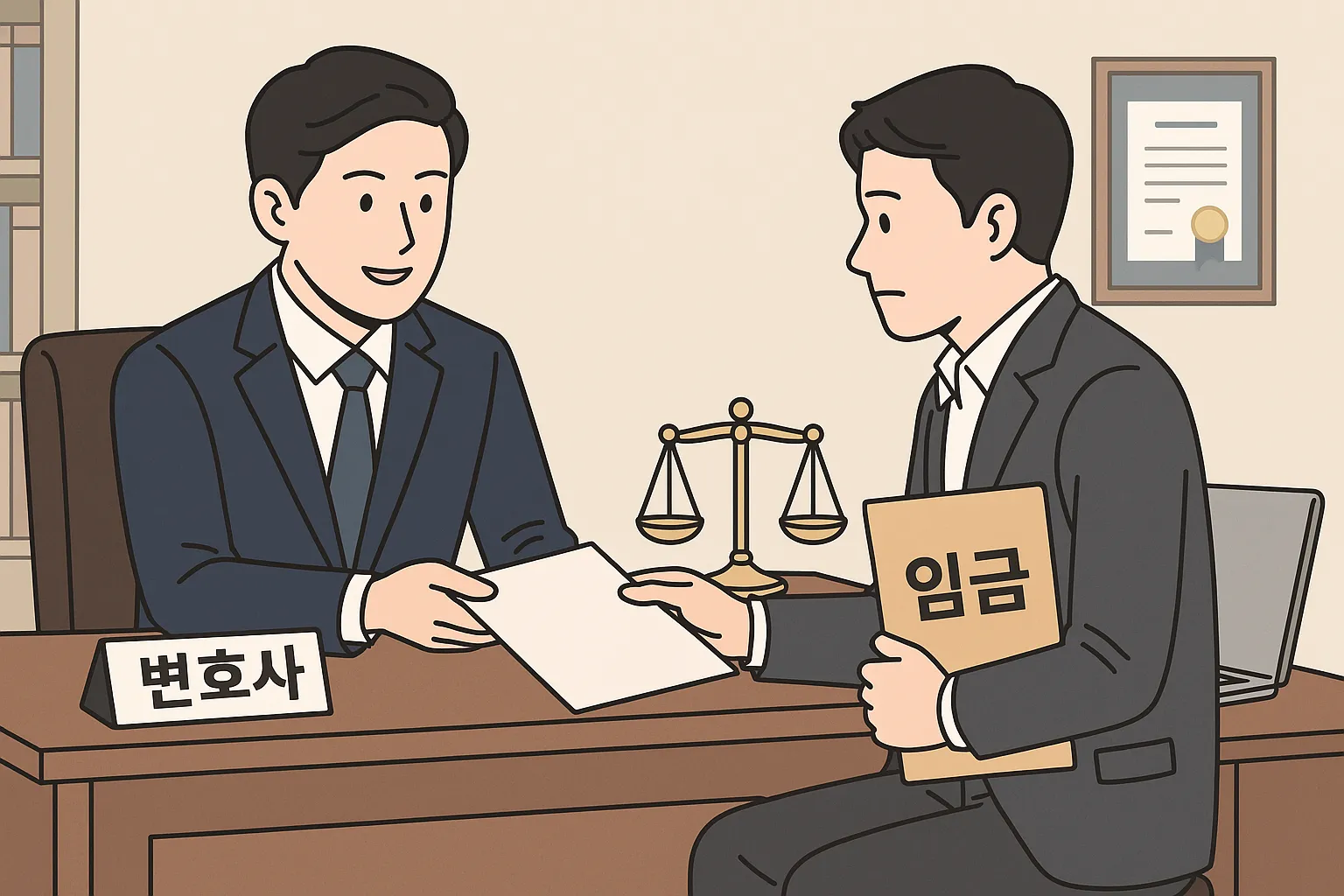
This is the account of a client who requested assistance with a report of unpaid wages.
The client worked in an executive position at a real estate development company and had been in charge of the company's core duties, such as personnel, finance, and legal affairs.
However, citing financial difficulties from 2023, the company did not pay the client several months' worth of wages, and ultimately, even after the date of retirement, no settlement of wages or retirement pay was made at all, and the state of nonpayment continued.
In addition, the client had also lent personal funds to the company several times in order to help with its operations, but the company did not return them.
The client ultimately proceeded with the legal procedure for a report of unpaid wages in order to claim the return of the unpaid wages, retirement pay, and the loan.
 How to Resolve Wage Arrears
If you are not being properly paid your wages, the following explains the methods available to resolve the matter.
▶Petition or complaint to the labor office
-Petition: a procedure in which an employee who has not been paid wages requests the regional employment and labor office to ‘pay the unpaid wages.’
-Complaint: a method of requesting the criminal punishment of the employer for a violation of the Labor Standards Act.
It may be filed online (through the Ministry of Employment and Labor's civil affairs portal) or by visiting the labor office having jurisdiction over the workplace, and it is ordinarily investigated and processed within 25 days.
▶Civil procedures (provisional attachment or lawsuit)
-Provisional attachment: a system for freezing the employer's property in advance.
-Small claims trial: where the unpaid wages are 30 million won or less, this may be conducted in a simple manner.
-Civil action: through a formal lawsuit, a judgment may be obtained and the wages recovered through compulsory execution (such as attachment and collection of property)
▶Compulsory execution
-On the basis of a final judgment or a notarial deed, the employer's property may be attached and auctioned through the court to recover the unpaid wages.
▶Support from the Korea Legal Aid Corporation
-An employee with an average monthly wage of less than 4 million won may receive legal consultation and litigation support at no cost.
-Applications may be made by visiting the nearest branch of the Legal Aid Corporation or through its website.
▶Disclosure of the list of employers who default on wages
The Ministry of Employment and Labor discloses the list of employers who repeatedly default on wages or default in large amounts.
This can be checked on the Ministry of Employment and Labor website (Information Disclosure → Disclosure of the List of Wage-Defaulting Employers), making it possible to inquire, before taking a job, whether the company in question has a history of unpaid wages.
Q&A on Wage Arrears
Q. If I report unpaid wages, can I receive the money right away?
A. Filing a report does not mean the money will come in immediately.
However, because the risk of criminal punishment arises for the employer, payment is often made by way of settlement.
If payment is ultimately not made, the wages may be recovered through compulsory execution by means of a civil lawsuit, or a certain amount may be secured by applying for
the Ministry of Employment and Labor's simplified substitute payment and similar programs.
Q. Can I file a report even if the amount of unpaid wages is not large?
A. A report may be filed regardless of the amount.
If the amount is 30 million won or less, a lawsuit may be brought more simply through the small claims procedure.
Whether the amount is large or small, unpaid wages constitute a crime in violation of the Labor Standards Act, so a report may be filed.
Q. Can I receive unpaid wages even if the company has gone bankrupt?
A. The substitute payment system may be used.
The substitute payment system is one under which the Minister of Employment and Labor pays unpaid wages and similar amounts on behalf of the employer.
A retired worker who has not received wages or severance pay due to the company's insolvency and who meets the following requirements may apply.
① Qualifies as a worker under the Labor Standards Act
② Retired from the relevant workplace within three years after the date one year before the reference date of retirement
③ Applies within two years from the date of a declaration of bankruptcy, a decision to commence rehabilitation, or a finding of facts equivalent to insolvency
Q. If I report unpaid wages, will I not suffer a disadvantage?
A. It is unlawful for an employer to dismiss a worker or impose a disadvantage on the ground of the report.
If a disadvantageous measure has been taken, a separate application for remedy against unfair dismissal or an unfair labor practice may be filed.
Q. What should I do if the business owner conceals assets?
A. In this case, it is necessary to freeze the assets in advance through a provisional attachment procedure.
If a provisional attachment is in place, actual execution (attachment or auction) becomes possible upon prevailing in the lawsuit.
Accordingly, in unpaid wage cases a combined strategy of lawsuit and provisional attachment is often used.


2. Daeryun's Assistance Throughout the Wage Arrears Report

Let us examine the assistance provided by Daeryun in the course of reporting unpaid wages.
At Daeryun, attorneys who have handled many cases related to unpaid wages took the lead and drafted the complaint on the basis of a thorough examination of the facts.
Wage Arrears Attorney Argues Proof of Employee Status
The client had been in charge of duties such as personnel, finance, and legal affairs at the defendant company.
The defendant company did not pay a total of 24 months' worth of wages at all, citing reasons such as the economic downturn.
Nevertheless, it processed withholding tax and insurance premium reports on paper as if it had paid wages to the client.
The defendant company prepared a letter of undertaking containing all of these matters and stating that it would settle all wages and severance pay by a certain period, but to date it has not performed at all.
Pursuant to Article 36 of the Labor Standards Act and Article 9 of the Employee Retirement Benefit Security Act, an employer must complete the payment of wages and severance pay within 14 days from the date on which the grounds for payment arise when a worker retires.
The attorney in charge emphasized that the defendant had an obligation to pay wages and severance pay and had violated it, and pursued remedies through legal measures, including a report of unpaid wages.
Wage Arrears Attorney Argues the Obligation to Repay the Loan
The client lent the company approximately 5 million won on a total of 10 occasions at the company's request.
This money was used for operating expenses such as the company's tax bookkeeping fees, four major insurance premiums, and legal costs.
The client continued to demand the return of the loan, and in response the company prepared a confirmation and promised to “pay the loan within 30 days of the client's date of retirement.”
However, even though well over 30 days had passed after the client left the company, the company did not pay at all, and accordingly a claim for the loan was pursued alongside a report of unpaid wages.
The attorney in charge emphasized that delay interest of 5% per annum under the Civil Act must be paid from the day following the due date until the copy of the complaint is served, and delay interest of 12% per annum under the Act on Special Cases concerning Expedition of Legal Proceedings must be paid from the following day until the date of actual payment.
3. Result of the Wage Arrears Report: Full Award of the Claimed Amount
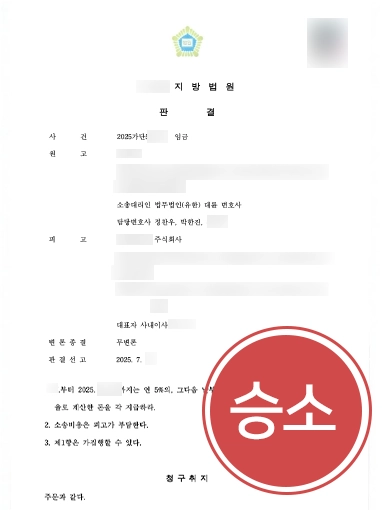
As a result of the report of unpaid wages, the court accepted all of the client's claims and rendered a judgment ordering payment of the full amount of the unpaid wages and severance pay, the full principal of the loan, and the statutory delay interest thereon as well as the litigation costs.
Wage Arrears: Why an Attorney's Help May Be Needed
In order to recover unpaid wages, one must prove worker status to the court, and along with reporting the wage default, it is necessary to secure evidence of it.
In addition, because one must also consider provisional attachment and compulsory execution procedures in case the employer conceals assets, it is important to obtain the assistance of an attorney from the stage of reporting the wage default.
Daeryun LLC, Korea's 9th-largest law firm (based on 2025 value-added tax filings with the National Tax Service), with attorneys who have handled numerous wage-default cases, provides the following legal services.
-Representation in wage-default petitions and complaints : a pressure strategy through petitions to the labor office and criminal complaints
-Conduct of civil litigation : representation throughout the entire process of litigation claiming wages, severance pay, and loaned money
-Provisional attachment and compulsory execution : securing the employer's assets to connect through to actual payment
-Support for substitute payment applications : utilizing the state compensation system where the company has gone insolvent
-Tailored consultation : a dedicated attorney providing close support from the early stage of the case, through evidence gathering, to strategy development
This content is based on actual case studies of Daeryun Law LLC with some adaptations, and the copyright belongs to our firm.
Unauthorized reproduction, duplication, or distribution and other copyright infringements may result in legal action under applicable laws.