
CONTENTS
- 1. The Client Charged with Occupational Embezzlement

- - How the Embezzlement Case Arose
- 2. Legal Information About Occupational Embezzlement
- - A Look at Occupational Breach of Trust
- - Sentencing Levels for Occupational Embezzlement and Breach of Trust
- 3. Assistance Provided in Defending Against Occupational Embezzlement
- - Defense Against the Occupational Embezzlement Charge
- - Active Explanation of the Breach of Trust Charge
- - Emphasizing the Legal Principles Governing the Elements of Breach of Trust
- 4. Successful Defense Against Occupational Embezzlement: Non-Referral
- - If You Need to Respond to an Investigation

1. The Client Charged with Occupational Embezzlement
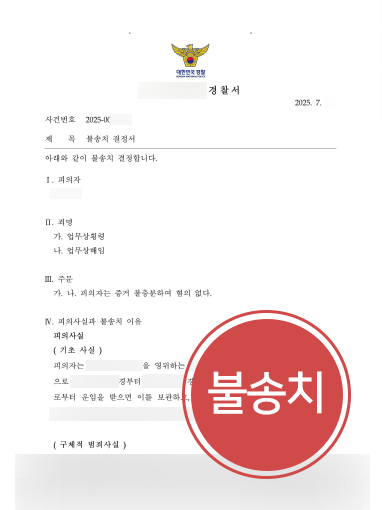
This is a case in which a client who became the subject of a criminal complaint for occupational embezzlement, through a criminal law attorney's legal assistance and the presentation of specific evidence, received a decision of non-referral and was able to avoid punishment.
 How the Embezzlement Case Arose
The client, who came to face a charge of occupational embezzlement, had served as a deputy manager in the sales department, handling the settlement of transportation payments with business partners and reporting to the head office, and recently resigned.
Shortly after the resignation, however, the company filed a criminal complaint on the ground that a portion of the past cash settlements had not been deposited with the head office.
Moreover, a charge of occupational breach of trust was also applied, placing the client at risk of criminal punishment.
The client emphasized that at the time there had been a practice of not delivering the settlement payments to the head office directly, but instead handing them to another sales employee who was traveling to the head office. The company denied this, however, and attributed all responsibility to the client.
The client therefore requested the assistance of a criminal law attorney in order to respond immediately.



2. Legal Information About Occupational Embezzlement
Occupational embezzlement is an offense in which a person who holds another's property in the course of duty, in breach of the duties of that position, unlawfully acquires or uses that property as if it were their own.
Elements of occupational embezzlement
② That the person refused to return the property held or committed an act of disposing of the property
③ That there was an intent of unlawful acquisition, that is, an intent to treat another's property as one's own and to dispose of it without authority
A Look at Occupational Breach of Trust
In addition, where one obtains an unlawful benefit in breach of one's duty, or causes a third party to obtain a benefit and thereby inflicts a loss, occupational breach of trust may also apply.
Elements of occupational breach of trust
② The existence of an act in breach of that duty
③ The occurrence of financial loss as a result of that act
④ The intent for oneself or a third party to obtain a benefit (intent of unlawful acquisition)
Sentencing Levels for Occupational Embezzlement and Breach of Trust
In summary, occupational embezzlement is established where a person who keeps another's property in the course of business embezzles that property or refuses to return it.
By contrast, occupational breach of trust is established where a person who handles another's affairs in the course of business, by an act in breach of that duty, acquires a pecuniary benefit or causes a third party to acquire it, thereby causing loss to the principal.
If charges of occupational embezzlement and occupational breach of trust are found to be established, the following punishment is imposed.
Statutory provision | Level of punishment |
Articles 355 and 356 of the Criminal Act | Imprisonment for not more than 10 years or a fine of not more than 30 million won |
3. Assistance Provided in Defending Against Occupational Embezzlement

The client, who had been accused of occupational embezzlement, consistently stated in the police investigation that there had been no fact whatsoever of using company funds for personal purposes or of intentionally causing loss to the company.
To support this, the criminal law attorney developed the following defense logic.
Defense Against the Occupational Embezzlement Charge
Lacking the time to deliver the payment directly to the head office, the client had used a method of delivering the settlement funds to the head office's operations division through a sales representative traveling on business.
This was a practice, and in most cases it was processed normally.
⇒ A structure in which embezzlement could not occur
▷ The complainant's claim that only part was embezzled also lacks persuasiveness under the rules of experience
⇒ The complainant also held weekly meetings on outstanding receivables, so if embezzlement had actually occurred it could have been confirmed immediately
The criminal law attorney accordingly emphasized that there was no direct evidence that the client had used the settlement funds personally, and that no intent to obtain an unlawful benefit was recognized either.
Active Explanation of the Breach of Trust Charge
The complainant argued that the client had omitted an essential verification procedure in the course of a transaction, causing financial loss to the company.
In reality, however, it emerged that the client had properly carried out the procedures for receiving the transaction payment and reporting in the course of handling the work, and that at the time no particular issue had been raised within the company.
▷ There was no direct and concrete causal relationship with the occurrence of the loss.
▷ There was no ‘intent to gain unlawful benefit,’ a requirement of the crime of breach of trust.
Accordingly, there were no circumstances at all indicating that the client had obtained personal benefit or had intentionally sought to cause loss to the company, and the attorney emphasized that the ‘intent to gain unlawful benefit,’ a key requirement of the breach of trust charge, was likewise not recognized.
Emphasizing the Legal Principles Governing the Elements of Breach of Trust
In this case, the client merely performed the work in accordance with ordinary procedures and practice, did not foresee or recognize that loss would arise to the company, and had no intent whatsoever to seek a benefit.
The criminal law attorney accordingly emphasized, on the basis of precedent, that for breach of trust to be established a mere occupational error or the occurrence of loss is not sufficient, and that there must be recognition that pecuniary loss will arise to the principal.
Supreme Court Decision 88Do542, decided May 24, 1988
Accordingly, the attorney logically argued that the elements of breach of trust, namely recognition of the breach of duty, recognition of the occurrence of loss, and intent to obtain an unlawful benefit, were not satisfied.
4. Successful Defense Against Occupational Embezzlement: Non-Referral

The investigative agency, which accepted the criminal law attorney's defense argument that occupational embezzlement and occupational breach of trust were not established, comprehensively considered the following points and rendered a non-referral decision.
▷ That the intent to obtain unlawful gain, which is a requirement for breach of trust, was not recognized
As a result, with the assistance of the criminal law attorney, the client was able to clear their name and conclude the case without any punishment.
If You Need to Respond to an Investigation
A charge of occupational embezzlement or breach of trust can be correctly assessed in law only by comprehensively considering various circumstances, such as the background of the transaction, the company's internal reporting and settlement procedures, and whether the practice was customary.
Daeryun LLC operates a system of assigning a responsible attorney who designs a strategy tailored to each field.
In addition, the firm supports the review of materials required given the nature of the case, such as accounting and financial analysis, and provides a systematic response so that a charge is not unfairly recognized.
If you are currently under investigation for occupational embezzlement or occupational breach of trust, or face the risk of indictment, 🔗legal consultation appointment, we invite you to obtain assistance without delay through a legal consultation appointment.
Related News

This content is based on actual case studies of Daeryun Law LLC with some adaptations, and the copyright belongs to our firm.
Unauthorized reproduction, duplication, or distribution and other copyright infringements may result in legal action under applicable laws.