
CONTENTS
- 1. The Client Charged with Distribution of Obscene Material

- 2. Explanation of the Concept of Distribution of Obscene Material
- - Elements of the Distribution of Obscene Material
- - Explanation of the Concept of Editing and Distributing False Video Material
- - Elements of Editing and Distributing False Video Material
- 3. Questions of the Client Charged with Distribution of Obscene Material
- - Is One Liable Even for Uploading Obscene Photographs at Another Person's Request?
- - Can I Be Punished Even If I Deleted It Promptly Without Any Intent to Distribute?
- - Is a Nude Photograph Always Deemed Obscene Material?
- - Can Uploading a Nude Photograph of Oneself Be Punishable?
- 4. Assistance in the Case of the Client Charged with Distribution of Obscene Material
- - Denial of the Charge of Producing and Distributing False Video Material
- - Dispute over Whether the Displayed Content Was Obscene
- - Submission of Sentencing Materials
- 5. The Judgment for the Client Charged with Distribution of Obscene Material

1. The Client Charged with Distribution of Obscene Material
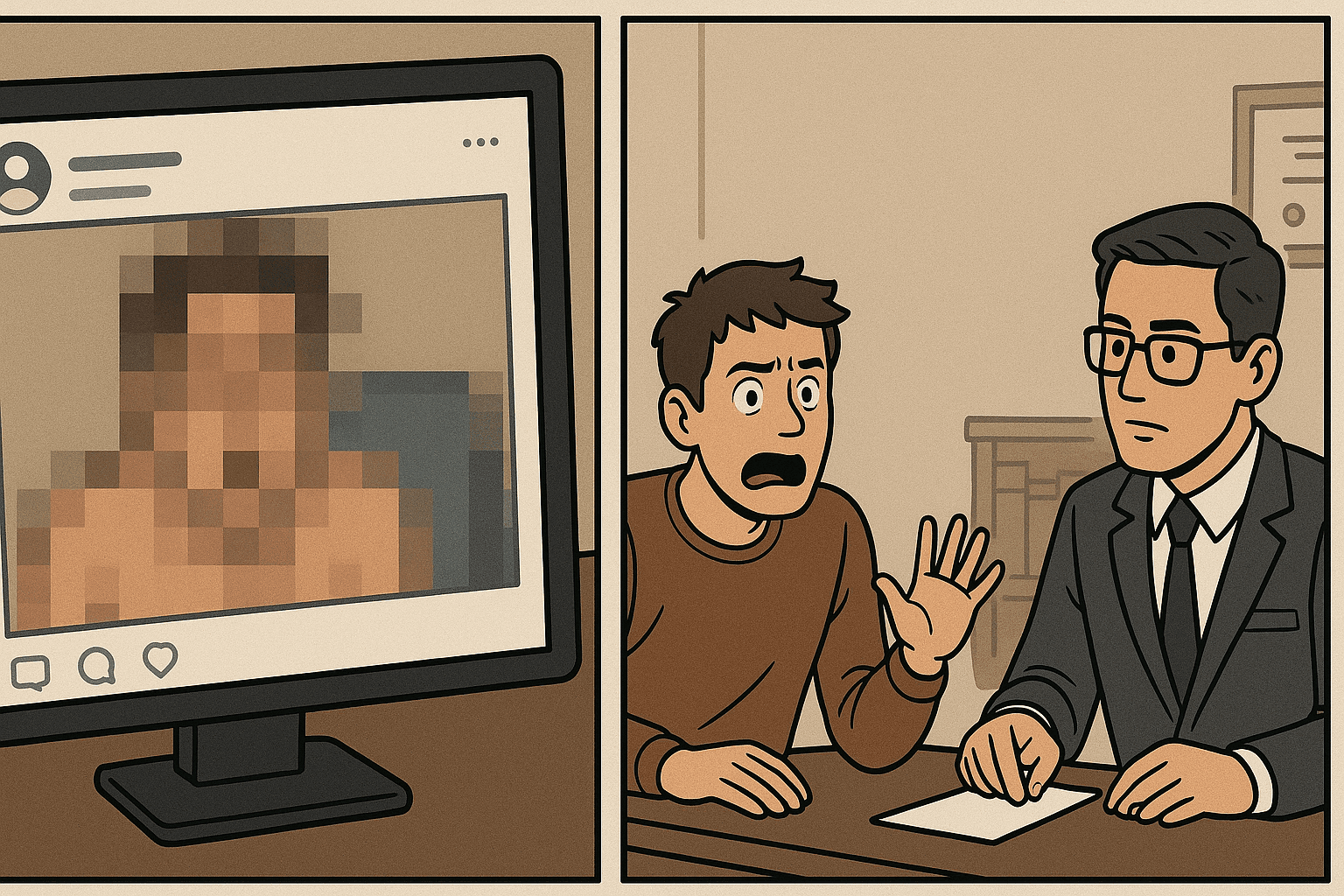
This is the account of a client who requested this firm's assistance, stating that they were under suspicion of the crime of distributing obscene material.
The client received a message through a social media platform from an unknown person asking whether the client could upload that person's nude photograph, saying they wanted a brief departure from the ordinary.
The client asked for at least minimal identifying information, and the other person sent a photograph with their initials written on it.
The photograph the client received was so skillfully edited that it could not be thought of as a composite image, and the client naturally mistook the face shown in the photograph to be that of the person who had requested the posting.
The client therefore uploaded the photograph to their own social media account, and after some time deleted it and even explained to the other person that the deletion had been completed.
However, the photograph was obscene material in which a nude photograph had been composited onto the face of a well-known influencer, the victim in this case, and upon learning that their photograph had been posted, the victim immediately filed a complaint against the client for the crime of distributing obscene material and for the production and distribution of false video material.
The client thus came under suspicion of the crime of distributing obscene material and of the production and distribution of false video material, and sought this firm's assistance in order to avoid punishment.
2. Explanation of the Concept of Distribution of Obscene Material
🔗Distribution of obscene material is a crime that punishes the act of publicly distributing, selling, or leasing, or distributing through an information and communications network, expressive material (such as photographs, videos, writings, and sounds) containing obscene content that runs counter to society’s general moral sense regarding sex.
Article 44-7 of the “Act on Promotion of Information and Communications Network Utilization and Information Protection” prohibits the act of distributing, selling, leasing, or providing obscene codes, words, sounds, images, or videos through an information and communications network.
Precedent defines obscene material as that which stimulates and arouses human sexual desire, evokes only sexual arousal, and is likely to harm sound sexual mores or good social order.
Accordingly, not everything is obscene material merely because it is suggestive or involves a great deal of exposure, and it is determined according to generally accepted social norms.
 Elements of the Distribution of Obscene Material
▶Object: An item or electronic representation containing obscene content
▶Act: Distribution, sale, lease, public exhibition or screening, online dissemination, and the like
▶Intent: The actor must have the intention to distribute or disseminate the material despite recognizing that it is obscene
The offense of distribution of obscene material is punishable by imprisonment for up to one year or a fine of up to 10 million won.


Explanation of the Concept of Editing and Distributing False Video Material
Another charge against the client in this case, the crime of editing and distributing false video material, is a crime that punishes the act of fabricating a nonexistent fact as video material, or falsely editing or compositing video material with the purpose of infringing on a particular person’s reputation or character, producing it, and then distributing, disseminating, or sharing it.
In particular, this crime has recently drawn attention as obscene material that composites a particular person’s face or body using deepfake technology has become a problem.
Under Article 14-2 of the “Act on Special Cases concerning the Punishment of Sexual Crimes,” the act of editing, compositing, or processing false video material and distributing, selling, leasing, or providing it, or publicly displaying or screening it, is prohibited.
Elements of Editing and Distributing False Video Material
▶Object: a false video that differs from the facts, or a composited or edited video
▶Conduct: distribution, dissemination, screening, exhibition, and the like, after editing, compositing, or processing
▶Intent: the intent to convey the video to others while knowing that it is false
A "false video" does not mean mere image manipulation, but a video that presents a fact that does not actually exist as if it were real.
In particular, false videos that may harm sexual images or the reputation of a specific person are the main targets.
Where the crime of editing and distributing a false video applies, the penalty is imprisonment for up to seven years or a fine of up to 50 million won.
3. Questions of the Client Charged with Distribution of Obscene Material
Let us review the matters inquired about to this firm by the client who was under suspicion of the crime of distribution of obscene material.
Is One Liable Even for Uploading Obscene Photographs at Another Person's Request?
Yes. The crime of distributing obscene material and crimes related to false video material are not exempted merely because there was a ‘request from another person.’
Because the person who actually carried out the act of distribution is regarded as the subject of punishment, even if you uploaded the material at another person's request, once you press the upload button you may be assessed as a ‘distributor.’
However, if you prove that you did not know intentionally that it was a third party's photograph, this may operate as a ground for mitigating liability.
Can I Be Punished Even If I Deleted It Promptly Without Any Intent to Distribute?
Once posted, the moment the material becomes publicly accessible to an unspecified number of people, the act of distribution is already established.
An argument that there was no distribution because it was deleted right away is therefore difficult to accept.
The fact that the distribution period was short and that there was no intent or commercial purpose, however, can be a ground for leniency or mitigation at the sentencing stage.
Is a Nude Photograph Always Deemed Obscene Material?
Not necessarily. Precedent regards as obscene material only that which merely arouses sexual excitement and is likely to harm sound sexual mores and social order.
Accordingly, mere nudity or photographs with artistic or medical value are not regarded as obscene material. The matter is judged comprehensively, considering ordinary social standards, the intent of the filming, the context, and the like.
Can Uploading a Nude Photograph of Oneself Be Punishable?
Yes, it can be punished. Many people think, ‘Why would it be a problem when it is a photograph of myself, not someone else?’ but the Act on Promotion of Information and Communications Network Utilization and Information Protection, Etc. provides that distributing ‘obscene codes, words, sounds, images, or videos’ through an information and communications network may be punished.
This provision does not distinguish whether the subject is another person or oneself. Therefore, even a nude photograph one has taken of oneself may constitute the distribution of obscene material if it is posted in an online space.
In particular, university students who posted nude verification photographs of themselves in the online community of a private university in Seoul were investigated by the police, and some were referred to the prosecutors' office with an opinion to indict.
They stated that “they had posted it as a joke because of stress during the exam period,” but the police, taking the view that even a mere joke constituted the charge of distributing obscene material in that it had been posted in a publicly accessible internet space, referred the case.
4. Assistance in the Case of the Client Charged with Distribution of Obscene Material
This firm's sex crime attorney provided the following assistance for the client charged with the crime of distributing obscene material.
Denial of the Charge of Producing and Distributing False Video Material
The attorney specializing in sexual offenses began the defense by denying, among the charges against the client, the charge of producing false video material, while admitting the charge of distributing obscene material.
The client had no acquaintance with the victim and had merely posted, for a brief period, on his own social media a photograph that a third party had sent at the third party's request, claiming that it was a photograph of himself.
The client therefore did no editing of the video material whatsoever, and it can be seen that he posted the photograph received from the third party as it was.
If false video material were to be edited, one would at least have to obtain the photograph that is the subject of the editing, yet the client knew nothing of the victim's personal information.
The attorney specializing in sexual offenses emphasized that, whatever the circumstances, the client should have examined whether the person appearing in the photograph was in fact the third party at the time he received it from that third party, and that the client was reflecting on his failure to do so adequately.
Through this defense, the client received a decision of no charge on the ground of insufficient evidence from the police as to the charge of producing and distributing false video material, and only the charge of distributing obscene material was referred to the prosecutors' office.
Dispute over Whether the Displayed Content Was Obscene
The sexual offense attorney conducted the defense by focusing on whether the photograph at issue in this case constituted an obscene display circulated to an unspecified large number of people.
For there to be a public display, an unspecified large number of people must be able to access the photograph, but the number of views of the photograph posted by the client was markedly low, so it is difficult to confirm whether those who viewed the photograph constituted an unspecified large number of people.
The client's social media account has relatively few followers and is not a well-known account, so it is also difficult to conclude that an unspecified large number of people could access their post.
In addition, according to Supreme Court Judgment 2006Do3558, obscenity refers to that which, under generally accepted social norms, stimulates the sexual desire of an ordinary person, arouses sexual excitement, impairs normal sexual shame, and runs counter to sexual moral notions.
Also, according to Supreme Court Judgment 2012Do13352, in order to deem a particular expressive material to be obscene material subject to criminal punishment, it is not sufficient that the material merely relates to sexual interest and gives a vulgar or licentious impression; rather, it must be capable of being assessed, in light of generally accepted social norms, as appealing wholly or predominantly to sexual interest alone, as having no literary, artistic, ideological, scientific, medical, or educational value whatsoever, and as expressly and explicitly portraying or depicting sexual parts or acts in an excessive and blatant manner, thereby damaging or distorting the dignity and worth of the human being as a person to be respected and protected.
However, in the photograph posted by the client in this case, the pose taken by the woman and the context do not suggest a pose evocative of a sexual act, and there is nothing whatsoever that explicitly depicts a sexual act.
The sexual offense attorney emphasized, taking these points together, that it is difficult to find that the client posted the photograph with intent as to obscenity.
Submission of Sentencing Materials
The sex crimes attorney emphasized that the client in this case was a first-time offender with no criminal record whatsoever and was sincerely reflecting on the posting of the photographs at issue in this case.
In addition, the client, through counsel, attempted to contact the victim’s side to reach a settlement, but the level of settlement money that the victim’s side had in mind was excessive, so a settlement was ultimately not reached.
However, the client conveyed sincere remorse and a letter of apology to the victim regarding the harm that had occurred to the victim.
To demonstrate this, the sex crimes attorney submitted a criminal record inquiry certificate, a letter of reflection, and a letter of apology as sentencing materials.
5. The Judgment for the Client Charged with Distribution of Obscene Material

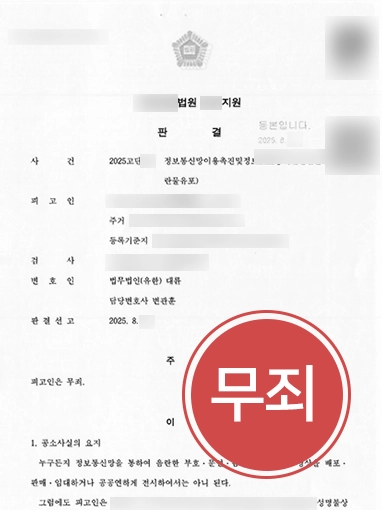
Following the defense by the attorney specializing in sexual offenses, the client received a judgment of acquittal regarding the distribution of obscene material.
The client was at risk of even serving an actual sentence due to a single moment's mistake, but with the assistance of the attorney specializing in sexual offenses, they were able to avoid punishment.
Obscene material is, in many cases, posted in a space accessible to an unspecified number of people or transmitted to many people.
Given the nature of online platforms, social media, and communities, it can spread worldwide the moment it is uploaded, so the spread of harm is assessed as serious.
The court regards this potential for mass dissemination as a grave factor, which increases the likelihood of an actual sentence.
In addition, where material is distributed through media that juveniles may access, the court imposes a strict punishment on the basis of the adverse effect on society as a whole.
Accordingly, failure to respond immediately upon being charged may lead not only to criminal punishment but also to a negative social assessment, so it is necessary to prepare a strategy and respond promptly.
If you are in a situation requiring assistance with the distribution of obscene material, please consider arranging a 🔗legal consultation with Daeryun Law Firm.
This content is based on actual case studies of Daeryun Law LLC with some adaptations, and the copyright belongs to our firm.
Unauthorized reproduction, duplication, or distribution and other copyright infringements may result in legal action under applicable laws.