
CONTENTS
- 1. A Client Who Sought Assistance With a Charge of Violating the Customs Act

- - Frequently Asked Questions About a Violation of the Customs Act
- 2. Defense Strategy for a Client Charged With a Violation of the Customs Act
- - Customs Attorney Emphasizes the Confession and Remorse
- - Customs Attorney Emphasizes That It Was Not a Meticulously Planned Offense
- - Customs Attorney Emphasizes the Absence of Any Possibility of Reoffending
- 3. Successful Defense Against an Actual Custodial Sentence on a Charge of Violating the Customs Act
- - Violation of the Customs Act: Can You Respond on Your Own?

1. A Client Who Sought Assistance With a Charge of Violating the Customs Act

This is the account of a client who sought assistance with a charge of violating the Customs Act.
The clients were inside directors of a company that produces construction materials and synthetic rubber products, and they had carried on the family business by importing certain raw materials for several decades.
However, due to an amendment of the law, synthetic-resin scrap that they had previously imported through normal channels was suddenly designated as a prohibited waste for import, and as a result they found themselves in a situation in which they could no longer secure raw materials.
With the factory at risk of shutting down, the clients pressed or cut the shape of the raw material to make it appear as a synthetic-resin sheet or strip product, and then attempted to clear customs by filing a false declaration under the name of an affiliated company.
However, during the customs clearance process it was confirmed that the actual goods did not match the contents of the declaration, and ultimately the clients were indicted on a charge of violating the Customs Act.
 Frequently Asked Questions About a Violation of the Customs Act
Q. What conduct is included in a violation of the Customs Act?
A. When people hear of a violation of the Customs Act, they often think only of smuggling.
In practice, however, the following may all constitute a violation of the Customs Act: △bringing in goods without declaring them; △filing a declaration, but with contents different from the actual goods; △falsely declaring the price or tax rate in order to pay less tax; △importing without obtaining the permits or approvals required for import, or importing by improper means; and △falsely entering required particulars in a declaration form.
Q. If one is caught for a violation of the Customs Act, what is the level of punishment?
A. The level of punishment varies greatly depending on the nature of the case.
Export and import of prohibited goods | Imprisonment for up to 7 years or a fine of up to 70 million won |
Smuggling import | Imprisonment for up to 5 years or a fine of up to the higher of ten times the customs duty or the cost of the goods |
Evasion of customs duty | Imprisonment for up to 3 years or a fine of up to the higher of five times the evaded customs duty or the cost of the goods |
Split imports to evade import restrictions | Imprisonment for up to 3 years or a fine of up to the cost of the goods |
Q. How does a "false declaration" differ from "smuggling import"?
A. The two concepts are similar but differ.
A false declaration means entering required particulars in a declaration form inconsistently with the facts.
By contrast, smuggling import refers to a case in which no declaration is filed at all, or goods entirely different from the declared contents are brought in.
It is essential to determine precisely which of the two the specific facts of the case correspond to.
Q. Is there any connection with environmental regulations or waste regulations?
A. If the imported goods constitute "waste," the matter is not solely an issue under the Customs Act; the laws relating to the transboundary movement of waste may also be violated at the same time, which can result in double sanctions.
Therefore, it is essential to confirm whether the raw material may be classified as waste and whether a separate permit from the Ministry of Environment is required.
Q. How should one respond at the investigation stage?
A. In Customs Act cases, the materials submitted and the attitude taken at the early stage are important.
It is necessary to fully demonstrate the following: △materials relating to the classification and nature of the items; △the absence of any purpose to evade tax; △efforts to remedy the permit or approval procedures; △whether the goods at issue were returned or disposed of; and △internal compliance training and recurrence prevention measures. If such materials are accepted, considerable consideration may be given in sentencing.
Q. Is it advantageous to file a voluntary declaration or a corrected declaration?
A. Filing a voluntary declaration or a corrected declaration may serve as a ground for mitigation.
However, criminal liability itself is not thereby exempted, and the extent of mitigation varies depending on the type of violation and the degree of intent.
Therefore, if you are considering a voluntary declaration, it is essential to consult an expert and prepare a response strategy.


2. Defense Strategy for a Client Charged With a Violation of the Customs Act

We set about establishing a defense strategy for the client charged with a violation of the Customs Act.
A customs attorney experienced in numerous violation of the Customs Act cases and a customs specialist holding a licensed customs broker qualification set about responding in collaboration.
Customs Attorney Emphasizes the Confession and Remorse
The customs attorney emphasized that the clients had fully confessed to all of the charges and were deeply remorseful.
The attorney also requested leniency, asserting that this case did not arise from an intent to evade tax or to smuggle in a planned manner, but rather from a desperate situation in which the family business was driven to the brink of survival by a sudden cutoff of raw materials caused by the amendment of the law.
Customs Attorney Emphasizes That It Was Not a Meticulously Planned Offense
With the family business at risk of survival, the clients heard that "if you change the shape, import as a different item may be possible," and because of their experience of having imported the raw material legally without any problem for several decades, they came to hold a vague expectation and to make a complacent judgment.
The customs attorney emphasized that the clients had not, from the outset, clearly recognized the conduct as unlawful and meticulously planned the offense.
Customs Attorney Emphasizes the Absence of Any Possibility of Reoffending
The customs attorney emphasized that the goods at issue had all been immediately returned, and that after the incident the clients sold the factory in question and completely ceased production using that raw material, so there was no possibility of reoffending whatsoever.
In addition, the attorney submitted that the clients planned to establish a compliance process for advance classification review of items and for customs and environmental regulations going forward, so that the same problem would not recur.
3. Successful Defense Against an Actual Custodial Sentence on a Charge of Violating the Customs Act
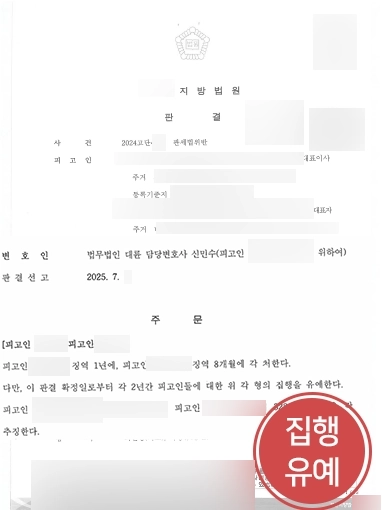
As a result of assisting the clients charged with a violation of the Customs Act, the court, taking into account the clients' full confession and remorse, the unavoidability caused by the abrupt amendment of the law, and the subsequent measures such as the return of all the goods at issue and the sale of the factory, imposed a suspended sentence instead of an actual custodial sentence.
This case demonstrated that even for a violation of the Customs Act, the outcome can vary greatly depending on the motive and circumstances of the offense, the subsequent measures, and whether there is a possibility of reoffending.
In particular, in matters relating to import-restricted items, a person who believes mistaken advice that "it is enough to change the shape or name when declaring" and carries it out accordingly may bear serious criminal liability.
Therefore, when import regulations change or there is a dispute over the classification of an item, it is important to use the advance review system or to proceed through the procedures safely after obtaining advice from an expert.
Violation of the Customs Act: Can You Respond on Your Own?
When facing investigation or trial for a Violation of the Customs Act, many people wonder, “Can I respond on my own without retaining an attorney?”
In practice, an improper response at the early stage may lead to criminal intent being found unintentionally or to unnecessarily heavy punishment.
The following are points to keep in mind, at a minimum, when responding on your own.
▶Organize the Facts Clearly
You should set out in specific detail when, what goods, and by what method they were imported.
It is necessary to secure, without omission, customs declarations, contracts, shipping documents, transaction records, and the like.
It is advisable to organize for yourself the matters relating to intent, such as “whether there was a purpose to reduce the tax amount” and “whether it arose from a lack of awareness of the permit or approval procedures.”
▶Confirm Whether a Permit or Approval Is Required
You must confirm whether the goods at issue are restricted import items or fall under waste.
If you imported, without approval, goods requiring a permit from a relevant authority such as the Ministry of Environment or the Ministry of Trade, Industry and Energy, you should review whether there was a way to acknowledge that fact and remedy it.
▶Prepare a Letter of Reflection and a Petition
Sincerely acknowledging the facts at the investigation stage and submitting a letter of reflection or a petition during the trial can also be helpful.
If you have a company or employees, you can emphasize that it was essential to maintaining your livelihood and employment.
▶Establish Measures to Prevent Recurrence
After the case, it is necessary to establish internal rules and compliance so that the same problem does not arise again.
Demonstrating that you have introduced a system such as advance review of tariff classification or a procedure for expert consultation before importation may work favorably in sentencing.
This content is based on actual case studies of Daeryun Law LLC with some adaptations, and the copyright belongs to our firm.
Unauthorized reproduction, duplication, or distribution and other copyright infringements may result in legal action under applicable laws.