
CONTENTS
- 1. Jeju Real Estate Attorney | Case Overview

- - Jeju Real Estate Attorney | Receiving Part of the Sale Proceeds
- - Jeju Real Estate Attorney | Legal Grounds Concerning the Punishment of Tax Evaders Act
- 2. Jeju Real Estate Attorney | Summary of the Key Issues
- - Jeju Real Estate Attorney | Whether the Father's Principal-Offender Charge Is Established
- - Jeju Real Estate Attorney | Whether the Client's Charge of Aiding Is Established
- - Jeju Real Estate Attorney | The Client Had No Intent to Aid
- 3. Jeju Real Estate Attorney | Case Result: Non-Referral

1. Jeju Real Estate Attorney | Case Overview

The client had been living a married life in the United Kingdom for five years.
He received contact from his father, with whom he had lost touch after his father divorced his mother 20 years earlier, saying that he had sold a building worth 3 billion won and would give part of the sale proceeds as a wedding gift.
 Jeju Real Estate Attorney | Receiving Part of the Sale Proceeds
The client's father told him that he had fully paid all the value-added tax and capital gains tax due when selling the building, that the money was clean, and that the client should take it and put it toward his newlywed funds.
The client used the approximately 400 million won he received to pay off his debts and covered his living expenses, spending all of it.
In the meantime, he received a notice from Korea stating that he had been booked on charges of aiding a violation of the Punishment of Tax Evaders Act and should undergo investigation promptly.
It turned out that the client's father was expected to owe 800 million won in capital gains tax, but, while in a state of excess debt, he had gifted a total of 400 million won to his child, the client, for the purpose of evading a disposition on default.
The client came to be suspected of having aided this while being aware of it.
Jeju Real Estate Attorney | Legal Grounds Concerning the Punishment of Tax Evaders Act
The attorney explained that it was necessary to examine the legal grounds for whether the client's father had truly violated the Punishment of Tax Evaders Act.
Under Article 88 of the Income Tax Act, capital gains refers to income arising from the transfer of an asset, and it is specified that this means the de facto transfer of ownership of an asset for consideration.
Pursuant to Article 94 of the same Act, capital gains tax is imposed on the transfer of land, buildings, and the like, and, under Article 98 of the same Act, the transfer date of an asset is deemed to be the earliest among the date of settlement of the price, the date of registration of the transfer of ownership, and the date of payment of the balance under the contract.
Under Article 110 of the same Act, the payment deadline for capital gains tax is calculated based on the last day of the month to which the transfer date belongs, and the deadline for reporting and payment is within two months following the last day of the month to which the transfer date belongs.
Under Article 162 of the Enforcement Decree of the Income Tax Act, the tax liability arises on the last day of the month in which the capital gains arise, so it is specified that the determination must be made by comprehensively considering the date of conclusion of the sales contract, the date of settlement of the price, the date of transfer of ownership, and the like.
Accordingly, the tax liability of the client's father can be deemed to have arisen on the last day of the month in which he received the entire 3 billion won in proceeds from the sale of the building.
However, it can be seen that the client's father transferred part of the sale proceeds to the client even before the tax liability arose.
2. Jeju Real Estate Attorney | Summary of the Key Issues
Upon reviewing the relevant legal principles, the attorney established that the father had not intentionally violated the Punishment of Tax Evaders Act, so the client likewise had no charge of aiding.
Jeju Real Estate Attorney | Whether the Father's Principal-Offender Charge Is Established
The attorney first examined, as a matter of legal principle, whether the client's father had violated the Punishment of Tax Evaders Act.
According to Supreme Court precedent, the capital gains tax liability arises on the last day of the month to which the date of receiving the entire sale price belongs.
Because the client's father gifted part of his property to the client before the capital gains tax liability arose, the elements of a violation of the Punishment of Tax Evaders Act were not satisfied.
Therefore, because the offense of the principal offender is not established, the client's charge of aiding is likewise not established.
Jeju Real Estate Attorney | Whether the Client's Charge of Aiding Is Established
The attorney argued that the charge against an accessory is established only if the crime charged against the principal offender is established.
According to Supreme Court precedent (2022Do5826), a gift of property made while no capital gains tax liability had arisen does not satisfy the elements of the offense of violating the Punishment of Tax Evaders Act.
Therefore, the client's charge of aiding was likewise not established.
Jeju Real Estate Attorney | The Client Had No Intent to Aid
The client did not know that his father had failed to pay capital gains tax when selling a building that his father had received from the client's grandfather.
He also had no idea at all whether the 400 million won had been given to him for the purpose of evading the obligation arising from the default.
The client argued that he was staying in the United Kingdom at the time of the case, and that, because he had been out of contact with his father for more than 20 years, he did not know of such facts.
The client argued that he also had no intent to aid, because he did not use the 400 million won he received for any improper purpose but used it to repay his debts and to cover living expenses.
3. Jeju Real Estate Attorney | Case Result: Non-Referral
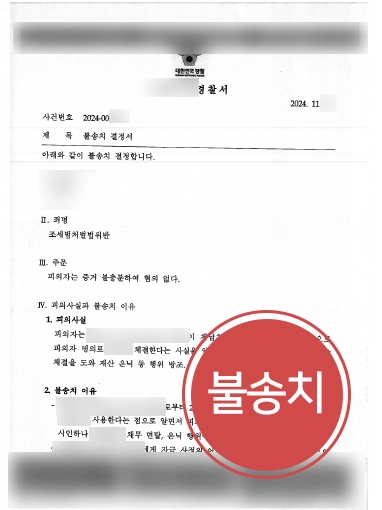
With the attorney's assistance, the client established that there was no suspicion of crime regarding the charge of aiding a violation of the Punishment of Tax Evaders Act and received a non-referral decision.
It was recognized that the client did not know of his father's failure to pay capital gains tax or of any intent to evade the tax liability, and that he did not use the amount he received for any improper purpose.
In addition, once the legal determination was made that the father's charge of violating the Punishment of Tax Evaders Act was not established, the conclusion was reached that the client's charge of aiding was likewise not established.
In the end, the client was freed from legal liability and able to clear up the injustice, and this case remains an example that once again confirmed the importance of applying the principles of tax law and criminal law in accordance with their original purpose.
If you find yourself in a situation where you have been wrongfully booked and investigated by an investigative agency, like this client, please come to a 🔗Jeju attorney.
This content is based on actual case studies of Daeryun Law LLC with some adaptations, and the copyright belongs to our firm.
Unauthorized reproduction, duplication, or distribution and other copyright infringements may result in legal action under applicable laws.