
CONTENTS
- 1. The Client Involved in a Suspicion of Electronic Financial Fraud

- - The Background of the Case Involving the Client in a Fraud Matter
- 2. Criteria for Punishment of Electronic Financial Fraud
- - Level of Punishment
- - Issues in the Case
- 3. Assistance Provided to the Client Charged with Electronic Financial Fraud
- - Voluntary Report and Cooperation with the Investigation
- - First-Time Offender and Submission of Petitions
- - Emphasis on Lack of Social Experience and the Absence of Benefit
- 4. Result of Assisting the Client Charged with Electronic Financial Fraud: a 'Suspended Sentence'
- - How to Respond to Electronic Financial Fraud

1. The Client Involved in a Suspicion of Electronic Financial Fraud
The client suspected of electronic financial fraud was in a situation where, on suspicion of acting as a cash courier in a voice phishing scheme, an actual custodial sentence was a concern, but with the systematic assistance of a criminal law specialist attorney, he was able to receive a judgment of a suspended sentence.
 The Background of the Case Involving the Client in a Fraud Matter
After posting his resume on a part-time job site, the client received contact from Company A and prepared an employment contract.
However, without knowing that the work was related to financial fraud, he came to perform the role of a cash courier on one occasion.
Afterward, upon realizing through the advice of acquaintances that his conduct could constitute a problem of electronic financial fraud, the client immediately stopped the work and contacted the police station on his own initiative, voluntarily appearing for and undergoing an investigation.
In response, the client consulted with a criminal law specialist attorney who had experience handling numerous electronic financial fraud cases and requested help in obtaining the greatest possible leniency.



2. Criteria for Punishment of Electronic Financial Fraud
Electronic financial fraud refers to a type of financial fraud carried out using telecommunications media such as the telephone and a PC.
Representative types include voice phishing, pharming, smishing, and memory hacking.
Level of Punishment
Where a person commits electronic financial fraud, he or she may be punished under the Special Act on Telecommunications-based Financial Fraud.
Where the offense is committed habitually, the punishment may be aggravated by up to one half of the sentence.
| Special Act on Telecommunications-based Financial Fraud, Article 15-2 | A person may be punished by imprisonment for a definite term of not less than one year or by a fine equivalent to not less than three times and not more than five times the criminal proceeds, or both may be imposed concurrently. |
In addition, because electronic financial fraud is conduct that deceives another person to obtain a pecuniary benefit, it may also be punished as the crime of fraud under the Criminal Act.
Level of Punishment for the Crime of Fraud
| Criminal Act, Article 347 (Crime of Fraud) | Imprisonment for not more than 20 years or a fine not exceeding 50 million won |
Issues in the Case
The principal issues in this electronic financial fraud case were whether the client intentionally participated in the electronic financial fraud offense, and how the fact that the client voluntarily reported the matter and cooperated with the investigation would be reflected in the criminal punishment and sentencing.
A further key issue was whether the facts that the client was a first-time offender with no risk of reoffending, that the client was a university student at the time of the incident who lacked social experience and experience of economic independence, and that the client gained no monetary benefit could influence the judgment.
3. Assistance Provided to the Client Charged with Electronic Financial Fraud

In order for the client charged with electronic financial fraud to receive the greatest possible leniency in this case, the following arguments were made.
Voluntary Report and Cooperation with the Investigation
The client first voluntarily reported his own electronic financial fraud offense to the police and also actively cooperated during the investigation.
Accordingly, the specialist criminal attorney, relying on the facts of the client's voluntary report and cooperation with the investigation, coordinated matters so as to minimize unnecessary questioning or additional investigation during the fraud case inquiry stage, and actively conveyed to the investigative agency the client's good faith and willingness to reflect on his conduct.
First-Time Offender and Submission of Petitions
The client is a first-time offender of electronic financial fraud with no risk of reoffending, and family members and acquaintances are petitioning for leniency.
Accordingly, the specialist criminal attorney systematically conveyed to the court the client's reflective attitude, the fact that he was a first-time offender, and the absence of any likelihood of reoffending, and actively provided assistance so that the content of the submitted petitions could be reflected favorably at trial.
Emphasis on Lack of Social Experience and the Absence of Benefit
The client was a university student at the time of the incident who lacked social experience and experience of economic independence, and through this electronic financial fraud case the client in fact gained no monetary benefit or personal gain whatsoever.
Accordingly, the specialist criminal attorney, relying on the client's lack of social experience and the fact that he gained no benefit, actively emphasized these points to the investigative agency and the court and provided systematic assistance so that the client could receive leniency.
4. Result of Assisting the Client Charged with Electronic Financial Fraud: a 'Suspended Sentence'

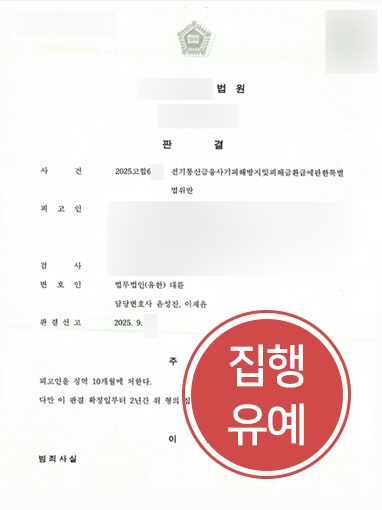
As a result of assisting the client charged with electronic financial fraud, the court rendered a suspended sentence.
In response, the client expressed gratitude for the attorney's systematic assistance and for the attentive support provided from the early stage of the case through to the final trial.
How to Respond to Electronic Financial Fraud
In the case of an electronic financial fraud or voice phishing matter, even where one performed only a partial role, there is a high likelihood of being referred to prosecution and indicted.
It is therefore very important to establish a response strategy promptly from the early stage of the case.
Daeryun Law Firm, the ninth-largest law firm in the Republic of Korea (based on 2025 value-added tax filings reported to the National Tax Service), has numerous specialist criminal attorneys and, drawing on extensive experience and know-how in electronic financial fraud cases, provides a tailored response suited to the client's circumstances.
At the early stage of the case, the firm responds to the investigative agency's inquiry, reviews the evidence, and organizes the client's voluntary reflection and cooperation in order to establish a strategy that may operate favorably for sentencing at the subsequent trial.
If you have become involved in a criminal matter related to electronic financial fraud, please do not delay and 🔗schedule a legal consultation with a criminal attorney to request assistance.


Watch related video content
for this case study.

I was a voice phishing collector?!
This content is based on actual case studies of Daeryun Law LLC with some adaptations, and the copyright belongs to our firm.
Unauthorized reproduction, duplication, or distribution and other copyright infringements may result in legal action under applicable laws.