
CONTENTS
- 1. Fraud Specialist Attorney | Case Details

- 2. Fraud Specialist Attorney | Explanation of the Concept of Quasi-Fraud
- - Requirements for the Establishment of Quasi-Fraud
- - Differences Between Quasi-Fraud and the Crime of Fraud
- 3. Fraud Specialist Attorney | Key Points of Legal Response to Quasi-Fraud
- - Assistance of the Fraud Specialist Attorney
- 4. Fraud Specialist Attorney | Case Result

1. Fraud Specialist Attorney | Case Details
This is the story of a client who came to a fraud specialist attorney and requested that a not-guilty verdict for quasi-fraud be obtained.
The client, in order to build and reside in a country house, won a bid for land at auction.
On a parcel adjacent to this land, a resident (hereinafter the victim) had obtained an occupancy permit and was using it; after acquiring the land at auction, the client thought that he should also be assigned and use the occupancy right to the adjacent land.
Accordingly, the client paid the victim 3 million won and purchased the occupancy right.
An occupancy right is ordinarily an administrative permit to use public land such as roads and rivers 'specially' for a particular purpose. It is not a real right such as superficies or an easement under the Civil Act, but a status under administrative law premised on the permission of the managing authority.
However, thereafter the victim's parents filed a complaint for quasi-fraud, alleging that the victim was a person who had been diagnosed with an intellectual disability and that the client had exploited this to obtain a financial benefit.
The client's position, however, was that he had not been aware at all of the victim's disability, and that even when he conversed with the victim during the transaction, he could not in the least have suspected any impairment of the victim's normal judgment or comprehension.
Accordingly, the client came to this firm's fraud specialist attorney, requesting that a not-guilty verdict for quasi-fraud be obtained.

2. Fraud Specialist Attorney | Explanation of the Concept of Quasi-Fraud
Quasi-fraud is a crime defined in Article 348 of the Criminal Act (Penal Code), referring to 'the act of obtaining a financial benefit by exploiting the impaired judgment of a person who is in a state of mental incapacity or diminished mental capacity.'
That is, it is established when a person obtains property or gains a financial benefit by exploiting the fact that the victim, while aware that the victim is in a state in which it is difficult for the victim to properly understand the meaning of the transaction, uses that point.
 Requirements for the Establishment of Quasi-Fraud
For quasi-fraud to be found, all of the following three elements must be proven.
1. Existence of the victim's mental disability
The victim must be deficient in normal judgment and disposition capacity due to an intellectual disability, a mental illness, or a decline in cognitive ability caused by old age, among other things.
2. The perpetrator's awareness and exploitation
The perpetrator must have known of the victim's state of mental disability and must have had the intent to exploit that weakness.
3. Acquisition of a financial benefit
As a result, the perpetrator must have acquired property or gained a financial benefit.
If any one of these is not proven, quasi-fraud is difficult to establish.
Differences Between Quasi-Fraud and the Crime of Fraud
Category | Quasi-fraud | |
Victim's state | Possesses normal judgment capacity | Deficient judgment capacity, such as mental incapacity or diminished mental capacity |
Perpetrator's conduct | A lie or deceptive act is required | No lie is required; however, it is established only where the deficiency in the other party's judgment capacity is recognized and exploited |
Legal basis | Criminal Act Article 347 | Criminal Act Article 348 |


3. Fraud Specialist Attorney | Key Points of Legal Response to Quasi-Fraud
If you are wrongfully suspected of quasi-fraud, you should respond using the following methods.
1. Review of the victim's state
Through a medical evaluation, daily-living capacity, and records of social activity, it must be proven that the victim had the judgment capacity to understand the transaction.
2. Absence of the perpetrator's awareness and intent
The point that the perpetrator did not know of the victim's disability or state is proven through statements and surrounding circumstances.
Circumstances showing that, at the time of the conversation or transaction, the victim made normal declarations of intent (recordings, text messages, the manner of preparing the contract, and so on) are secured.
3. Proof of the fairness of the transaction
If, as in the client's case, the amount paid does not differ greatly from the market price, that fact is proven through an appraisal report and transaction precedents to show that there was no acquisition of an improper financial benefit.
Assistance of the Fraud Specialist Attorney
This firm's fraud specialist attorney assisted in the client's case as follows.
1. Analysis of precedents
By reviewing similar cases, such as the Changwon District Court 2021 Godan 952 judgment, the attorney relied on the legal principle that "without intent premised on awareness of the victim's mental disability, quasi-fraud cannot be established."
2. Verification of the victim's state
The attorney gathered materials showing that the victim performed studies and daily life normally and possessed the discernment to sufficiently understand the contents of the contract.
The fraud specialist attorney submitted as evidence a message that the victim had sent to the client stating that the victim was doing an assignment in order to carry out studies.
3. Proof of the absence of the client's awareness and intent
The fraud specialist attorney secured, through call records, text messages from the contract negotiation, and on-site testimony, the fact that the client had a natural conversation with the victim at the time of the transaction and that there were no outward circumstances from which the existence of a disability could be inferred.
4. Demonstration of the fairness of the transaction
Through an appraisal, the fraud specialist attorney proved that 3 million won was similar to the objective market price of the occupancy permit, emphasizing that it was not an improper benefit.
5. Response to the investigation and trial
From the police investigation stage, the fraud specialist attorney accompanied the client to provide support so that the statements would not be distorted, and in court developed the pleading with a focus on the "absence of awareness of the victim's state and absence of intent."
4. Fraud Specialist Attorney | Case Result

The court found that the degree of the victim's intellectual disability was minor and that the victim had the discernment to understand the contract, that the client had not recognized the victim's disability and had no intent, and that there was no fact of obtaining an improper benefit because the client had purchased the occupancy permit for an amount close to the market price.
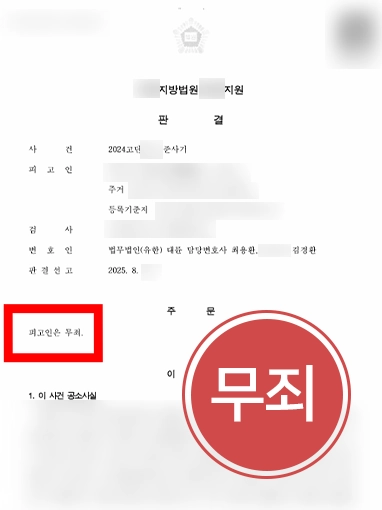
In the end, the client received a not-guilty verdict for quasi-fraud and was able to avoid being wrongfully subjected to criminal punishment.
Because for quasi-fraud the intent that recognizes and exploits the victim's deficient judgment capacity is the core, establishment is difficult if the victim's disability or state was not known.
In a situation such as the client's, proving that the transaction was fair and the consideration appropriate is an important point of defense.
If you are under investigation on a fraud-related charge, it is safer to consult with a fraud specialist attorney from the early stage and to prepare for securing evidence and responding to the investigation.
If you are in a situation where help is needed, please proceed with Daeryun Law Firm's 🔗legal consultation reservation.
This content is based on actual case studies of Daeryun Law LLC with some adaptations, and the copyright belongs to our firm.
Unauthorized reproduction, duplication, or distribution and other copyright infringements may result in legal action under applicable laws.