
CONTENTS
- 1. The Client Who Sought the Changwon Attorney's Office

- - The Client Accused of the Crime of Fraud
- 2. Case-Related Statutes Explained by the Changwon Attorney's Office
- - Crime of Fraud Precedents
- 3. Two Arguments of the Changwon Attorney's Office
- - Argument ① The Role of a Messenger
- - Argument ② No Intent to Defraud
- 4. The Police Decision on the Changwon Attorney Office's Arguments
- - If You Are Involved in a Crime of Fraud

1. The Client Who Sought the Changwon Attorney's Office

The client sought a Changwon attorney's office in order to accurately understand a complex crime of fraud case and to be presented with a solution.
 The Client Accused of the Crime of Fraud
The account of the client who sought the assistance of a Changwon attorney is as follows.
The client was a person who performed simple administrative support related to brokerage work, such as on-site guidance of brokerage objects and general clerical tasks.
One day, while working as usual, the client suddenly learned that he had been accused by a real estate buyer.
The reason was that the client allegedly played a leading role in the contracting process as if he were a licensed real estate agent and defrauded a brokerage fee.
The client was performing simple administrative support and committed no wrongdoing, yet was accused of the crime of fraud, which left him quite bewildered.
🔗Crime of fraud and 🔗violation of the Licensed Real Estate Agents Act Involved in these charges, the client sought a Changwon attorney in order to resolve the matter promptly through the assistance of an attorney.
2. Case-Related Statutes Explained by the Changwon Attorney's Office
The client was involved in charges of the crime of fraud and violation of the Licensed Real Estate Agents Act, and sought the assistance of a Changwon attorney.
The crime of fraud refers to a crime of deceiving another person to receive property or obtain a pecuniary benefit.
A violation of the Licensed Real Estate Agents Act refers to an act of breaching the Licensed Real Estate Agents Act, exerting an unlawful influence on a real estate transaction, or a case where a broker intentionally violates the law.
If this charge is established, a person may be punished under the following provisions.
Fraud (Article 347 of the Criminal Act)
A person who deceives another to receive the delivery of property or to obtain a pecuniary benefit shall be punished by imprisonment of up to 10 years or a fine of up to 20 million won.
Violation of the Licensed Real Estate Agents Act (Article 48)
A person who engages in a brokerage business without registering the establishment of a brokerage office shall be punished by imprisonment of up to 3 years or a fine of up to 30 million won.
Crime of Fraud Precedents
| Crime of Fraud Recognized (Supreme Court Decision 97Do286) | If the defendant, as a passive party, submitted documents with false content as evidence with the intent to actively deceive the court, or submitted an answer or brief containing arguments based on such documents, the commencement of the execution of the crime of fraud is recognized |
| Crime of Fraud Denied (Supreme Court Decision 2002Do5265) | The mere fact that a person became temporarily unable to pay the price for goods after delivery due to a change in economic circumstances cannot be regarded as constituting the crime of fraud |


3. Two Arguments of the Changwon Attorney's Office
The Changwon attorney analyzed the facts of the case, researched the relevant law, and established a systematic defense strategy.
In order to prove that the client did not commit the crime of fraud, the attorney made the following arguments.
Argument ① The Role of a Messenger
At the time of the incident, the client held a licensed real estate agent qualification but did not operate an independent licensed real estate agent's office.
At the request of the complainant, the client performed only simple support work, such as posting listings on a real estate app.
Therefore, it was emphasized that the client did not actually act as a broker, but was merely a messenger who served only as an intermediary.
Argument ② No Intent to Defraud
The client delivered the brokerage commission to the licensed real estate agent but received a portion of it as a service fee.
The complainant was also aware of this fact, and the client used the service fee in accordance with the purpose entrusted by the complainant.
Nevertheless, the complainant claims that the client played a leading role in the contract conclusion process as if the client were a licensed real estate agent and received the brokerage commission.
The client emphasized that, in light of the fact that the client returned the amount received as a service fee to the complainant, it is difficult to find that there was any intent to obtain money by deception.
4. The Police Decision on the Changwon Attorney Office's Arguments
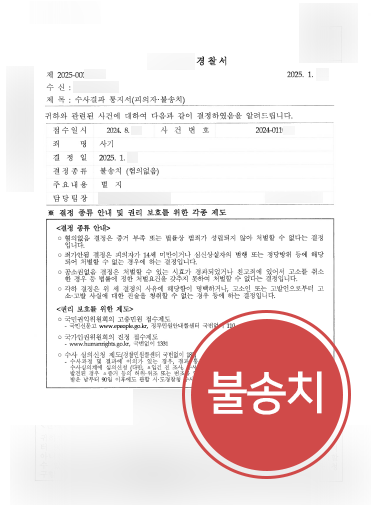
The police, accepting the arguments of the Changwon attorney office, ultimately issued a decision of non-referral (no suspicion of crime).
The client, who promptly concluded the case through the non-referral decision, expressed deep gratitude to the Changwon attorney.
If You Are Involved in a Crime of Fraud
If you are involved in a criminal case, gathering as much favorable evidence as possible and steering the case in a favorable direction can be important.
In particular, in the case of a crime of fraud, proving intent is very important, so consulting a 🔗criminal attorney who can establish a concrete strategy can be helpful.
At Daeryun, criminal attorneys experienced in this area provide close representation from consultation through the conclusion of the case, protecting the rights of clients.
If you are involved in a charge of fraud and no solution comes to mind, please entrust your case through a criminal attorney 🔗legal consultation booking.
See More
This content is based on actual case studies of Daeryun Law LLC with some adaptations, and the copyright belongs to our firm.
Unauthorized reproduction, duplication, or distribution and other copyright infringements may result in legal action under applicable laws.