
CONTENTS
- 1. Busan Criminal Case Attorney | Details of the Case

- 2. Busan Criminal Case Attorney | Details of the Assistance
- 3. Busan Criminal Case Attorney | Concluding the Case With No Right to Prosecute and a Suspension of Indictment

1. Busan Criminal Case Attorney | Details of the Case

The attorney came to consult with a client who, after having previously served a prison term on a fraud charge, had been released on parole and was living his life.
 A Client on Parole
The client had been sentenced to imprisonment on a fraud charge four years earlier, served the term, was recognized as a model prisoner, and was released on parole.
After release, the client was registered as a basic livelihood recipient and was making a living through day labor amid financial hardship.
However, after the parole, an unexpected legal problem arose.
Charged Over a Past Fraud Record
Ten years earlier, the client had borrowed approximately 20 million won from the victim while misrepresenting the intended use, and had ultimately failed to repay it.
The victim had taken no particular legal action for a long time but then, after the client was released on parole, suddenly filed a criminal complaint against the client for fraud.
Because this was a new fraud charge that had not been dealt with at the time of the earlier trial, the client was worried that his parole might be revoked.
The client eventually went to the victim belatedly and promised an apology and repayment, but the victim was firm in the intention to pursue the complaint.
The client was then questioned by the police and gave a statement admitting all of the charges.
However, the client remained anxious and was particularly concerned about the possibility that this case might result in revocation of his parole.
For this reason, the client decided to obtain the attorney's assistance and came in urgently.
2. Busan Criminal Case Attorney | Review of the Case
Attorney, what are the charges against the client?
Attorney: Yes, the crime of fraud was applied to the client on the charge of having defrauded the victim of approximately 20 million won about 10 years ago. At the time, he borrowed the money in the name of business funds but failed to repay it, and it was also revealed that he had used the money for personal repayment rather than for business funds, which led to the fraud complaint. Accordingly, the victim belatedly proceeded with the complaint, and the matter developed into criminal proceedings.
Attorney, then what are the issues that should be addressed as the focus of the case?
Attorney: The most important issues in this case were largely twofold. The first was whether the statute of limitations for prosecution had expired. The statute of limitations for prosecution for the crime of fraud is 10 years, and because some of the client's charges arose between 2013 and 2015, there was a possibility that the statute of limitations for prosecution for certain criminal conduct had expired. The second was the possibility that he had already been punished as a single comprehensive crime. If the client continuously defrauded money from the same victim, whether to treat this as separate crimes of fraud or as one crime (a single comprehensive crime) became an important question.
What Is a Single Comprehensive Crime of Fraud?
A single comprehensive crime of fraud refers to a case in which several fraudulent acts fall within one set of constituent elements of a crime and constitute a single crime.
In other words, it is the principle that, where the victim is the same and the fraudulent conduct continues consistently, even multiple instances of fraudulent conduct are treated and punished as a single crime.
For example, if fraudulent acts were committed against the same person on several occasions, these are not evaluated as separate independent crimes but are regarded as a single crime of fraud.
In Supreme Court Decision 2016Do11318, rendered October 27, 2016, the court held that, in property crimes such as fraud, where acts of the same kind are repeatedly committed against the same victim over a certain period under a single and continuing criminal intent, the acts taken together may constitute a single comprehensive crime.
The court also held that the singleness and continuity of criminal intent must be reasonably determined by examining the method and manner of each individual offense, the motive for the offenses, the time interval between each offense, and whether the subsequent offenses occurred amid a continuing situation that took advantage of the same opportunity or relationship.


3. Busan Criminal Case Attorney | Details of the Assistance
The attorney made the following arguments regarding the client's fraud charge and asserted that there was no right to prosecute.
Argument That the Statute of Limitations Had Expired for Some Charges
The victim filed a complaint regarding part of the crime of fraud committed by the client, but the statute of limitations for prosecution had already expired for some of those charges.
🔗Habitual Fraud and other forms of fraud carry a 10-year statute of limitations for prosecution, but because some of the fraudulent acts the client committed against the victim occurred beyond that period, the complaint had no effect as to those charges.
As a result, a situation arose in which legal responsibility for some of the charges could no longer be pursued.
Withdrawal of the Victim's Complaint
Through the attorney's mediation and assistance, the client met the victim in person and conveyed an apology.
The victim initially maintained that there was no intention to settle and wanted punishment, but through the attorney's careful persuasion and advice, the victim continued the conversation with the client.
In the end, the victim withdrew the complaint and expressed an intention not to seek punishment, through which the client obtained an opportunity to avoid punishment.
Argument That the Amount Defrauded Was Small
The attorney actively emphasized that the amount of harm from the fraudulent act the client committed against the victim was small, and devised a strategy to resolve the case.
Taking into account that the amount of harm was not large, the attorney spared no assistance so that a suspension of indictment could be requested.
4. Busan Criminal Case Attorney | Concluding the Case With No Right to Prosecute and a Suspension of Indictment
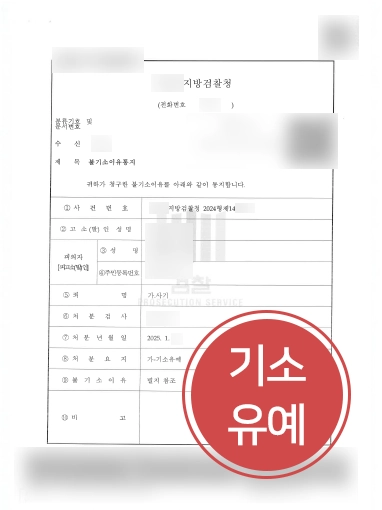
The attorney concluded the case for the client with a no right to prosecute and a suspension of indictment.
The prosecution issued a suspension of indictment on the ground of no right to prosecute, citing that the statute of limitations had expired for some charges, that the amount defrauded was small, and that the victim had withdrawn the complaint.
The client was greatly distressed at being held back once again by a past record while on parole, but through the attorney's active assistance, the client was able to receive a suspension of indictment without the parole being revoked.
If, as in this case, you are at risk of an actual custodial sentence during parole review, please visit an attorney and apply for a 🔗Legal Consultation Reservation.
If you would like a prompt consultation, we recommend using the 🔗AI Daeryun service to receive a range of services, including case analysis, precedents, and connection to a consultation.
This content is based on actual case studies of Daeryun Law LLC with some adaptations, and the copyright belongs to our firm.
Unauthorized reproduction, duplication, or distribution and other copyright infringements may result in legal action under applicable laws.