
CONTENTS
- 1. The Client Involved in Numerous Charges Including Obstruction of Official Duties by Deceit

- - How the Client Became Involved in the Criminal Case
- 2. The Strategy to Prove Innocence on Obstruction of Official Duties by Deceit and Other Charges
- - The Investigative Flaws in the Process of Screening Suspects
- - The Possibility of Account Trading and Misuse by a Third Party
- - The Absence of a Motive and Circumstances for the Offense
- 3. Result of the Numerous Charges Including Obstruction of Official Duties by Deceit, ‘Acquittal’
- - Criminal Attorney FAQ
- 4. The Requirements for Establishing Obstruction of Official Duties by Deceit and Other Charges
- - Level of Punishment
- - If You Need the Assistance of a Professional?

1. The Client Involved in Numerous Charges Including Obstruction of Official Duties by Deceit
The client, who was involved in numerous charges including obstruction of official duties by deceit, faced the risk of criminal punishment, but was able to prove innocence through the assistance of a criminal attorney.
 How the Client Became Involved in the Criminal Case
The client was facing trial for obstruction of official duties by deceit and the crime of intimidation after posting on a university community bulletin board a message to the effect that a bomb had been installed.
Based on the time the post was made, the investigative agency traced the author's IP and secured dozens of phone numbers, then cross-checked them against enrollment at the university. As a result, the client, who was the only match, was identified as the perpetrator.
The police then arrested the client, and the crime of obstruction of official duties by deceit was thereby also established.
However, from the early stage of the police investigation, the client consistently and strongly denied ever having written the threatening post and pleaded the injustice of having been falsely accused.
The client, wrongfully involved in the case on numerous charges, then requested the assistance of a criminal attorney in order to prove innocence.



2. The Strategy to Prove Innocence on Obstruction of Official Duties by Deceit and Other Charges

The following issues were identified so that the client could prove innocence on the charges of obstruction of official duties by deceit and the others in this case.
· Whether there was a possibility of account trading and misuse
· The absence of a motive for the offense and of objective circumstances
The Investigative Flaws in the Process of Screening Suspects
The criminal attorney determined that, although the investigative agency had narrowed the client down as the sole suspect among those who had accessed the IP at the same time, this process was based on multiple assumptions and conjectures and could hardly be regarded as reasonable.
Accordingly, the attorney closely analyzed the limitations and uncertainty of the IP and phone number materials secured by the investigative agency.
The attorney also reviewed the possibility of other persons with similar conditions having accessed the site, and emphasized that no systematic elimination had been carried out in the process of identifying the perpetrator.
The Possibility of Account Trading and Misuse by a Third Party
The criminal attorney closely reviewed recent news and cases related to the trading of community accounts and submitted them as evidence.
On this basis, the attorney emphasized that this case had no direct connection with the university student and that the possibility that a third party had simply used an account acquired through a transaction to write the false post could not be ruled out.
The Absence of a Motive and Circumstances for the Offense
The client is an ordinary university student who has no motive whatsoever to harbor any dissatisfaction or hostility toward a state institution.
Accordingly, as a result of conducting digital forensics on the client's mobile phone, the criminal attorney emphasized that only extremely ordinary daily activities, such as watching YouTube and playing mobile games, were confirmed, and that there were no circumstances suggesting that the client had planned or carried out the offense in this case.
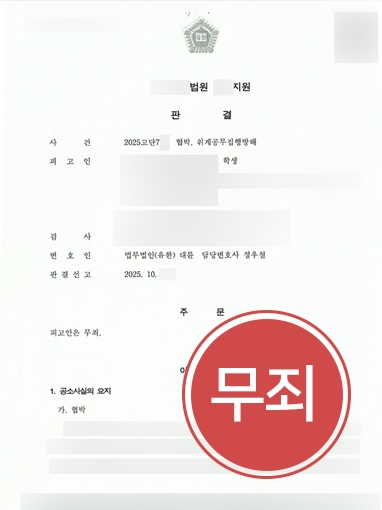
3. Result of the Numerous Charges Including Obstruction of Official Duties by Deceit, ‘Acquittal’

By proving the limitations of the IP tracing and the possibility of account misuse, the criminal attorney emphasized that reasonable doubt could not be ruled out and ultimately secured a judgment of acquittal.
The client then expressed gratitude, saying, “Thanks to the attorney, I was able to prove my innocence on the charges of obstruction of official duties by deceit and intimidation.”
Criminal Attorney FAQ
A. Yes. Even a mere prank call or false report may be punished as the crime of obstruction of official duties by deceit if it actually causes confusion in, or obstruction of, the performance of a public official's duties. In such cases, a strategy of receiving an attorney's assistance from the early stage of the case to defend against the claim that the obstruction was intentional, through securing evidence that can prove the report was false, confirming the caller's identity, and obtaining witness statements, is important.Q. Can a mere prank or false report also amount to the crime of obstruction of official duties by deceit?
A. Yes, there are. If, together with the spreading of false information that throws a public official's duties into confusion, a statement or post that induces fear is included, the two crimes may be applied together. For example, if a person makes a false report while making threatening remarks to a public official during a police investigation, both the act of obstruction and the act of intimidation may be acknowledged at the same time. Therefore, if you become involved in such a case, it is advisable to prepare an appropriate response from the investigation stage.Q. Are there cases in which the crime of obstruction of official duties by deceit and the crime of intimidation are applied together?
4. The Requirements for Establishing Obstruction of Official Duties by Deceit and Other Charges
The client became involved in a case of obstruction of official duties by deceit and the crime of intimidation for having written a post to the effect that a bomb would be installed at a state institution.
According to Supreme Court precedent, the Court has held as follows regarding the requirements for establishing obstruction of official duties by deceit. (Supreme Court, judgment of January 28, 2016, 2015Do17297)
The crime of intimidation is a crime that gives notice of harm to the other party so as to instill fear, thereby infringing on the other party's freedom of decision-making.
This may be established not only through verbal expression but also through conduct, and even profanity may be recognized as the crime of intimidation depending on the situation and content.
Level of Punishment
Obstruction of official duties by deceit and the crime of intimidation are punished under the Criminal Act as follows.
As this shows, these are by no means crimes to be taken lightly, so if you become involved in such a case, you should promptly consult an attorney and prepare a response.
Level of Punishment for Obstruction of Official Duties by Deceit
| Article 137 of the Criminal Act | Imprisonment for up to 5 years or a fine of up to 10 million won |
Level of Punishment for the Crime of Intimidation
| Article 283 of the Criminal Act | Imprisonment for up to 3 years or a fine of up to 5 million won, detention, or a minor fine |
If You Need the Assistance of a Professional?
Daeryun Law Firm has numerous attorneys with extensive experience in criminal cases, and it thoroughly reviews the facts and forms a response strategy from the early investigation stage.
In addition, in cooperation with its evidence investigation center, the firm secures objective evidence through digital forensics, analysis of call records, and review of CCTV materials to support the client's position, and at the trial stage it mounts a strategic defense, centered on legal grounds, so as to secure an acquittal or a reduction of sentence.
If you have become involved in numerous charges in a situation such as the above, please promptly request assistance through a 🔗legal consultation reservation.


Watch related video content
for this case study.

They say they'll kill me 'for the first time in my life'..😱 Will I be punished for threatening?
This content is based on actual case studies of Daeryun Law LLC with some adaptations, and the copyright belongs to our firm.
Unauthorized reproduction, duplication, or distribution and other copyright infringements may result in legal action under applicable laws.