
CONTENTS
- 1. Tax Appeal Litigation, Overview of the Case Involving the Reclassification of Customs Items

- - Issues in the Case Involving the Reclassification of Customs Items
- - The Positions of the Plaintiff and the Defendant in the Tax Appeal Litigation
- 2. Tax Appeal Litigation, Legal Review Regarding Unlawfulness
- - 1. Criteria and Methods for Item Classification under the Customs Act
- - 2. Relevant Provisions and Interpretation of the HSK
- - 3. Whether the Goods at Issue Can Be Included in HSK No. 2103.90-9040
- 3. Tax Appeal Litigation, What Was the Court's Determination?
- 4. Tax Appeal Litigation, What Was Daeryun's Strategy?

1. Tax Appeal Litigation, Overview of the Case Involving the Reclassification of Customs Items
We will review the overview of this tax appeal litigation case.
The plaintiff (Company A) is a company engaged in the distribution, processing, sale, and import and export of agricultural products, and in 2021 it imported fermented soybeans from China (hereinafter, the goods at issue).
At the time of the import declaration, the plaintiff classified and declared the goods as meju (HSK No. 2103.90-9040), to which a customs duty rate of 8% applies.
However, the defendant (the head of the Pyeongtaek Customs Office), relying on a reply from the Customs Valuation and Classification Institute, reclassified the goods at issue as parts of other edible plants (HSK No. 2008.19-9000), to which a customs duty rate of 45% applies, and accordingly notified the plaintiff to file an amended customs declaration.
The plaintiff objected and filed a claim for correction with respect to customs duty, value-added tax, and additional tax totaling KRW 234,719,750, but it was rejected. The plaintiff then filed a request for review (a Korea-specific pre-litigation administrative remedy, such as a tax objection raised before resorting to the courts) with the Korea Customs Service, which was dismissed, and accordingly brought this lawsuit.
 Issues in the Case Involving the Reclassification of Customs Items
-Whether the goods at issue can be recognized as meju (HSK No. 2103.90-9040)
-Whether the head of the Customs Office's change of the item classification was justified
-Whether the rejection disposition at issue (rejection of the claim for correction) was lawful
The Positions of the Plaintiff and the Defendant in the Tax Appeal Litigation
The Plaintiff's (Company A's) Argument
-The goods at issue are used for making doenjang, and they differ from traditional meju only in their manufacturing method while being essentially identical.
-They meet the definition of meju, and a customs duty rate of 8% should apply.
-The defendant's application of the high duty rate (45%) is improper.
The Defendant's (the Head of the Pyeongtaek Customs Office's) Argument
-The goods at issue are not ‘meju’ but rather fall under ‘other prepared or preserved foodstuffs.’
-Item classification is determined based on the manufacturing method, composition, use, and the like, and it is justified to apply the 45% customs duty rate in accordance with the existing determination of the Customs Valuation and Classification Institute.


2. Tax Appeal Litigation, Legal Review Regarding Unlawfulness
This is the court's legal review regarding the unlawfulness in the tax appeal litigation.
1. Criteria and Methods for Item Classification under the Customs Act
Under Article 50 of the Customs Act and its Enforcement Decree, item classification is determined in accordance with the ‘General Rules of the Tariff Schedule’ and the ‘HS Convention.’
According to the General Rules of the Tariff Schedule, goods must be classified objectively based on their principal characteristics, function, composition, degree of processing, and the like, and the importer's subjective use or the actual use after importation is not taken into account. (Supreme Court, Judgment of April 14, 2022, 2017 Du 53767)
2. Relevant Provisions and Interpretation of the HSK
This is because meju is a traditional ingredient unique to Korea and is commonly used, and even if meju is not necessarily made by traditional methods, it can be encompassed within HSK No. 2013.90-9040.
It is merely that, in addition to being made from grains such as soybeans, made by applying heat, formed into blocks and dried, and used for making doenjang, the attribute of being fermented in a food-engineering sense is added.
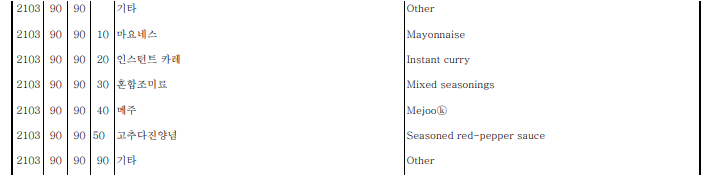
At present, meju (HSK No. 2103.90-9040) is listed, together with mayonnaise, instant curry, and mixed seasonings, under the ‘other’ item (90) of the ‘other’ subheading, which classifies sauces and preparations therefor, mixed condiments, and mustard flour and meal and prepared mustard, within Chapter 21, to which ‘various food preparations’ belong.
The same ‘other’ subheading also includes the jang products doenjang, chunjang, and gochujang.
The HS Explanatory Notes do not contain a definition of meju or related content, and goods classified under heading No. 2103 are commonly subject to the basic rate of 8%.
3. Whether the Goods at Issue Can Be Included in HSK No. 2103.90-9040
However, the main reason the Customs Valuation and Classification Institute regarded the goods at issue as HSK No. 2008.19-9000 (fruit, nuts, and other parts of plants suitable for food, prepared or preserved by other methods), with a customs duty rate of 45%, was that it received a reply to its inquiry from the Commissioner of the Ministry of Food and Drug Safety stating that boiled soybeans fermented with Bacillus subtilis constitute ‘cheonggukjang.’
However, it cannot be regarded that all soybeans fermented with Bacillus subtilis become cheonggukjang; other attributes must also be satisfied.
The definition of cheonggukjang states that it refers to a ‘paste, pellet, or powder.’
This does not match the state of being dried in the shape of soybean grains, which was the standard at the time of the import declaration of the goods at issue.
It also had to be confirmed that the goods conform to the quality standard for meju rather than the quality standard for cheonggukjang.
3. Tax Appeal Litigation, What Was the Court's Determination?
Regarding the tax appeal litigation, the court found that the goods at issue fall under meju.
The reasoning was that whether Aspergillus oryzae was used, as the defendant argued, is not a decisive factor, and that considering the nutritional components and the use, it is reasonable to regard the goods as falling under meju.
Accordingly, the court determined that a customs duty rate of 8% should apply to the goods at issue, and that the head of the Customs Office's rejection of the claim for correction was unlawful.
The customs duty rate for meju was set at 8%, together with various jang products and the like, because it is goods closely related to the everyday dietary life of the people.
The court held, “The customs duty rate for meju was set low because consideration was given to keeping the burden on the final consumer, arising from the pass-through of customs duty, within a reasonable level, and there is no public-interest necessity to regard the goods at issue, whose inherent use is for making doenjang, as goods other than meju.”
4. Tax Appeal Litigation, What Was Daeryun's Strategy?
This was a case in which the classification of the composition of the goods at issue became the point of dispute in the tax appeal litigation.
A company that imports or exports goods may be put in a difficult position when, as in the case above, the classification of the composition of the goods is construed differently and a high customs duty is imposed.
For a company that must prepare for such customs litigation, it is above all important to analyze the precise code and item classification of the goods at issue and to assess whether the customs authority's taxation disposition is lawful.
At Daeryun Law Firm LLP, 🔗tax attorneys with experience in the tax authorities and 🔗customs attorneys, together with customs specialist advisors who have experience as licensed customs brokers, form a task force and represent clients in claims for correction and requests for review against improper taxation dispositions.
If you need prior examination or the like in connection with the classification of various items such as foodstuffs, medical devices, transportation equipment, and electrical equipment, you can receive advice on the application procedures, so you are welcome to request a consultation regarding any related inquiries at any time.