Korea Association for the Rehabilitation of Persons with Disabilities, discusses ‘direction of improving domestic law’ to realize UNCRPD
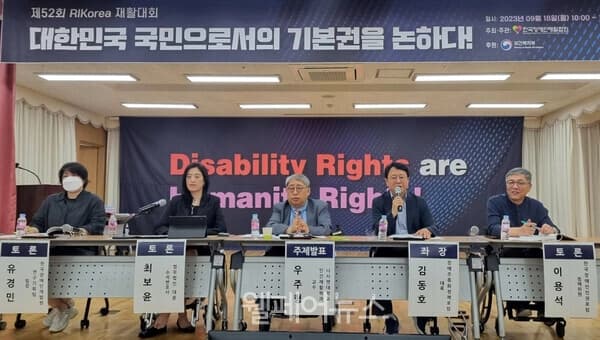
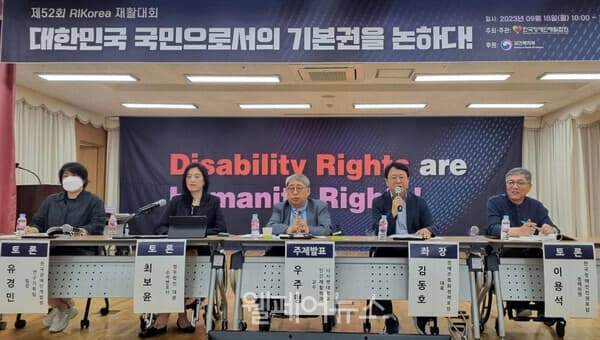
In order to harmonize UNCRPD domestic laws, we seek practical improvements that can be felt by the parties in solidarity with the launch of the investigation and analysis TFT.The Korean Association for the Rehabilitation of Persons with Disabilities announced that at the 52nd RI Korea Rehabilitation Conference held on the 18th of last month, about 100 experts from the disability community and academia from all over the country participated and held a planning session titled ‘Directions and tasks for improving domestic law for the realization of the UN Convention on the Rights of Persons with Disabilities (UNCRPD)’ to explore ways to harmonize UNCRPD domestic laws. The Korea Association for the Rehabilitation of the Disabled, established in 1954, is Korea's first organization for the disabled. It has been holding the RI Korea Rehabilitation Conference every September, a forum for public discussion to explore various domestic and international disability issues and alternatives. The 52nd Rehabilitation Conference, prepared in conjunction with the RI Korea Expert Committee, which includes 218 professors and center directors from all over the country, consisted of a total of 9 sessions, and discussed major issues in each detailed field such as health, occupation, and education, as well as macro issues such as constitutional amendment and harmonization of UNCRPD domestic laws based on the basic rights of persons with disabilities. The planning session to discuss basic rights as citizens of the Republic of Korea through UNCRPD was chaired by Kim Dong-ho, CEO of the Disability Mainstreaming Policy Forum, and Professor Woo Woo-hyung of Nazarene University gave a presentation. Subsequently, Lee Yong-seok, policy committee member of the Korea Forum for the Rights of Persons with Disabilities, senior lawyer Choi Bo-yoon of the law firm, and Kyeong-min Yu, team leader of the Korea Development Institute for the Disabled, appeared as discussants. In his presentation, Professor Woo Joo-hyung pointed out the reality, saying, “Even today, 15 years after the UNCRPD came into effect, there is a lack of a national-level action plan.” “Not only that, it is difficult for Korea to know whether the current domestic law conflicts with the UNCRPD, and which law needs supplementation.” To improve this, Professor Woo announced the launch of a task force team with the Korea Rehabilitation Association for the Disabled to seek ways to improve domestic laws to realize UNCRPD. Professor Woo mentioned controversial laws that urgently need improvement, such as the Enforcement Decree of the Maternal and Child Health Act, which conflicts with the right to life, and Article 732 of the Commercial Act, which conflicts with the right to health, and explained, “In order to improve laws that are in conflict with the UNCRPD or require supplementation, we plan to take a multi-year approach with a two-track investigation and analysis TF team and an on-site TF team.” The research and analysis TF team plans to focus on establishing indicators and legal amendments to determine whether there is a conflict of laws, and the proposed legal amendments will be implemented through the field TF team composed of disabled people's solidarity. During the discussion, policy committee member Lee Yong-seok emphasized the urgency of harmonizing UNCRPD with domestic law, saying, “Various issues that are incorporated in our lives, including the issue of differential treatment of disabled persons registered as foreigners, the controversy over judicial hospitalization of psychosocially disabled people, and the protected birth system that can be abused to legally abandon children with disabilities, are issues that conflict with UNCRPD.” Lawyer Choi Bo-yoon said, “UNCRPD is an international treaty that is incorporated into domestic law without separate implementing legislative procedures.” He said, “It is unfortunate that there is no government position or regulations in case of conflicting domestic laws, lack of discussion to prepare the basis for action on conflicting laws, and few specific cases have been discovered.” He added, “I hope that full-scale discussions on improving domestic law through the operation of this TF team will become more public and attract interest from the government and the National Assembly as it is a big step in harmonizing UNCRPD domestic law.” Yu Kyung-min, head of the UNCRPD team, who was the last discussant, said, “Last June, UNCRPD team leader Kyung-min Yoo said, “I think it is essential to reorganize the legal system for harmonization of UNCRPD domestic laws, which is an international issue not only in Korea but also with the UN Conference of States Parties on the Rights of Persons with Disabilities being held on the topic of harmonization of domestic laws. However, there is still confusion about terminology,” he said. “I hope that the concepts and indicators will be clearly defined in the future activities for harmonization of UNCRPD domestic laws.” Kim In-gyu, president of the Korea Rehabilitation Association for Persons with Disabilities, who hosted the discussion, said, “Harmonization of UNCRPD domestic laws is a disability policy to guarantee the basic rights of persons with disabilities.” “Solidarity with the disabled community is essential by presenting a blueprint,” he said, adding, “I hope everyone in the disabled community will join us so that we can lead the National Assembly and the government to move proactively as one.” [Reporter Park Seong-yong, Disabled Newspaper/Welfare News] [View full article] - Korea Association for the Rehabilitation of Persons with Disabilities, discusses ‘direction of improving domestic law’ to realize UNCRPD










![건강기능식품 꼼꼼히 따져 먹고 가려 먹자 [KTV생활&정책]](/_next/image?url=https%3A%2F%2Fd1tgonli21s4df.cloudfront.net%2Fupload%2Fboard%2Fbroadcast%2F20230807022943472.jpg&w=828&q=75)
![건강기능식품 꼼꼼히 따져 먹고 가려 먹자 [KTV생활&정책]](/_next/image?url=https%3A%2F%2Fd1tgonli21s4df.cloudfront.net%2Fupload%2Fboard%2Fbroadcast%2F20230807022943472.jpg&w=3840&q=75)