Page title background (PC version)Page title background (mobile version)

Press Coverage

Numerous media outlets recognize the expertise of Daeryun Law LLC.
Explore interviews, legal commentary, and columns by Daeryun lawyers.

Medipana
2025-08-25
[기고] 의약품허가특허 연계제도 중심으로 본 허가와 특허 교차점
[Contribution] The intersection of approval and patent with a focus on the pharmaceutical approval and patent linking system
Pharmaceutical product approval is governed by the Pharmaceutical Affairs Act and patents are separate concepts governed by the Patent Act, but in practice, the two are closely linked. Below, we will provide an overview of the patent system and the pharmaceutical product approval process and explain how they are linked.1. What is a patent?A patent is an intellectual property rights system that legally protects an inventor so that he or she can exclusively practice an invention for a certain period of time. Korea's patent law stipulates inventions with 'industrial applicability', 'novelty', and 'inventive step' as patent requirements, and provides strong exclusive effects to registered patents to prevent unauthorized use by third parties. According to various studies, drug prices plummet by more than 70-80% after patent expiration. Therefore, in the pharmaceutical industry, patent rights are a key means of recovering enormous development costs. Patents, which cost hundreds of billions of won to develop a new drug, can be said to be a factor directly related to the survival of a company.2. What is the drug approval/patent linkage system? This system is a device that connects patents and drug product approvals to protect the patent rights of original drugs and at the same time promote the legal entry of generics. Korea's approved patent linkage system consists of the following three axes: ① Patent registration: When the original company applies for product approval, related patents can be registered with the Ministry of Food and Drug Safety. These patents are taken into consideration when a generic company applies for product approval. ② Notification system and sales ban: Generic developer is obligated to notify the original company when applying for approval, and if it is judged that there is a risk of infringing on the patent, the original company can apply for a sales ban. ③ Priority sales product approval: The generic company that succeeds in patent evasion for the first time can sell alone for 9 months. This acts as a device to encourage generic development.3. The general flow of patent registration from patent application to registration, duration and extension is as follows. ① Filing: The contents of the invention are submitted to the Korean Intellectual Property Office along with the specification. ② Examination and registration decision: After application, the examination stage is entered. At this time, the patent office examiner determines whether the patent requirements are met and if it is judged to be a valid patent, it is registered. ③ Duration: Lasts for 20 years from the date of application, and in the case of pharmaceutical patents, the 'permission delay period' is Reflecting this, it is possible to extend the duration for up to 5 years. Pharmaceutical patents are usually filed in the early stages of development, before or after preclinical or phase 1 clinical trials. As explained earlier, strong exclusive effect is recognized in registered patents.4. Pharmaceutical product approval: General industrial products undergoing clinical trials from phase 1 to phase 3 can be manufactured and sold freely. However, in the pharmaceutical industry, only drugs that have received ‘item approval’ after passing phase 1 to 3 clinical trials can be sold. In other words, there is a strong hurdle called ‘approval’ in the pharmaceutical market.5. In the pharmaceutical development process where patents and approvals are linked, a patent for the 'target substance' is generally applied first, and then approval is obtained after clinical trials. These two processes are linked in the following way: patents are a means of protection, and licensing is a means of market entry. No matter how good a patent you have, you cannot sell it without permission, and conversely, even if you have permission, if you do not apply for a patent and do not have exclusive rights or the patent has expired, you cannot make a profit. Even when a generic company launches a generic drug after the original company launches a product, the approval and patent are linked. It is common for generic companies to analyze the original company's patents and establish an avoidance strategy (claim invalidity or non-infringement). Afterwards, if avoidance is deemed possible, the generic company will apply for drug product approval, and according to the patent system (license-patent linking system), the generic company must notify the patent holder of the approval application. At this time, if the original company applies for a sales ban, the Ministry of Food and Drug Safety can delay the entry of generics for a certain period of time. Conversely, there is also a system in which generic companies attack the original company. The priority sales product licensing system is an incentive to encourage patent avoidance. If the generic company successfully evades the patent, it will benefit from exclusive sales rights for a certain period of time.6. Conclusion It is no exaggeration to say that the success or failure of new drug development or generic drug development depends on ‘how to devise a patent strategy to recover the cost of new drug development,’ ‘whether a valid patent exists at the time of approval,’ and ‘whether that patent can be avoided.’ Therefore, we conclude by emphasizing that pharmaceutical companies must not only consider the simple approval process but also have a complex response strategy that includes patent strategy. | Contribution | Lee Il-hyeong, attorney at Daeryun Pharmaceutical Bio Healthcare Center[View full article] [Contribution] The intersection of approval and patent with a focus on the pharmaceutical approval and patent linking system
Financial News
2025-08-25
명의만 빌려줬는데...'가짜 석유 판매' 공범 몰린 30대 檢 판단은
I only lent the name... The decision to make a 30-year-old accused of being an accomplice in 'selling fake oil'
A woman who was sent to the prosecution on charges of aiding and abetting the sale of fake oil was acquitted. According to the legal community on the 25th, the Daejeon District Prosecutors' Office decided not to indict Mr. A, in his 30s, on charges of aiding and abetting violation of the Petroleum and Petroleum Alternative Fuel Business Act on the 17th. In 2021, Mr. A was asked by his former lover, Mr. B, to lend him the business name needed to operate a gas station. At the time, Mr. B persuaded him by emphasizing that he had bad credit, and Mr. A reportedly responded. However, Mr. B later operated a gas station in Mr. A's name and was caught selling fake oil worth 230 million won for about two weeks starting in March of the following year. The police determined that Mr. A helped Mr. B sell fake oil in exchange for a certain amount of compensation, and handed the case over to the prosecution. Mr. A completely denied the charges. It is true that he lent his name, but he was not aware of the sale of fake oil at all. Mr. A claimed, “I first met him while working as a part-time worker at Mr. B’s business, and since we were thinking of getting married, I took the loan of the name lightly.” He added, “In fact, I did not even receive the promised profits from the business, so I asked Mr. B to close the business several times.” The prosecution found that Mr. A was not guilty. The prosecution explained, “It is confirmed that the suspect lent his name in exchange for financial compensation,” and added, “Also, there is a vague perception that the gas station business will be used for illegal purposes such as tax evasion, but when looking at various circumstances, it is difficult to say that the suspect was aware of the sale of fake oil and participated in the crime.” Kim Dong-gu, an attorney at Daeryun Law Firm who represented Mr. “It must be done,” he said. “We were able to receive an acquittal by thoroughly explaining through objective data such as communication records and bank account deposit and withdrawal details that Mr. A was not aware of the fact that fake oil was being sold.”[View full article] I only lent the name... The decision to make a 30-year-old accused of being an accomplice in 'selling fake oil'
KBC Gwangju Broadcasting
2025-08-25
'정부 관리' 예술물 철거했다 7억 원대 피소…法 "배상 책임 없다"
'Government official' sued for 700 million won for demolishing artwork... Law: “No liability for compensation”
The former representative of the officetel commercial management group, who was sued for 700 million won in damages for arbitrarily removing an art sculpture installed in the building's common space, won the case in the first trial. On the 17th of last month, the Seoul Central District Court dismissed the plaintiff's claim in a lawsuit seeking damages filed by the officetel commercial management group against four people, including former CEO Mr. In 2015, Mr. A and others demolished and discarded the art sculpture installed in front of the main entrance on the first floor of the officetel building. Later, in 2020, the district office ordered the management team to restore the demolished sculpture to its original state. This measure was taken in accordance with the old Culture and Arts Promotion Act, which stipulates that when constructing a building of a certain size or larger, an amount equivalent to a certain percentage of the construction cost must be used to install art decorations such as paintings, sculptures, and crafts. It was in accordance with Article 11, Paragraph 1. The management team that received instructions for restoration claimed that Mr. A, who was in charge of disposal at the time, demolished the sculpture without permission from the district office and caused damage to the officetel by failing to obtain the consent of more than 2/3 of the unit owners required under the Apartment Building Act. On the other hand, Mr. A and others countered that they were not responsible for compensation. According to the management regulations, they are only liable for damages when they cause damage due to intent or gross negligence, and they were responsible for damages at the time. This means that they did not neglect their duties. At the time, the sculpture was removed in response to complaints from residents, and the management director also did not notify them of legal procedures during the process. The court ruled in favor of Mr. A and others. The court said, "It is acknowledged that the defendants proposed a project and demolished it without going through the procedures set forth in the Multi-Purpose Building Act," but added, "There is a strong possibility that this act will be viewed not as a personal gain, but as a measure for the benefit of the residents, such as maintenance of old facilities and improvement of aesthetics." It also said, "The defendants are not legal experts, and unless the professional consignment management company that communicated with the defendants during the demolition pointed out the legal problem, there is no violation of their duty of care." He stated the reason for the sentencing, saying, "It is difficult to say that there was," and stated the reason for the sentencing. Attorney Park Jeong-gyu of Daeryun Law Firm, who represented the defendant, said, "The issue in this case was whether the liability requirement of 'intention or gross negligence' required by the management regulations was met." He added, "The members of the management group were 'ordinary people' who were only representatives of each neighborhood, and did not specifically know the laws related to the sculpture in this case, and it was difficult to easily understand the legal nature of the sculpture or the basis for its installation. “I gave my explanation,” he said.[View full article] 'Government official' sued for 700 million won for demolishing artwork... Law: “No liability for compensation”
Pharmacy Newspaper
2025-08-25
[기고] AI ·IoT 기반 의료기 법적·윤리적 측면 도전 과제
[Contribution] Challenges in legal and ethical aspects of AI and IoT-based medical devices
Contributors and Pharmacy Newspaper 「We planned a series related to medical devices.. In this contribution AI and IoT Ethics of basic medical devices, Let’s take a look at regulatory challenges. 1. A new paradigm for medical devicesChatGPTrepresented by AI While the craze is spreading across society,, Artificial intelligence in the medical field(AI)and Internet of Things(IoT) Technology is being adopted quickly. Learned video data AI software is cancer∙Early detection of major diseases such as cardiovascular disease, IoT Patient's electrocardiogram via wearable device, blood sugar, sleep patterns 24The sight of time monitoring is no longer unfamiliar..However, these innovative changes are also accompanied by legal and ethical challenges.. "AIWho is responsible if the diagnosis made by?", "IoT How safe is the patient data collected through the device??" Questions such as these have now become an unavoidable reality.. 2. AI·IoT Characteristics of medical devices – Products that are difficult to regulate under the existing regulatory systemAI Algorithm's learning ability: Once an existing medical device receives approval, its structure and performance are fixed.. however AI·IoT The devices have fundamentally different characteristics. in other words AI The performance of the algorithm is updated as the learning data increases., Sometimes the forecasting method itself can change. frequent updates: Software patching through the above learning, Dataset replacement, Cloud updates, etc. are made and accordingly, AI Medical devices change frequently. For existing medical devices, there are almost no changes to the approval requirements after approval., Existing medical device laws are enacted to suit these characteristics.. however AI Medical devices can be difficult to regulate under existing approval systems due to frequent updates.. IoT The ambivalence of connectivity: Remote monitoring and cloud linkage are possible through continuous network connection, and the resulting convenience is considerable., As a reaction, security risks also increase.. existing medical laws-Existence of areas that are difficult to regulate through the medical device law system: With existing medical devices, the doctor is the subject of the final diagnosis, so the doctor has ultimate responsibility.. However, you can make your own judgment based on the learning data. AI For software, As medical devices can even perform diagnostics, it may become unclear who holds ultimate legal responsibility..These characteristics are AI·IoT These are factors that make regulating medical devices difficult., Accordingly, various legal, There are ethical issues involved. 3. ethical challenge – Issues of patient rights and responsibilities. Lack of transparency in the decision-making processAIThe decision-making process of 'black box'close to. In fact, research is still ongoing. ChatGPTIt is said that it is difficult for humans to explain the thought process of. in other words, AIThis means that it is difficult for us to fully understand the way of thinking of.patients and medical staff AII received a diagnosis from, It is difficult to know how the results were derived.. As a result, the patient's right to self-determination is violated or, Problems may arise where legal responsibility becomes unclear.. me. Unclear responsibilityAI The following entities are involved in diagnostic activities using medical devices:, The distribution of responsibilities between them is still unclear.• medical staff: The doctor who made the final diagnosis and treatment decision• manufacturing company: Medical device company that designed the algorithm• hospital: The organization that introduced the device and used it on the patient. Privacy and Security RisksIoT The risk of hacking inevitably follows the process of real-time data transmission through devices.. patient's electrocardiogram, When sensitive health information such as blood sugar records is leaked to the outside world, The patient's personal rights can be seriously violated..In addition, by using patients’ health information, AI Training diagnostic software, As far as the contributor understands, consent for the use of personal information has not yet been properly obtained. 'AI learning'I know that there are many cases where. Although it has not been an issue yet, In this regard, the issue of personal information infringement may also arise.. 4. Regulatory challengesIn the case of Korea 「Medical Device Act」and recently enacted 「Digital Medical Products Act」via software medical devices(SaMD)It regulates, The regulatory sandbox system is used to provide temporary permission and verification of new technologies.. but, AI algorithmic 'continuous learning'Specific regulations or previously mentioned responsibilities, Specific regulations on personal information protection issues are lacking..USA(FDA)silver AI/ML SaMD Related guidelines, etc. are disclosed on the website.. European Union(EU)The main feature of regulation is the dual regulatory approach.. European Medicines Agency(European Medicines Agency, EMA)This medical device regulation(Medical Device Regulation, MDR) and Artificial Intelligence Act(Artificial Intelligence Act, AIA)according to AI Manage basic medical devices.MDRsilver AI Design of medical devices, including basic medical devices, development, sets out requirements for clinical evaluation and post-marketing surveillance;, AIAis a risk-based classification, transparency, Defines human supervision requirements, etc..medical treatmentAI The company is USA, When entering the European market, you must meet strict standards to enter the market, so you need to prepare for this.. Additionally, domestic regulations are still being established., It seems necessary to prepare in advance for regulations that will become stricter.. 5. conclusionAI·IoT Based medical devices are already revolutionizing the lives of patients., It is clear that this trend will accelerate further.. However, the problem is that there is still a large gap between the speed of technological development and the speed of development of legal and ethical systems.. especially, The ethics discussed earlier, The reality is that no one can clearly explain how to deal with legal problems.. Medical device innovation is sustainable only when patient safety and rights are guaranteed, so ethical practices that ensure this are possible., Regulatory discussions are urgently needed.. Therefore, regulators, industry, medical staff, The contributor believes that a forum for discussion in which the legal community participates is needed..one side, big flow AI·IoT It is clear that government regulations related to medical devices will be strengthened.. Some regulations may require considerable technical difficulty., I think there is a need for related industries to prepare proactively for this.. Contributor: Attorney Lee Il-hyung(ilhyunglee@naver.com)lawyer/chemist/patent attorney/american accountant(Maine)pass the exam(前)Attorney at Celltrion Domestic Legal Team(現)law firm(finite) Daeryun Medical Pharmaceutical Group/Director of Pharmaceutical Bio Healthcare Center [View full article] [Contribution] Challenges in legal and ethical aspects of AI and IoT-based medical devices
Chosun Biz
2025-08-21
[Why] “지주사 지위 필요없다” 일진홀딩스 이어 노루홀딩스도 반납한 까닭은
[Why] “There is no need for holding company status” The reason why Noroo Holdings returned after Iljin Holdings
When a company excluded from a holding company under the Fair Trade Act reports, the Fair Trade Commission reviews it.“There are more regulations than benefits”Mid-sized corporate holding companies are giving up their holding company status under the Fair Trade Act.. past 2Following Iljin Holdings’ abandonment of holding company status in February,, Noroo Holdings also gave up its holding company status.. In particular, it is noteworthy that they are voluntarily giving up their positions.. The industry believes that this is because there are more regulations than the actual benefits of maintaining a holding company.. 20According to the Japanese mid-sized business community and the Financial Supervisory Service's electronic disclosure system,, Noroo Paint, Noroo Auto Coating, etc. 8Noroo Holdings, a holding company that controls 10 subsidiaries, 14We were notified by the Fair Trade Commission that we do not qualify as a holding company under the Monopoly Regulation and Fair Trade Act.. anticipant 2month 19Iljin Holdings was also notified by the Fair Trade Commission that the Fair Trade Act does not apply to holding companies..What is noteworthy is that both companies voluntarily gave up their holding company status.. Noroo Holdings last year 8month 13Day, Iljin Holdings last year 2month 17Reported to the Fair Trade Commission requesting exclusion from the holding company under the Fair Trade Act.. As the Fair Trade Commission determined that the company's report met the requirements, the two companies were excluded from holding companies under the Fair Trade Act..In fact, the two companies already did not meet the holding company requirements.. The Fair Trade Commission passed 2017Based on the total assets of the holding company 1000From 100 million won 5000This is because it was raised to billions of won.. Noroo Holdings 2024The total assets on a separate basis at the end of the year are 3897It's billions of won. During the same period, the total assets of Iljin Holdings were also 2858It's billions of won. 5000Noroo Holdings and Iljin Holdings, valued at less than 100 million won, were scheduled to automatically lose their holding company status..However, the Fair Trade Commission has postponed the application of the standards to companies that do not meet the holding company standards, allowing companies to maintain their holding company status if they wish., You can now give up your holding company status if you don't want to.. The Fair Trade Commission has set the standards 2027year 6postponed until March.The reason why mid-sized companies are giving up their holding company status is because there are many regulations.. According to the Fair Trade Act, a holding company is 2It is prohibited to hold debt exceeding two times the amount of debt.. The standards for financial safety are higher than those of general corporations..There is also an obligation to maintain shareholding ratios in subsidiaries and subsidiaries.. In the case of a listed company, the holding company has the total number of issued shares for its subsidiaries. 20% more, In case of unlisted companies 40% It is mandatory to hold more than. About the grandchild company 50% Must have a stake of more than.There are also restrictions on stock ownership.. A holding company cannot own stocks of domestic affiliates other than its subsidiaries., Shares of non-affiliated companies are divided into the total number of shares issued by the company. 5%It is also prohibited to hold more than. You cannot even own stocks of financial companies..The obligation to disclose governance structure is also a burden for holding companies.. Holding company shareholder status, Status of subsidiaries and subsidiaries, Stock ownership status, Financial status, etc. must be disclosed in detail., If excluded from a holding company, it is free from this detailed disclosure obligation and only has to disclose the same level as a general company..Woohyung Jeong, senior attorney at Daeryun Law Firm, said: “The Fair Trade Act views holding companies as targets of regulation in order to establish a fair economic order.”While “Debt ratio is restricted when excluded from holding companies under the Fair Trade Act., Obligation to maintain subsidiary shareholding ratio, This can be resolved through restrictions on stock ownership of affiliates, etc., The obligation to report or disclose is reduced, allowing for more free corporate activities.”explained. On the other hand, the actual benefits gained from maintaining the holding company status are small.. Previously, ‘Special exception for non-inclusion of income and dividends from holding companies in gross income’Through this, holding companies had the advantage of being recognized as less subject to tax on dividends than general corporations.. In the case of a general corporation, regarding the invested corporation 100%Dividends must have shares of 100%If excluded from taxation, In case of a holding company 30% Dividend even if it is more than 90%It was possible to exclude taxation for.for example Ahistorian 50%Dividends for companies with a shareholding ratio of 100If you are receiving billions of won, General corporations 50Hundreds of millions of won, The holding company 90Hundreds of millions of won were excluded from taxation..However, with the revision of the Corporate Tax Act, the standards for non-inclusion of profits for holding companies and general corporations were integrated.. Re-taxing dividends on which corporate tax has already been paid ‘double taxation’As a social consensus was formed that, 2022year 12month 31After this date, whether it is a holding company or a general corporation, the shareholding ratio 50% If it is above this, the entire dividend can be excluded from taxation..Currently, the purpose is to provide additional time for the holding company to acquire stocks of listed subsidiaries. ‘Special exception to the holding company's non-inclusion rate of income and dividends in profits’go 2026year 12month 31Although it was postponed until, 2027From 2018, profits for the holding company are expected to decline..Hanmin Kim Tax Accountant Hanmin Tax Accountant “In the past, a holding company with a small shareholding ratio could be subject to a high rate of non-inclusion of dividends in profits., 2023Since the standards for holding companies and non-holding companies have been integrated, actual profits have decreased compared to general corporations.”said. As Noroo Holdings was excluded from the holding company 2026The corporate tax burden on dividends is expected to increase by 2020.. However, most of the shares in subsidiaries are 50% Because it is more than, 2027The burden is expected to decrease from 2018 due to the abolition of special corporate tax provisions.. As of the first half of this year, the shareholding ratio of subsidiaries is Noroo Paint. 50.5%, Noroo Chemical 100%, IPK 40%, Noroo Auto Coating 50.47%, Basic Tech 100%all.Oh Sang-wook, an attorney at Daeryun Law Firm, “(Noroo Holdings) If excluded from a holding company, the benefit of not including dividends in corporate taxable income will be reduced.”said.The industry believes that mid-sized companies will continue to return to their holding company status.. An accounting manager at a mid-sized company said: “asset size 1000More than 100 million won 5000Among holding companies with less than 100 million won, an increasing number of companies are considering whether they should maintain their holding company status under the Fair Trade Act.”said. but, Giving up the status of a holding company under the Fair Trade Act does not mean dismantling the actual holding company system..Reporter Kim Jong-un (xbookleader@chosunbiz.com) [View full article] [Why] “There is no need for holding company status” The reason why Noroo Holdings returned after Iljin Holdings
2 places including Laurider
2025-08-21
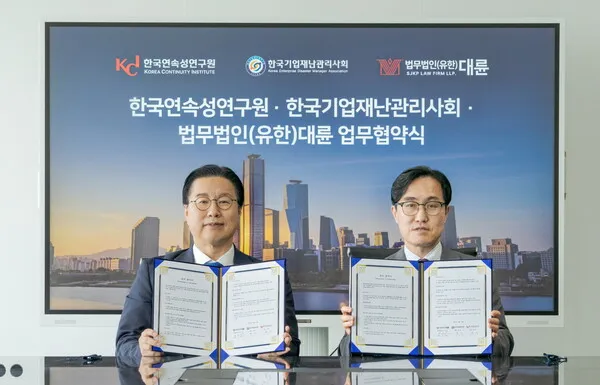
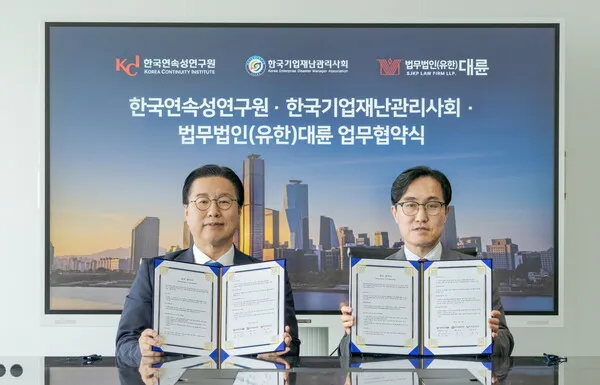
법무법인 대륜, 한국연속성연구원·한국기업재난관리사회와 MOU
Daeryun Law Firm, MOU with Korea Continuity Institute and Korea Corporate Disaster Management Association
Providing comprehensive risk management solutions including corporate disaster management... ‘Securing business continuity’ Daeryun “We will become a strong partner for corporate customer growth through cooperation with experts” Daeryun Law Firm announced on the 21st that it signed a three-party MOU with Korea Continuity Research Institute Co., Ltd. and Korea Corporate Disaster Management Association to strengthen corporate disaster management and legal risk response. At the signing ceremony held at the Daeryun Seoul headquarters branch office on August 19, Daeryun Law Firm Management CEO Kim Kuk-il, CEO Choi Yi-seon, lawyer Son Gye-jun, Korea Continuity Research Institute and Korea Corporate Disaster Management Association CEO and Chairman Yang Jun, Vice Chairman Jang Ho-jin, and Director Park Jong-pil attended. Korea Continuity Research Institute Co., Ltd. is an organization that provides professional consulting and education for corporate business continuity, including corporate disaster management (BCMS), major civil disaster response consulting, risk assessment, and recovery strategy establishment. In particular, it helps maintain corporate operations along with immediate damage recovery in the event of a disaster, and has strengths in document work as well as establishing a practical disaster response system. The Korea Corporate Disaster Management Association is a professional organization that strengthens the capabilities of the ‘Corporate Disaster Manager’, a national professional qualification of the Ministry of the Interior and Safety, and establishes the ‘Corporate Disaster Mitigation Activities’ system, and is working to establish a policy and institutional foundation to revitalize the ‘Act on Support for Corporate Autonomous Activities for Disaster Reduction’. With this MOU, Daeryun plans to provide comprehensive risk management solutions, including corporate disaster management, and promote the development of an integrated consulting model to secure corporate business continuity. Specifically, it plans to ▲ strengthen the legal basis and risk response system for the corporate disaster management consulting process, ▲ jointly provide legal advice on the Severe Accident Punishment Act and disaster reduction activities, and ▲ assist in joint bidding for large corporations and public institutions by holding joint seminars and training. Yangjun, Korea Continuity Research Institute Co., Ltd. The CEO said, “This MOU is meaningful in establishing a system that operates in the event of an actual disaster, not just a document,” and “We will create a market where talented disaster management experts are recognized.” Kim Kuk-il, CEO of Daeryun Law Firm, said, “Through cooperation with corporate disaster management experts, Daeryun will become the strongest legal partner for the growth of corporate clients.” He added, “By combining Daeryun’s one-firm system and their expertise, we will create synergy that goes beyond the limitations of the existing market.” “We will create it,” he emphasized. Meanwhile, Daeryun Law Firm is helping major domestic companies achieve stable growth by providing advice on the Severe Accident Punishment Act, criminal response to industrial accidents, and corporate risk consulting related to information leakage incidents. Reporter Son Dong-wook, Lawleader, twson@lawleader.co.kr Law Leader - Daeryun Law Firm, MOU with Korea Continuity Institute and Korea Corporate Disaster Management Association (Click here) Money Today - Strategic three-party MOU with Korea Corporate Disaster Management Association and Daeryun Law Firm-KCI (Click here)
4 places including Seoul Shinmun
2025-08-21
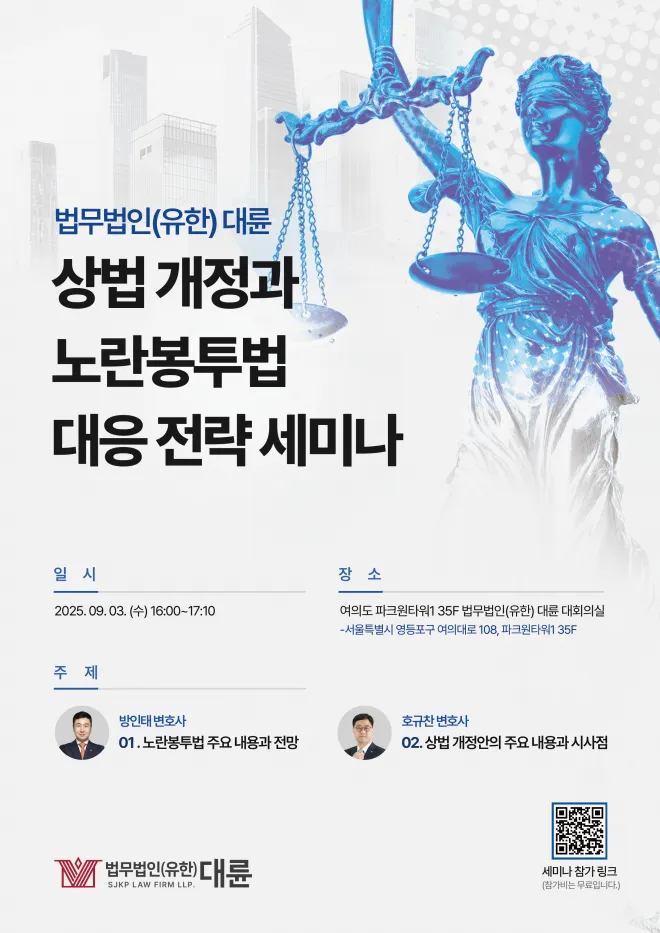
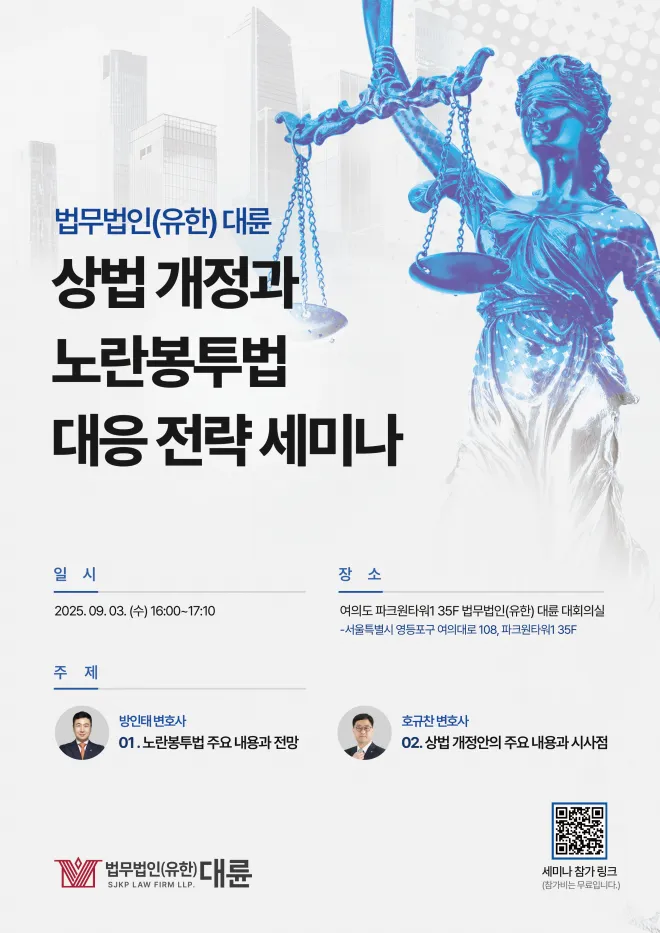
법무법인 대륜, 상법 개정·노란 봉투법 대응 전략 세미나’ 개최
Daeryun Law Firm holds ‘Commercial Act Revision and Yellow Envelope Act Response Strategy Seminar’
Daeryun Law Firm announced on the 21st that it will hold the ‘2025 Commercial Act Revision and Yellow Envelope Act Response Strategy Seminar’ at its Seoul headquarters branch office on September 3. This seminar was prepared to preemptively prepare for the labor-management relations and corporate governance environment that will change depending on changes in laws. On the 3rd of last month, a bill to amend the Commercial Act, which aims to expand directors' duty of loyalty and improve corporate governance, was passed by the National Assembly. This amendment also includes strengthening the independent director system, introducing an electronic general meeting of shareholders, and strengthening the 3% rule, so companies are busy responding to this. In addition, Articles 2 and 3 of the Labor Union Act, the so-called ‘Yellow Envelope Act’, which contains contents such as limiting companies’ claims for compensation and expanding collective bargaining matters, are also scheduled to be processed at the extraordinary plenary session of the National Assembly this month. It is expected to bring about significant changes in labor-management relations along with the corporate management environment, so it is necessary to prepare response strategies after the law is enforced. At the seminar, attorneys Ho Gyu-chan (36th class of the Judicial Research and Training Institute) and Bang In-tae (41st class of the Judicial Research and Training Institute) from Daeryun Corporate Legal Group will appear as presenters. Attorney Bang, a labor lawyer registered with the Korean Bar Association and well-versed in legal advice in the human resources and labor areas of companies, will give a presentation on the main contents and prospects of the Yellow Envelope Act. Attorney Ho explains the key issues and implications of the amendment to the Commercial Act. While working in the Commercial Law Department of the Ministry of Justice, Attorney Ho participated in the revision of the corporate section of the Commercial Act, and later served as an advisor on corporate governance and financial law to law firms and financial institutions. After the presentation, the two lawyers plan to conduct a Q&A and discuss practical responses to major issues. The seminar will be held simultaneously online and offline, and anyone can apply for free. Applications for participation can be made on the Daeryun official website. Kim Kuk-il, CEO of Daeryun Management, said, "The Yellow Envelope Act and the amendment to the Commercial Act are important issues that can simultaneously bring new risks and opportunities to companies' labor-management relations strategies, governance structures, and overall operating methods. I hope that this seminar will help companies review their response strategies and establish practical directions." Meanwhile, Daeryun focuses on corporate legal groups and provides customized legal services for companies such as labor re-transfer, collective bargaining, and board consulting. We are providing services, and we have recently formed a task force in response to the amendment to the Commercial Act to support the preparation of strategic countermeasures.. Reporter Jeong Cheol-wook, Busan[View full article] Seoul Shinmun - Daeryun Law Firm holds ‘Commercial Act Revision and Yellow Envelope Act Response Strategy Seminar’ (Go here) Blotter - [Law Firm ON] Daeryun holds ‘Commercial Act Amendment and Yellow Envelope Act Response Strategy Seminar’ (Go here) Tax Ilbo - Daeryun Law Firm holds ‘Commercial Act Revision and No-Severe Act Response Strategy Seminar’ (Go here) Law Leader - Daeryun Law Firm holds ‘Commercial Act Amendment and Yellow Envelope Act Response Strategy Seminar’ (Go here)
KBC Gwangju Broadcasting
2025-08-20
거짓 리뷰 올렸다?...'명예훼손' 입건 유튜버, 무혐의
Posted a false review?... YouTuber booked for 'defamation', acquitted
A decision was made not to forward a YouTuber who was being investigated by the police for posting a malicious home appliance review video. On the 14th of last month, Yuseong Police Station in Daejeon decided not to forward a man in his 40s, Mr. A, who is suspected of defamation under the Information and Communications Network Act. This year, Mr. A was accused of posting a video containing false facts related to the products of electronics company B on his YouTube channel. Company B claimed that Mr. A had exaggerated the defect rate of its products by inflating the actual rate. It was claimed that the cause of the defect was determined to be a manufacturing defect, unlike in reality. Mr. A denied the charge, saying that he had compared the defect rate with similar product lines through an actual investigation. In addition, the company name was not mentioned in the video, and the product was also mosaiced, so it was emphasized that the manufacturer of the product could not be identified as Company B. The police determined that Mr. A was not guilty. The police said, "The content contained in the video is based on the suspect's own investigation as well as the results of experiments by private companies and researchers. He said, "The suspect requested Company A to make improvements in this regard, but the company ignored them. In the long term, it appears that Company A also needs to inspect or correct the cause of the defect rate." He also explained the reason for the decision to not forward the video, saying, "The suspect posted the video because it was created based on evidence for the purpose of public interest, not to slander Company A, so there was a perception that it was false." Attorney Cho Sang-soo of Daeryun Law Firm, who represented Mr. A, said. “Article 310 of the Criminal Act stipulates that illegality arises if the facts stated are true and solely for the public interest,” he said. “We emphasized that consumer complaints have been filed with Mr. A, who is recognized in the home appliance industry and has many subscribers, and that we have produced a video based on these to prevent damage.” Go Woori (wego@ikbc.co.kr)[View full article] Posted a false review?... YouTuber booked for 'defamation', acquitted (Click here)
Global Epic
2025-08-20
보복운전처벌 난폭운전과 달라…변호사가 말하는 성립요건은
Punishment for retaliatory driving is different from reckless driving... What the lawyer says are the conditions for establishment
Many drivers experience retaliatory driving and reckless driving on the road. However, there are not many cases where the difference between the two terms is clearly known. Reckless driving is a crime under the Road Traffic Act and is an act that poses a threat to an unspecified number of people. It occurs when two or more of the nine acts, such as violating a traffic signal or crossing the center line, are committed consecutively or one act is repeated, and can be punished by imprisonment for up to one year or a fine of up to 5 million won. On the other hand, retaliatory driving is a special crime under the criminal law and is an act of intimidation targeting a specific person. A single act is enough, and as a car is recognized as a 'dangerous object', special injuries (imprisonment for 1 to 10 years), special threats (imprisonment for 7 years or less or a fine not exceeding 10 million won), and special assaults (imprisonment for up to 5 years or a fine not exceeding 10 million won) are applied. However, for a retaliatory driving charge to be established, objective circumstances such as intentionality, persistence, repetition, and creating fear in the victim are required. Everything must be proven. Even if you honked your horn for a long time simply because you were in a bad mood, or changed lanes quickly without a turn signal, charges may not be established if there was no clear intent to threaten. A recent case I handled clearly shows the importance of concrete evidence. Client A, who worked as a bus driver, was booked on charges of special threats last year. Mr. A, who was driving in the bus-only lane at the time, tried to overtake the bus in front through the second lane on the right as it was traveling at a slow speed. However, the vehicle running in the next lane did not easily give space. Accordingly, Mr. A got behind the vehicle in question and flashed his high beam lights, and even crossed over into the second lane even after returning to the bus lane. After meeting the client, I carefully reviewed the circumstances of the incident. In particular, we examined whether Mr. A's actions met the requirements for retaliatory driving. As a result, it was determined that it was difficult to prove the ‘intention’ of retaliation in Mr. A’s actions. Mr. A claimed that at the time, he turned on his high beam as a signal to adjust his driving speed to the damaged vehicle. In addition, regarding the lane crossing, it was emphasized that it was a mistake that occurred while steering the steering wheel to avoid colliding with the median, and that it was not intentional. The prosecution also saw circumstances showing that Mr. A crossed the lane toward the victim and threatened the victim even though he entered the bus lane after flashing his high beam lights, but decided not to prosecute, saying that considering the extent of crossing the lane, it is difficult to consider it as intentional retaliation. As can be seen from this incident, there is an exact legal standard for retaliatory driving, which is a common behavior committed by drivers on the road. It is clearly different from conflict. Therefore, even if you are accused, you can avoid unfair punishment through systematic response. Above all, we must keep in mind that collecting early evidence and organizing facts are key factors that determine the outcome of a case. When you are subject to retaliatory driving on the road, it is important to keep a safe distance and not fight back. After securing evidence with a black box or mobile phone, report it to 112 or the Safety Report Center, and record the vehicle number, time, location, and specific threatening actions in detail. Attorney Lee Ha-neul of the Daeryun Law Firm said, “Conversely, if you have been identified as the perpetrator of retaliatory driving, it is more important to accurately determine the facts than hasty admission.” He added, “Retaliatory driving is a special crime that carries the possibility of imprisonment even for first-time offenders, so help from experts must be obtained from the initial investigation stage. Black box video, witness statements, and the situation at the time. He said, “It is more important than anything to find areas to dispute the charges by comprehensively reviewing the charges, and to lower the level of punishment through a sincere agreement with the victim. Also, it is more important to prevent such situations by making defensive driving a habit.” Global Epic CP Lee Soo-hwan / lsh@globalepic.co.kr Punishment for retaliatory driving is different from reckless driving... What the lawyer says are the establishment requirements (link)
Financial News
2025-08-20
가맹점주 공개 비난한 사업자 항소심서도 ‘무죄’
The business that publicly criticized the franchise owner is found not guilty in the appeal trial.
A franchisee who was accused of publicly criticizing a franchise owner was acquitted in the first trial and also in the appeal trial. The 4th Criminal Division of the Daegu District Court dismissed the prosecution's appeal and upheld the original trial ruling that acquitted Mr. A, a man in his 40s who was indicted on defamation charges, on the 9th of last month. In 2022, Mr. A said, “Mr. B, one of the franchise owners, intentionally failed to repay his debt and was even punished criminally.” He was accused of spreading the information to other franchise owners. Mr. B, who heard this from other store owners, filed a complaint against Mr. A, and the investigation began. Mr. A denied the charges. Mr. B was violating the franchise agreement by purchasing materials through external companies other than those designated by the head office, and claimed that the problem arose by introducing these external companies to other store owners. He emphasized that he only met with the franchise owners to discuss the matter and did not make any defamatory remarks. Based on the statements of the franchise owners, the prosecution determined that Mr. A was guilty and requested a summary order of a fine of 2 million won. Afterwards, a court order was issued, but Mr. A, who refused to comply, requested a formal trial. The first trial court declared him not guilty. The court said, "The part where the victim heard the defendant's remarks from the franchise owners is nothing more than a report containing a repeat statement, so it has no evidence," and added, "The only evidence that could be consistent with the indictment is the store owners' statements that they heard the remarks directly from the defendant." However, "the statement of the store owners is different from what is stated in the indictment, so it is not confirmed that the defendant made the remarks." He added, "The defendant and the store owners are going through a legal dispute, so their “It is difficult to believe the statement as it is,” he added. The prosecution, which objected to this, filed an appeal on the grounds of misconception of facts. However, the appellate court also upheld the not guilty verdict, saying that there were no reasonable circumstances to consider the original trial's judgment unfair. Attorney Jeon Hyeong-oh of the Daeryun Law Firm, who represented Mr. A, explained, "During the investigation, the store owners were unable to properly answer the contents of their testimony or their statements conflicted with each other. We emphasized that their statements were intended to punish Mr. A for his ill-feeling, and the court also accepted this and appears to have failed to recognize its credibility." Reporter Kwon Byeong-seok (bsk730@fnnews.com)[View full article] The business that publicly criticized the franchise owner was found not guilty in the appeal trial (link)
Have more questions?
Quick Menu

KakaoTalk