CONTENTS
- 1. Industrial Accident Claim | Procedure for Industrial Accident Insurance Compensation

- - Differences from Claims for Damages Against the Employer
- 2. Industrial Accident Claim | Scope and Core of the Claim
- - Types of Insurance Benefits That Can Be Received
- - Cases Where the Accident Compensation Provisions Apply
- - Additionally Recognized Medical Care Benefits
- 3. Industrial Accident Claim | Application Procedure and Documents to Prepare
- - Essential Documents to Prepare for an Industrial Accident Application
- 4. Industrial Accident Application | Workers in Special Types of Employment and Labor Providers
- 5. Industrial Accident Application | Insurance Non-Enrollment, Concealment, and Liability
- - Checklist Before Filing an Industrial Accident Application

1. Industrial Accident Claim | Procedure for Industrial Accident Insurance Compensation

An industrial accident claim is the procedure that a worker generally follows in order to receive compensation, such as medical expenses and living expenses, from the State-operated industrial accident compensation insurance after being injured or dying because of an accident or occupational disease in the course of work.
As with employment insurance, the employer pays the premiums for industrial accident compensation insurance. Because the State manages the fund and pays the benefits, however, the worker can claim the rights guaranteed by law regardless of the employer.
The governing principle of industrial accident compensation insurance lies in its social insurance character.
The Korea Workers' Compensation and Welfare Service acts as the insurer, and the worker or the worker's surviving family generally must claim the benefits directly.
The employer is only obligated to report that an industrial accident has occurred and to cooperate with the injured worker by providing materials and confirming the facts; the company has no obligation to file the claim on the worker's behalf.
As a result, both the starting point and the core of an industrial accident claim rest on the worker's own initiative in filing it.
 Differences from Claims for Damages Against the Employer
A worker may also pursue a civil claim for damages against the employer.
In that situation, a tort under the Civil Act provides the legal basis, and damages may be claimed only where the work-related accident resulted from the employer's intent or negligence.
The amount of damages is determined by converting the loss the worker actually suffered into a monetary figure.
If a worker injured in an industrial accident has already received civil damages, however, the Korea Workers' Compensation and Welfare Service does not pay insurance benefits to the extent of the money and goods received as damages, up to the limit of those benefits.
If the worker has received, or is entitled to receive, insurance benefits through an industrial accident claim, the employer is relieved of accident compensation liability for the same cause within that scope.
See More
2. Industrial Accident Claim | Scope and Core of the Claim

The insurance benefits available through an industrial accident claim broadly cover medical expenses, living expenses, and rehabilitation expenses.
These benefits are calculated on the basis of the average wage.
The average wage rises or falls each year according to the rate of change in the average wage of all workers, and once a worker reaches the age of 60, it rises or falls according to the rate of change in consumer prices.
Rate of Change in the Average Wage in 2025
- Rate of change in the average wage of all workers: 1.0248 (a 2.48% increase)
- Rate of change in consumer prices: 1.0306 (a 3.06% increase)
- Applicable period: January 1, 2025 to December 31, 2025
Types of Insurance Benefits That Can Be Received
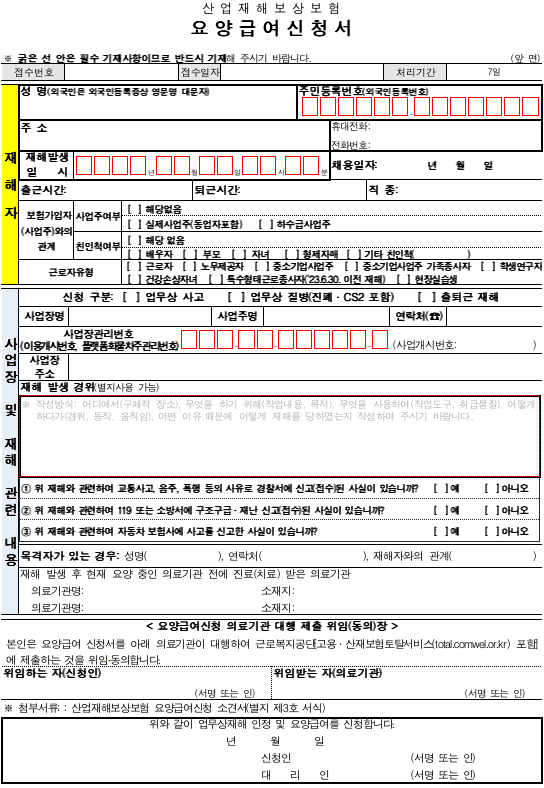
- Medical care benefits: the full cost of treatment, such as examination and diagnostic fees, hospitalization fees, surgery fees, medication costs, transportation costs, and prosthetic and orthotic devices
- Temporary disability benefits: where a worker cannot work and receives no wages during medical care, 70% of the average wage is paid
- Disability benefits: where a permanent disability remains after treatment, a lump sum or annuity is paid according to the disability grade
- Nursing benefits: paid where a recipient of medical care benefits still requires nursing care after recovery
- Survivors' benefits: paid to the surviving family where a worker dies from a work-related cause
- Injury-disease compensation annuity: paid where the illness remains uncured more than two years after a recipient of medical care benefits began medical care, or where the worker is in a severe medical condition of grade 1 to 3 and cannot work because of the ongoing treatment
Funeral expenses and vocational rehabilitation benefits, among others, can also be received through an industrial accident claim.
A key point is that any accident requiring four or more days of treatment qualifies for industrial accident compensation, and the same applies to daily workers, part-time workers, foreign workers, and field trainees.
Cases Where the Accident Compensation Provisions Apply
Where the injury can be treated through medical care within three days, or where the workplace is not subject to industrial accident compensation insurance, an industrial accident claim cannot be filed.
In that situation, the accident compensation provisions of the Labor Standards Act may apply instead.
The employer then pays the worker treatment costs (medical care compensation), 60% of the average wage during the medical care period (temporary disability compensation), and, where a disability has arisen, disability compensation according to its grade.
Additionally Recognized Medical Care Benefits
The medical care benefits that an industrial accident claim can additionally recognize are as follows.
- Dental prosthetics
- Rehabilitation aids
- Medications and treatment materials for burn patients
- Prescription and inspection fees for rehabilitation aids
- Transportation fees
- Treatment aids
- Herbal medicine packets and decoction fees in Korean medicine
- Rehabilitation treatment fees
- Vaccination costs
See More

Summary of daily work accident recognition criteria and industrial accident application method

How to apply and judge industrial accident handling standards that employers need to know
What is the average wage standard applied when calculating compensation from the Korea Workers' Compensation and Welfare Service?
3. Industrial Accident Claim | Application Procedure and Documents to Prepare

An industrial accident claim generally proceeds through the following stages.
① Confirming the claimant's eligibility
Confirm that the event qualifies as an industrial accident, meaning an accident that occurred in the course of work, such as a fall or a machinery accident.
Occupational diseases, such as pneumoconiosis and mental illness arising from job stress, may also qualify for an industrial accident claim.
② Preparing the application documents
Prepare the medical care benefit application form (four copies in total), a statement of the circumstances of the accident, and evidence that can establish the work-related nature of the accident.
③ Submission to and review by the Korea Workers' Compensation and Welfare Service
When the claim is filed through the competent Korea Workers' Compensation and Welfare Service, the Service determines whether the event is an accidental injury or an occupational disease and reviews whether to approve the claim.
Where the work-related cause is clear, the decision on whether to approve medical care is generally made within seven days.
④ Responding to a non-approval
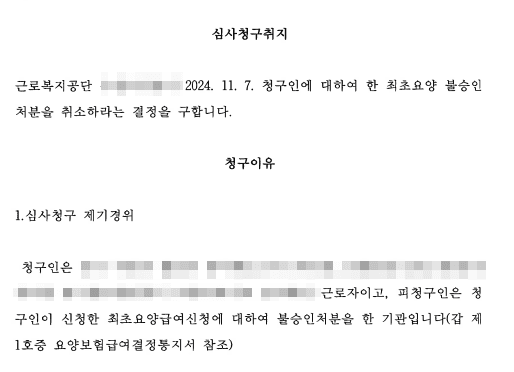
If you receive a notice of non-approval, you may request a reexamination from the Korea Workers' Compensation and Welfare Service within 90 days.
If the claim is still not approved after deliberation by the Occupational Disease Adjudication Committee, you may request a reexamination from the Industrial Accident Compensation Insurance Reexamination Committee of the Ministry of Employment and Labor, or you may file administrative litigation.
In these situations, the right to claim medical care benefits is subject to a three-year extinctive prescription.
Essential Documents to Prepare for an Industrial Accident Application
When filing an industrial accident application, you generally need to gather first the materials that establish the facts showing that medical care benefits should be paid because of an industrial accident.
1. Basic Documents
- Application for medical care benefits (Korea Workers' Compensation and Welfare Service form)
- Statement of the circumstances of the accident (preferably prepared separately)
2. Supporting Documents
- Employment contract, job description, and work log
- Accident photographs, CCTV footage, and witness statements
- Medical records, medical certificate, and emergency activity log
- Employment insurance insured-status history inquiry, and health insurance benefit history (10 years)
3. Additional Documents in Case of Death
- Death certificate, postmortem examination certificate, and autopsy report
- Resident registration certificate and marriage relationship certificate for compensation of the victim and surviving family
4. Industrial Accident Application | Workers in Special Types of Employment and Labor Providers
Since July 2023, workers' compensation insurance coverage has expanded beyond ‘workers in special types of employment’ to the concept of ‘labor providers’ who supply labor to multiple businesses through online platforms.
The leading occupations among workers in special types of employment number 18 in total, including insurance solicitors, home-study tutors, quick-service and substitute drivers, delivery riders, home-appliance installation technicians, golf course caddies, parcel delivery workers, and software technicians.
Because delivery-app riders and substitute drivers are connected to customers through platforms, they may in particular receive workers' compensation coverage regardless of the form of their contract.
An industrial accident application remains possible even if the worker was not enrolled in the insurance at the time of the initial accident.
5. Industrial Accident Application | Insurance Non-Enrollment, Concealment, and Liability

The employer is obligated to enroll in industrial accident compensation insurance.
Even if the employer fails to pay the premiums or does not enroll, however, the worker's rights remain protected.
A problem caused by the employer's failure to enroll is solely a matter between the business owner and the Service, and the injured worker may exercise the right to compensation in full.
In addition, industrial accident compensation rests on no-fault liability, so compensation may be available even when the accident occurred through the worker's own carelessness or mistake, as long as there is a causal relationship with the work.
Employer's Obligations and Violations | Sanctions for Violation |
Suspension of work upon the occurrence of a serious accident, and the like | If no measures are taken, imprisonment for up to 5 years or a fine of up to 50 million won
|
Reporting to the Minister of Employment and Labor without delay upon the occurrence of an accident | Failure to report the occurrence, an administrative fine of up to 30 million won |
Damaging the site of a serious accident or concealing the occurrence of an industrial accident | Imprisonment for up to 1 year or a fine of up to 10 million won
|
Checklist Before Filing an Industrial Accident Application
For an industrial accident application, filing the application for medical care benefits is the true starting point, and you generally need to prepare sufficient supporting materials carefully until the approval decision becomes final.
If the facts are complex and the application is not straightforward, or if there is a concern that it may be rejected, it can help to obtain the assistance of professionals such as a labor attorney or a lawyer who concentrates on labor matters.
If you have any questions about an industrial accident application, you may leave a consultation request with our firm's Labor and Industrial Accident Group.
Legal professionals well versed in the laws relating to industrial accidents, including experience with a court division dedicated to labor crimes as well as with the Ministry of Employment and Labor and the Labor Relations Commission, will work with you.
See More