
CONTENTS
- 1. Violation of the Copyright Act | Case Details

- 2. Violation of the Copyright Act | Examples of Violating Acts and Level of Punishment
- 3. Violation of the Copyright Act | Assistance Provided by the Intellectual Property Attorney
- - The Prosecution's Non-Prosecution Decision
- 4. Violation of the Copyright Act | Key Response Points When Suspected

1. Violation of the Copyright Act | Case Details
This is the account of a client who came to our firm and sought assistance after being suspected of violating the Copyright Act.
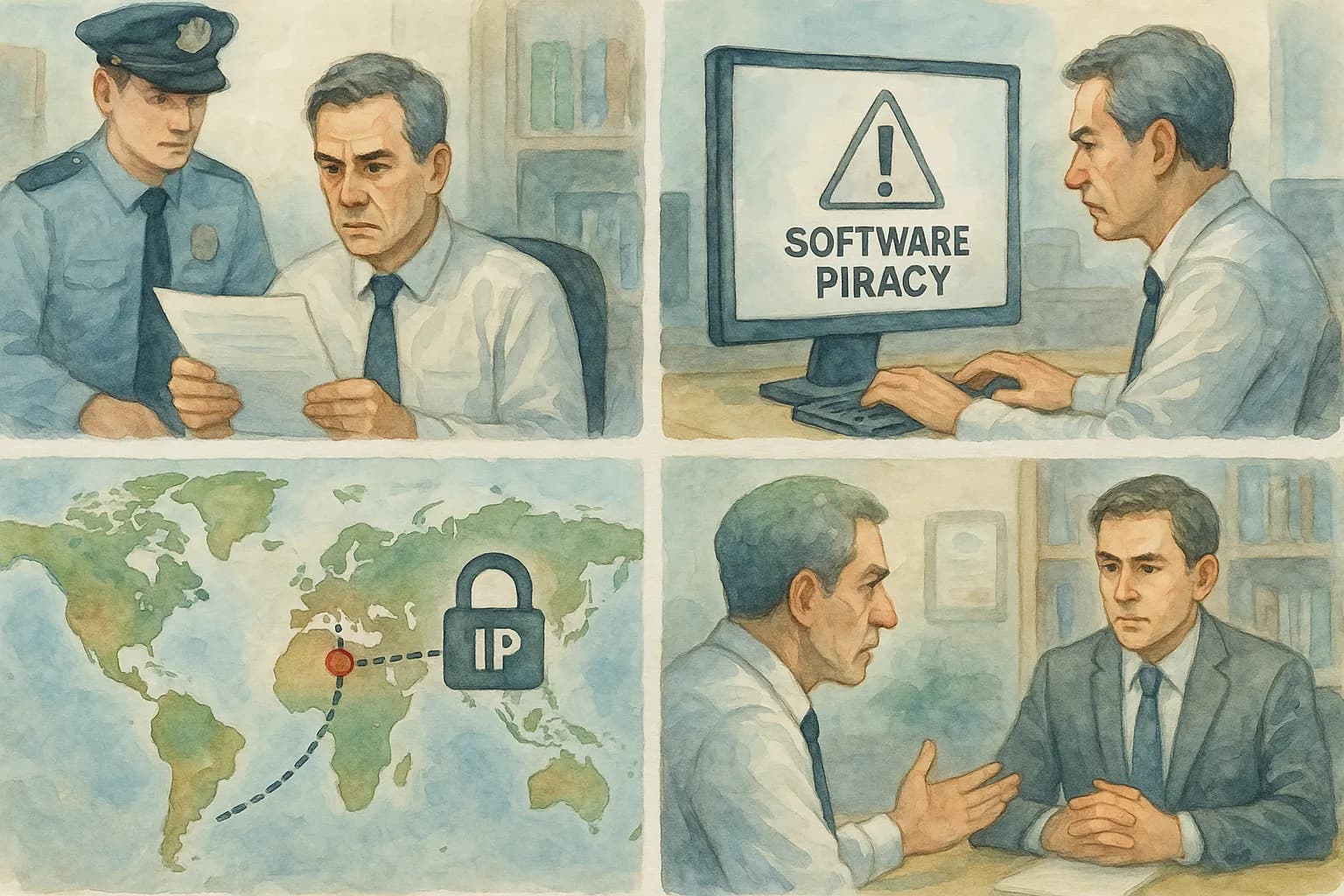
While working in a research position at a mid-sized domestic company, the client received a notice from the police stating, “Appear for questioning regarding the unauthorized use of software.”
The investigation found that the program the client had used was expensive paid software developed by a German company specializing in electromagnetic-wave simulation, and records remained showing that it had been used on the client's personal PC and work computer without a proper license.
The German company operated an access-IP tracking system to block unauthorized use of its program, and when this confirmed the client's access history, it filed a criminal complaint on suspicion of violating the Copyright Act.
The client, stating that “it was merely personal use for study and experimentation,” retained an intellectual property attorney to seek legal assistance.
2. Violation of the Copyright Act | Examples of Violating Acts and Level of Punishment
The Copyright Act defines the reproduction, distribution, transmission, or use of another person's work without permission as a clear infringement.
In particular, in the case of a program work (software), unauthorized installation or use itself is regarded as an act of reproduction and is subject to criminal punishment.
▪ Representative Examples of Acts Violating the Copyright Act
Downloading illegally reproduced movies, audio recordings, or programs from the internet
Using another person's design or source code without permission and incorporating it into development
Reproducing a program without authorization and distributing or sharing it with a third party
▪ Level of Punishment for Violating the Copyright Act
Where a violation occurs in the course of a corporation's business, the corporation may also be subject to punishment
However, in the case of personal, non-profit use, certain exceptions are recognized, and the key criteria in such cases are the purpose, scale, and whether any gain was obtained.


3. Violation of the Copyright Act | Assistance Provided by the Intellectual Property Attorney
In this case, the intellectual property attorney conducted the defense centering on the fact that the client's conduct did not satisfy the elements of copyright infringement.
① Assertion of the Absence of a Profit-Making Purpose and of Personal Use
Citing Article 30 and Article 101-3(1)4 of the Copyright Act, the intellectual property attorney emphasized that reproduction is permitted where a published work is used personally, without a profit-making purpose, or within the family or a comparable scope.
The client demonstrated that the program had not been used for commercial purposes or for company work, but had been used for the purpose of studying and researching electromagnetic-wave simulation.
② Proof of the Non-Profit Nature of the Use
The client stated that, out of personal curiosity, the client had downloaded the program while researching the structure of electromagnetic-wave absorbers and had used it only briefly for experimentation, and that the client had not used the data for company research materials or profit-making activities.
The client also proved that the company's internal server records showed no trace of the program having been used in any work project.
③ Submission of a Letter of Apology and Letters of Appeal
The client deeply reflected on having become the subject of an investigation following the copyright holder's complaint and submitted a handwritten letter of apology prepared by the client.
Fellow employees also submitted letters of appeal stating that “the client has always had a high level of enthusiasm for research and has never pursued improper gain.”
Through this, the investigative authorities came to clearly recognize that the client was not a habitual infringer or one acting for profit.
 The Prosecution's Non-Prosecution Decision
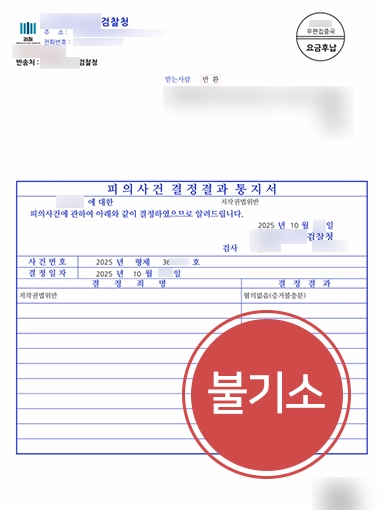
On the basis of the above legal principles and evidence, the intellectual property attorney argued that the client's conduct “constituted personal study without a profit-making purpose and could not be regarded as having infringed another person's property rights.”
Accordingly, the prosecution issued a disposition of 'no suspicion of crime (insufficient evidence)' on the grounds that “the client's use of the program is judged to be non-profit use for the purpose of study, and there is no evidence that it was directly used for company work.”
That is, the investigative authorities judged that the conduct did not satisfy the elements of the offense of violating the Copyright Act, and the client was not subject to criminal punishment.
4. Violation of the Copyright Act | Key Response Points When Suspected
In a case involving suspicion of violating the Copyright Act, the outcome of the disposition can vary greatly depending on the direction of the statements made in the early stage of the investigation.
Accordingly, the following step-by-step response strategy is important.
Step | Key Response Points |
Step 1: Preparing the Initial Statement | Organize and state the time of installation and use of the program, the purpose, and the scope of use |
Step 2: Proving the Absence of a Profit-Making Purpose | Prove through objective materials (such as server records) that there was no financial gain or commercial use |
Step 3: Submitting a Letter of Apology and a Settlement Agreement | Express an apology to the victim and a promise to prevent recurrence to secure the possibility of leniency |
Step 4: Conducting the Investigation with an Attorney Present | Attendance of an attorney is essential so that there is no unnecessary confession or misunderstanding during the initial statement |
Step 5: Seeking a Non-Prosecution Disposition | Seek closure at the prosecution stage by considering non-profit use, first-time offense, and an attitude of reflection together |
Because a case involving violation of the Copyright Act can result in criminal punishment even on the basis of a single act of “using a program once,” a thorough review of the legal principles and an evidentiary strategy must be carried out from the early stage.
This case began with a complaint by a foreign software company as an investigation into a violation of the Copyright Act, but it is a case in which, through the intellectual property attorney's legal response and the submission of evidentiary materials, a decision of no suspicion of crime (non-prosecution) was obtained at the prosecution stage.
This case illustrates the core of interpreting the Copyright Act, which distinguishes between “non-profit personal use” and “infringing acts for a profit-making purpose.”
The client not only avoided legal punishment but was also able to resolve the misunderstanding regarding the use of the program and restore trust.
A violation of the Copyright Act may be regarded as a crime even where there is a simple download or personal use, if it is against the will of the copyright holder.
However, because there is a clearly defined scope of non-profit, personal use that is recognized as an exception under the law, the key is to accurately prove the purpose, scope, and circumstances of use from the early stage of the investigation.
If you have been contacted by an investigation regarding a copyright matter, you should consult with an intellectual property attorney through 🔗Legal Consultation Booking and establish a response strategy in order to avoid unnecessary criminal punishment.
At our firm, intellectual property attorneys, patent attorneys, and the digital forensics center will work together to provide a tailored strategy.
This content is based on actual case studies of Daeryun Law LLC with some adaptations, and the copyright belongs to our firm.
Unauthorized reproduction, duplication, or distribution and other copyright infringements may result in legal action under applicable laws.