
CONTENTS
- 1. The Client Who Sought Out a Criminal Defense Attorney

- - Circumstances Leading to the Intimidation Complaint
- 2. Assistance Provided by the Criminal Defense Attorney
- - Intimidation Defense Strategy ① | Explaining the Background of the Remarks
- - Intimidation Defense Strategy ② | Analysis of the Intent of the Remarks
- - Intimidation Defense Strategy ③ | Legal Analysis and Presentation of Precedent
- 3. Result of the Criminal Defense Attorney's Assistance, Non-prosecution
- - Elements and Level of Punishment of the Crime of Intimidation
- - If You Have Become Involved in a Criminal Case
- - FAQ Regarding the Crime of Intimidation

1. The Client Who Sought Out a Criminal Defense Attorney
This is the account of the client who sought out a criminal defense attorney.
 Circumstances Leading to the Intimidation Complaint

The client resided in an apartment and had suffered for a long time from floor noise coming from the unit above.
He filed complaints with the management office several times and even requested measurement from a floor-noise center, but the noise problem hardly improved.
As the sounds continued day and night, leading to insomnia and headaches, the client ultimately went to the upper unit in person and cautiously voiced his objection.
At that time, however, the resident of the upper unit responded as though nothing could be done, saying that the children were young and did not understand well.
In reality, however, the children appeared to be of an age fully capable of communication, and because there had been no improvement despite repeated explanations, the client's frustration boiled over.
In that course, the client, overcome by a momentary emotion, made somewhat sharp remarks toward the child, and these remarks gave rise to a misunderstanding, leading to a complaint against him for intimidation.
The client pleaded that he had merely objected out of deep frustration and had no intention whatsoever to threaten anyone.
In response, the firm's criminal defense attorney established a careful defense strategy from the early stage in order to prove the situation the client faced, the circumstances under which the remarks came about, and the fact that there was no actual intent to threaten.


2. Assistance Provided by the Criminal Defense Attorney

After closely reviewing the client's statement and the actual circumstances of the case, the criminal defense attorney concluded that this case was one in which a momentary expression of emotion had been misunderstood as intimidation.
Accordingly, the defense strategy was established with the core of the case placed on the ‘absence of intent to intimidate’ and the ‘reasonableness of the circumstances’.
Intimidation Defense Strategy ① | Explaining the Background of the Remarks
First, in order to objectively prove that the client had suffered floor-noise damage over a long period, the attorney secured related materials, including the record of complaints to the management office, the consultation application submitted to the floor-noise center, and a transcript of recordings.
Through this, the attorney emphasized that the client had not simply acted emotionally but had continued to make reasonable efforts to resolve the problem.
Intimidation Defense Strategy ② | Analysis of the Intent of the Remarks
In addition, the attorney analyzed in detail the specific situation in which the remarks at issue came about and the intent behind the expression.
In particular, the attorney demonstrated that the client's remarks did not mean an intention to inflict harm on the other party, but rather were intended to confirm whether the other party's statement that “the child could not be controlled” was true.
In other words, the attorney highlighted that the remarks were not made to instill fear in the other party but amounted only to an expression made in the process of trying to confirm the facts amid continuous noise damage.
Intimidation Defense Strategy ③ | Legal Analysis and Presentation of Precedent
To the investigative authorities, the attorney explained in legal terms that the ‘notice of harm,’ which is a requirement for the establishment of intimidation, did not exist.
The attorney submitted a written opinion citing the precedent below, to the effect that ordinary words arising in the course of a mere quarrel or objection are difficult to regard as intimidation under generally accepted social norms.
Supreme Court Decision of May 10, 1991, 90Do2102
3. Result of the Criminal Defense Attorney's Assistance, Non-prosecution

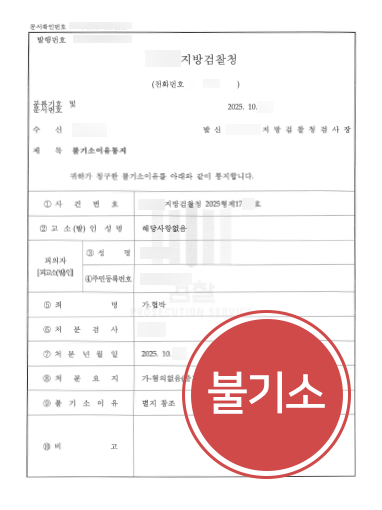
Through the criminal defense attorney's logical defense and submission of evidence, the prosecution determined that it was difficult to regard the client's remarks as constituting intimidation.
In the end, the client received a disposition of no suspicion of crime (non-prosecution), and the matter did not proceed to an unnecessary criminal trial.
Despite a long period of suffering, the client was able to restore his reputation through the legal determination.
Elements and Level of Punishment of the Crime of Intimidation
The crime of intimidation is established when a person gives notice of harm of a degree capable of causing fear in the other party.
In other words, an unpleasant word or emotional expression arising merely in the course of a quarrel does not, by itself, establish the crime of intimidation.
Here, a notice of harm refers to the act of conveying specific and realistic harm (damage to the body, property, reputation, and the like) to a degree that the other party would actually fear.
Accordingly, if everyday disputes, objections, warnings, and emotional remarks are at a level that can be tolerated under generally accepted social norms, there is a high likelihood that they will not be subject to criminal punishment.
However, where repeated or threatening words and conduct are involved, the matter may be judged to constitute intimidation, so accurate legal response is necessary from the early stage of the case.
Level of Punishment for the Crime of Intimidation
Statutory Provision | Level of Punishment |
Article 283 of the Criminal Act (Penal Code) | Imprisonment with labor for not more than three years, a fine of not more than five million won, detention, or a minor fine |
If You Have Become Involved in a Criminal Case
This case was an example showing that a simple quarrel can escalate into a criminal case.
Daeryun LLC has many attorneys with experience handling a variety of criminal cases, including intimidation, insult, assault, and defamation.
The firm comprehensively manages the drafting of statements, the direction of testimony, and the submission of evidence from the early stage of the investigation, and provides all-around assistance, including accompaniment during police questioning and response at trial.
If you have become involved in a criminal case against your intent due to floor noise, workplace conflict, or a family quarrel, please request assistance through a 🔗Legal Consultation Booking.
FAQ Regarding the Crime of Intimidation
A. Yes. Remarks made through text messages, SNS, or messengers can also be regarded as intimidation if the notice of harm is clear.Q. Attorney, can words said by text message or KakaoTalk also be punished as intimidation?
However, it is advisable to review the possibility of punishment according to the specific context and intent.
A. That is not the case. Q. Attorney, if the victim felt ‘scared,’ is it automatically the crime of intimidation?
The crime of intimidation requires not only the victim's subjective sense of fear but also that the remark be at a level that can objectively be regarded as intimidation under generally accepted social norms.
This content is based on actual case studies of Daeryun Law LLC with some adaptations, and the copyright belongs to our firm.
Unauthorized reproduction, duplication, or distribution and other copyright infringements may result in legal action under applicable laws.