
CONTENTS
- 1. Details of the Food Sanitation Act Violation Case

- - Assistance Provided by the Attorney Specializing in Criminal Matters
- 2. Result of the Food Sanitation Act Violation Case
- - The Concept of a Food Sanitation Act Violation
- 3. Key Points for Responding to a Food Sanitation Act Violation

1. Details of the Food Sanitation Act Violation Case
This is the account of a client who, facing charges of violating the Food Sanitation Act, needed the assistance of an attorney specializing in criminal matters.
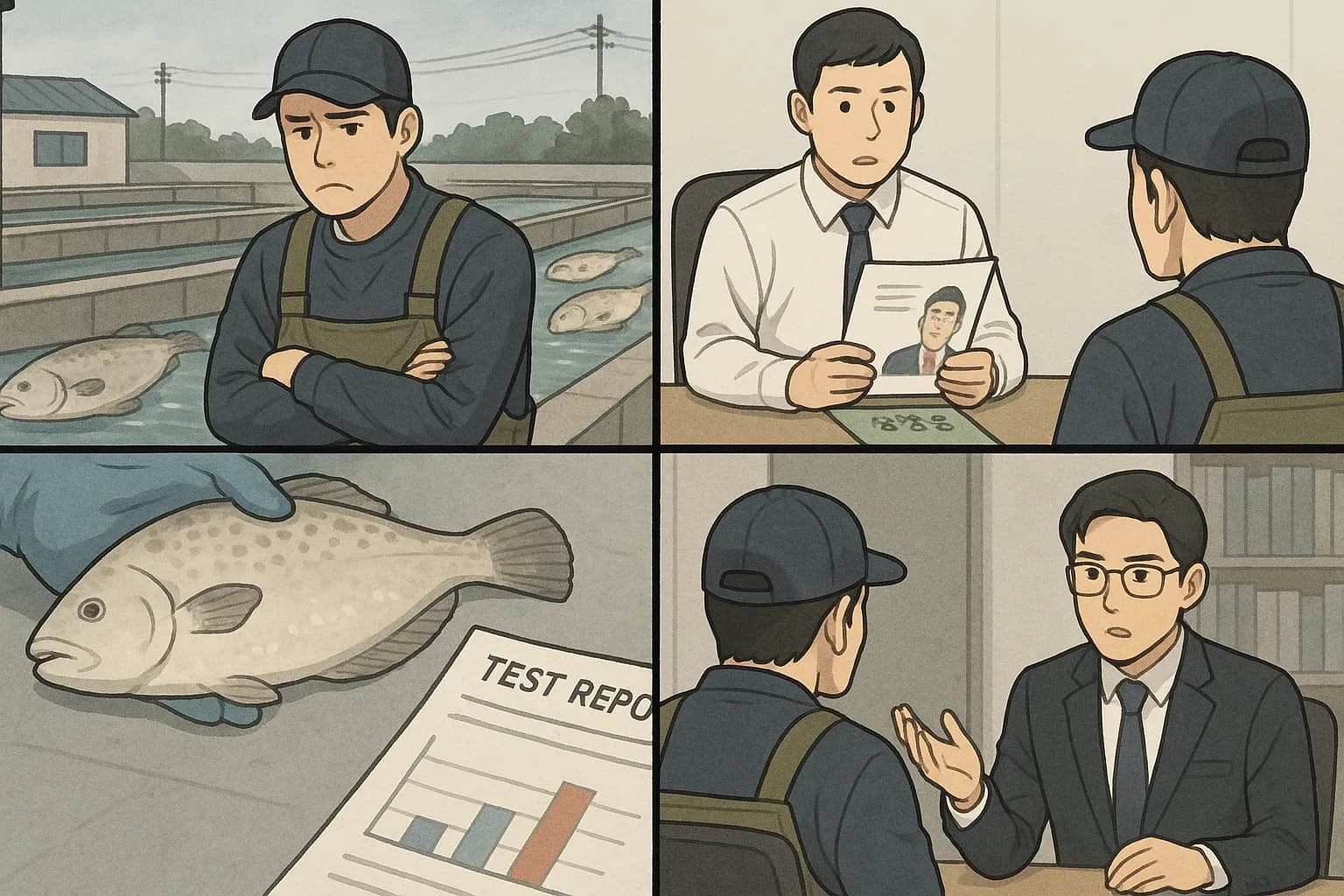
The client, who operated an aquaculture business, came to be investigated by the competent administrative agency on charges of violating the Food Sanitation Act on the grounds that a drug component exceeding the permissible residue limit had been detected in the farmed flatfish the client had supplied.
As a result of the investigation, although the drug in question was a treatment medication generally used at fish farms, the matter was included as subject to criminal punishment because the detected level exceeded the permissible standard.
The client argued, “I did not intentionally supply fish with residual medication, the customary withdrawal period had been observed, and the fish had also passed the regular inspections of the National Fishery Products Quality Management Service,” but this argument was not accepted in the initial investigation, leaving the client at risk of being indicted on the charge of violating the Food Sanitation Act.
Asserting that this outcome was unjust, the client retained an attorney specializing in criminal matters to handle the case.
 Assistance Provided by the Attorney Specializing in Criminal Matters
· Demonstrating Safety Management Efforts Through Submission of Official Inspection Records
It was confirmed that the client had regularly undergone fishery product safety inspections by the National Fishery Products Quality Management Service, and to establish this, the attorney specializing in criminal matters submitted as evidence the safety inspection result notices and the entire body of inspection records from the National Fishery Products Quality Management Service.
Through this, it was emphasized that the client had faithfully fulfilled the duty of food safety management on a routine basis.
· Explaining the Growing Environment During the Low Water Temperature Period and the Circumstances of Drug Use
Based on data analyzing the environmental factors of the fish farm, the attorney specializing in criminal matters explained the unavoidable nature of using a permitted drug in a situation where fish diseases had spread due to the low water temperature at the time.
The attorney also emphasized that there were grounds to reasonably believe that a sufficient withdrawal period (the waiting period from drug administration to shipment) had been observed, thereby highlighting that this was not the client’s intent but a management error.
· Submission of Materials Showing No Prior Record of the Same Offense and Diligent Management
The client had no prior record whatsoever of similar violations and had a history of faithfully complying with the relevant regulations as a fishery product distribution business.
The attorney specializing in criminal matters submitted the criminal record inquiry report, business management logs, safety management manuals, and other materials together to support the point that the client was not a person who had intentionally committed a violation of the Food Sanitation Act.


2. Result of the Food Sanitation Act Violation Case
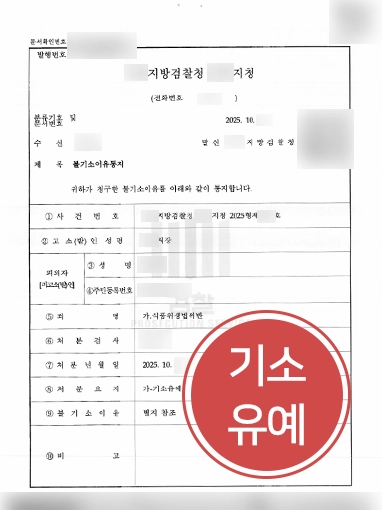
In the Food Sanitation Act violation case, after comprehensively reviewing the submitted materials and statements, the prosecution recognized that the client’s conduct lacked intent and that the client had sufficiently carried out preventive measures in advance.
Accordingly, a disposition of suspension of indictment was issued in the client’s case.
A suspension of indictment is a system under which, although the facts of the offense are recognized, the prosecutor, taking comprehensive account of the gravity of the offense, the motive, prior records, and the degree of remorse, does not refer the case to trial and defers punishment.
In other words, it does not remain as a criminal record, and the case is concluded without the imposition of criminal punishment.
In this case as well, the client’s diligent management and remorse, along with the absence of intent in the offense, were recognized, and the matter was concluded with a suspension of indictment.
The Concept of a Food Sanitation Act Violation
A violation of the Food Sanitation Act refers to a case in which an act harmful to the human body is committed or a standard is violated in the course of manufacturing, processing, cooking, storing, or selling food.
Representative examples include the following.
· Selling food in which antibiotics, pesticides, or drugs exceeding the permissible limit have been detected
· Manufacturing food in an unauthorized facility
· False labeling or misrepresentation of the place of origin
· Failure to comply with sanitation standards
The levels of punishment for a violation of the Food Sanitation Act are as follows.
Type of Violation | Level of Punishment |
Manufacturing or selling harmful food | Imprisonment for not more than 10 years or a fine of not more than 100 million won |
Exceeding the permissible residue limit for veterinary drugs | Imprisonment for not more than 5 years or a fine of not more than 50 million won |
3. Key Points for Responding to a Food Sanitation Act Violation

In Food Sanitation Act violation cases, securing evidence and organizing the facts from the very initial response stage are highly important.
· Immediately Secure Inspection and Management Records
Pre-shipment inspections of fishery products or food, result notices from the National Fishery Products Quality Management Service, quality certification materials, and the like must be secured immediately.
The management history from an inspection agency serves as the most important basis for showing that ‘there was no intent.’
· Clearly Explain the Circumstances of Drug Use and Environmental Factors
In the case of aquaculture, the use of drugs for the purpose of disease prevention may be unavoidable.
The type of drug, the date of administration, and the withdrawal period must be organized in specific detail and submitted.
· Secure Evidence of the Business Operator’s Performance of Management Duties
Employee training logs, internal sanitation management regulations, pre-shipment inspection records, and similar materials can strongly establish that the violation was not intentional.
· Secure Materials on Control of the Distribution Process
Through contracts with supplied businesses, shipment dates, delivery certificates, and the like, control over the distribution process must be established in order to reduce the scope of liability.
· Submit a Letter of Reflection and an Improvement Plan for Leniency
Preparing specific measures such as system improvements to prevent recurrence and the strengthening of sanitation manuals can work favorably in the prosecution’s assessment.
In Food Sanitation Act violation cases, the presence or absence of intent, the management system, and the diligence of post-incident measures determine the outcome of the case.
As in this case, if the act constituting the violation occurred in an environment where it was unavoidable, and management records and inspection materials exist, there is a strong likelihood of concluding the case with a suspension of indictment or a non-prosecution disposition.
Therefore, for food-related business operators, leaving a management history at every stage of production and distribution itself serves as a ‘legal shield.’
Because organizing evidence systematically with the assistance of an attorney at the initial investigation stage is the most certain way to prevent an unjust punishment, if you are facing related charges, we encourage you to proceed with a 🔗legal consultation appointment.
This content is based on actual case studies of Daeryun Law LLC with some adaptations, and the copyright belongs to our firm.
Unauthorized reproduction, duplication, or distribution and other copyright infringements may result in legal action under applicable laws.