
CONTENTS
- 1. Administrative Law Office | Case Details

- 2. Administrative Law Office | Assistance Provided by the Attorney Specializing in Administrative Matters
- - Pointing Out the Impropriety of the Lower Court's Judgment
- - Asserting Procedural Illegality
- - Pointing Out the Impropriety of the Statutory Interpretation
- 3. Administrative Law Office | Result of the Administrative Litigation Appeal Case
- - Cadastral Resurvey and Administrative Appeals
- - Concept and Procedure of Administrative Litigation
- - Key Points in Responding to Administrative Cases
- 4. Administrative Law Office | Daeryun LLC One-Stop Response System

1. Administrative Law Office | Case Details
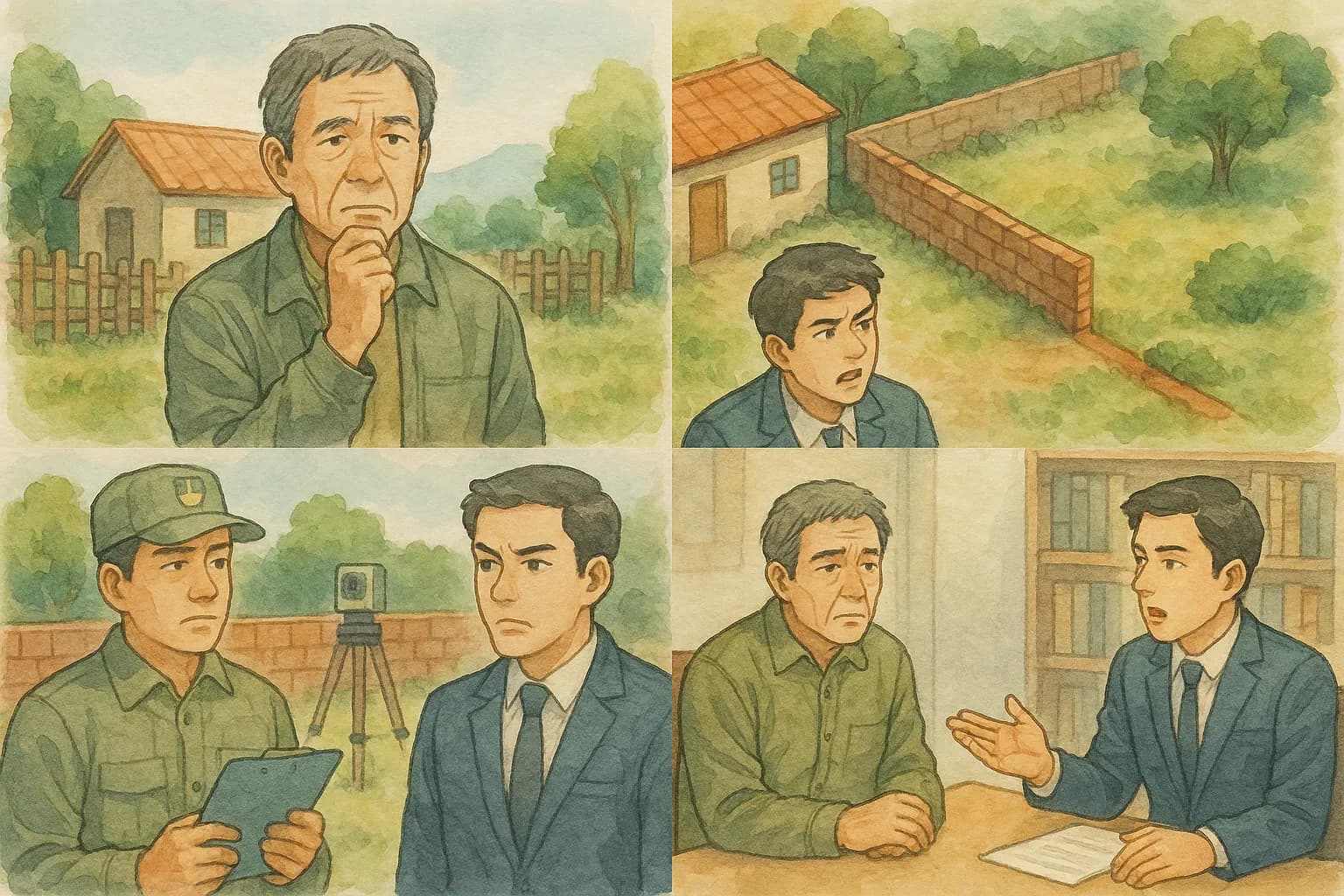
A client who came to Daeryun, an administrative law office, owned a country house inherited from his father.
A wall had been installed on this land for a long time, and the client believed that his land extended beyond the wall.
However, a problem arose when the county office conducted a cadastral resurvey.
According to the survey results, a draft cadastral confirmation report was prepared, stating that the client's land was reduced from 30 pyeong to 25 pyeong and that the 5 pyeong outside the wall would belong to the adjacent landowner.
Subsequently, the adjacent landowner (a third party) objected to this and filed an administrative appeal, and the Administrative Appeals Commission granted the third party's claim on the ground that “where there is no dispute over the boundary on the ground, the decision should be based on the actual boundary.”
As a result, the client received a decision under which he was to receive 2 million won in compensation and give up the 30 pyeong outside the wall.
However, the client was not even notified that the administrative appeal proceedings were taking place and had only received the notice of the result.
Feeling that the outcome was unjust, the client filed an administrative litigation, but received a judgment of dismissal from the court of first instance.
Accordingly, the client decided to file an administrative litigation appeal and sought the assistance of an attorney specializing in administrative matters.
2. Administrative Law Office | Assistance Provided by the Attorney Specializing in Administrative Matters
After analyzing the case, the attorney specializing in administrative matters identified that the key issues in this case lay in (1) the interpretation of “where there is no dispute” under Article 14(1)1 of the Special Act on Cadastral Resurvey, (2) procedural illegality such as the failure to guarantee the right to state an opinion, and (3) the misapprehension of facts in the lower court's judgment.
Accordingly, the following legal-principle-centered strategy for the administrative litigation appeal was established.
 Pointing Out the Impropriety of the Lower Court's Judgment
The attorney specializing in administrative matters presented as evidence the fact that the third party had continued a boundary dispute with the client even before the cadastral resurvey measurement.
Accordingly, he argued that the administrative appeal ruling that “the boundary determination should be based on the actual boundary” was an erroneous interpretation of legal principles, and that it was proper to base the determination on the records at the time of the cadastral resurvey measurement and the official registers.
Asserting Procedural Illegality
Article 16 of the Special Act on Cadastral Resurvey provides that landowners and interested parties must be guaranteed an opportunity to submit their opinions during the boundary determination process.
Nevertheless, the client did not receive any prior notice or request to appear.
The attorney specializing in administrative matters strongly argued that this constituted a violation of the duty of prior notice and opportunity to be heard under the Administrative Procedures Act, and that the ruling itself was procedurally unlawful.
Pointing Out the Impropriety of the Statutory Interpretation
The attorney specializing in administrative matters emphasized that the phrase “where there is no dispute over the boundary on the ground” in Article 14(1)2 of the Special Act on Cadastral Resurvey does not specify whether it refers to before or after the measurement, so interpreting it to include only disputes arising before the measurement was an improper expansive interpretation.
In other words, he developed the argument that arbitrarily interpreting requirements not specified in the statute and thereby infringing on the people's property rights violates the constitutional principle of proportionality and the provisions guaranteeing property rights.
Through this multifaceted legal response, it was demonstrated that the client's rights had been procedurally infringed.


3. Administrative Law Office | Result of the Administrative Litigation Appeal Case
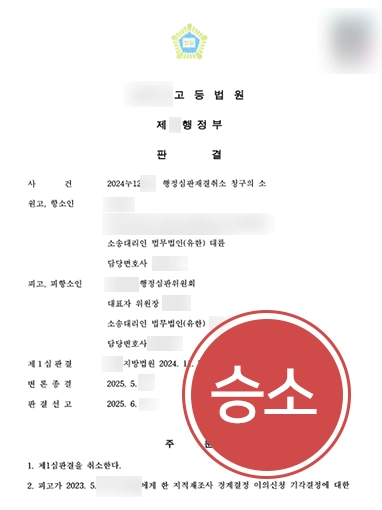
The appellate court accepted the arguments of the attorney specializing in administrative matters and rendered a judgment revoking the administrative appeal ruling.
As a result, the administrative appeal ruling was revoked, and the client was able to take the first step toward recovering his rights to the entire 30 pyeong of land.
Cadastral Resurvey and Administrative Appeals
The cadastral resurvey system is a procedure under the “Special Act on Cadastral Resurvey” for correcting the boundary, area, location, and other features of registered land using the latest measurement technology.
If, in this process, the opinions of interested parties are not reflected or an incorrect measurement standard is applied, an objection can be raised through an administrative appeal.
An administrative appeal is a procedure by which the people raise an objection to a disposition of an administrative agency, and it is a system that allows an incorrect administrative decision to be corrected at a stage before going to court.
However, because administrative appeals proceed mainly through documentary review, if the opportunity for prior notice or for stating an opinion is missed, there is a risk that an unjust result may be reached in the administrative litigation appeal.
Concept and Procedure of Administrative Litigation
If a party objects to the decision in an administrative appeal, the party may file administrative litigation.
Administrative litigation is a procedure in which the judiciary directly determines the unlawfulness of an administrative agency's disposition or ruling, and under the Administrative Litigation Act, it must be filed within 90 days from the date of receipt of the written ruling.
· Administrative Litigation Procedure
2. Submission of the answer by the defendant administrative agency
3. Examination of evidence and the conduct of oral argument dates
4. Pronouncement of judgment and its finalization
In particular, litigation related to cadastral resurveying involves a complex combination of specialized surveying knowledge, the assessment of officially announced land prices, and the determination of infringement of property rights, so if assistance with an appeal in administrative litigation is needed, the cooperation of an attorney focusing on administrative matters and an attorney focusing on real estate is essential.
Key Points in Responding to Administrative Cases
· Reviewing the Legality of the Disposition Notice: Confirm whether the prior notice or opportunity-to-be-heard procedure was omitted
· Legal-Principle-Centered Arguments: Examine whether there was an abuse of discretion by the administrative agency, procedural illegality, or improper statutory interpretation
· Securing Evidence: Secure official materials such as survey drawings, cadastral maps, boundary determination reports, and official documents
· Deadline Management: The filing periods for administrative appeals and administrative litigation must be strictly observed
· Collaboration with Experts: Surveying, land law, and administrative procedure all require integrated analysis
4. Administrative Law Office | Daeryun LLC One-Stop Response System

Disputes related to real estate and administrative matters are highly demanding cases that simultaneously require attention to procedural illegality, specialized knowledge, and statutory interpretation.
Accordingly, Daeryun LLC operates a one-stop response system in which experts in each field collaborate.
· Response to the entire administrative appeal and administrative litigation procedure, and determination of illegality
· Analysis of boundary, area, and survey disputes, and advisory on appraisal
· Specialized performance of examination of evidence and proof of procedural defects
· Verification of survey records and collaboration on on-site appraisal
Through this, we respond with a consistent strategy from the administrative appeal stage through the litigation stage, and provide tailored legal support for the substantive recovery of rights.
With an administrative disposition, an infringement of rights can occur from a single procedural omission.
By establishing a response strategy from the early stage through the professional assistance of an administrative law office, it is possible to correct an unjust administrative appeal result and recover substantive rights.
In this case, although the opposing party formed a specialized team of attorneys from a large law firm and responded intensely, the Daeryun attorney cross-applied administrative legal principles and constitutional principles to persuade the court and reverse the result.
In this way, Daeryun LLC presents practice-oriented solutions to protect the client's legitimate property rights, with an attorney specializing in administrative matters and an attorney specializing in real estate cooperating at every stage before administrative appeal and administrative litigation.
If you need assistance, please proceed with a 🔗legal consultation reservation now.
This content is based on actual case studies of Daeryun Law LLC with some adaptations, and the copyright belongs to our firm.
Unauthorized reproduction, duplication, or distribution and other copyright infringements may result in legal action under applicable laws.