
CONTENTS
- 1. A Client Facing the Risk of Punishment for Failure to Take Measures After an Accident

- - The Circumstances of the Drunk Driving and the Accident
- 2. Assistance Provided to Defend Against Punishment for Failure to Take Measures After an Accident
- - Preparation for and Accompaniment to the Police Investigation
- - Establishing That the Duty to Take Measures After the Accident Was Fulfilled
- - A Thorough Legal Review of the Timing of the Drinking
- 3. Successful Defense Against Punishment for Failure to Take Measures After an Accident, Non-Referral of All Charges Including Drunk Driving
- - Standards and Levels of Punishment for Failure to Take Measures After an Accident
- - Standards and Levels of Punishment for Drunk Driving
- - The Assistance Points of Daeryun Law Firm
- - Frequently Asked Questions About the Case

1. A Client Facing the Risk of Punishment for Failure to Take Measures After an Accident
This is the account of a client who came to Daeryun Law Firm ahead of a police investigation while facing the risk of punishment for failure to take measures after an accident.
 The Circumstances of the Drunk Driving and the Accident
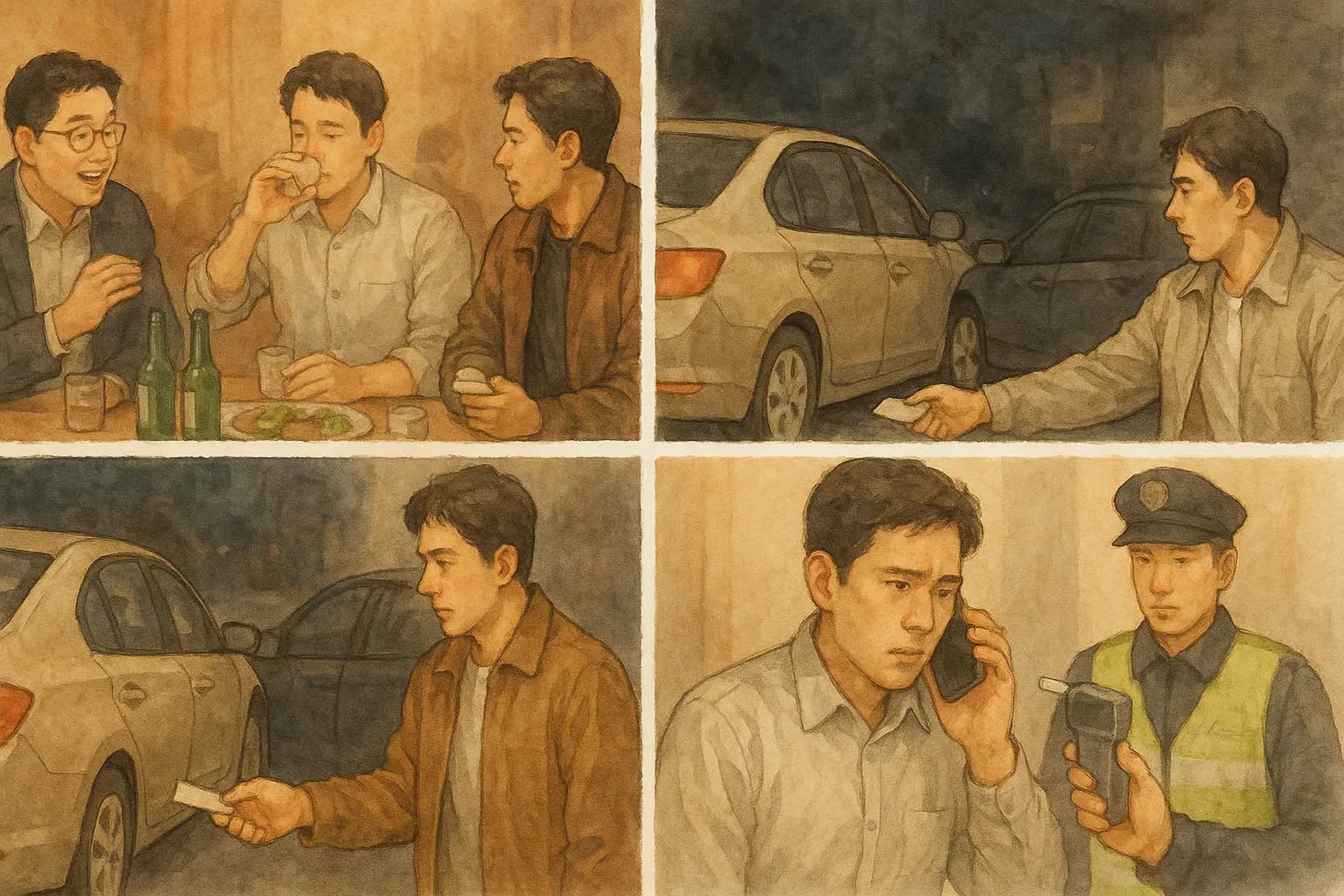
The client, a first-time driver who ordinarily complied with traffic laws, caused this accident while moving from an evening gathering, where he had one drink, to the main drinking gathering.
Because the vehicle owner who was with him at the time had consumed a larger amount of alcohol, the client, who had drunk relatively less, was driving the vehicle to move to another location when a minor contact accident occurred.
The client immediately stopped the vehicle and handed his business card to the owner of the damaged vehicle, and after saying, “Please contact me after you decide whether to settle in cash or process it through insurance,” he left the scene.
Afterward, while he was drinking additional alcohol at another gathering, he suddenly received a call from the police.
The police asked him to appear, saying, “An accident occurred, so why did you just leave without completing the handling of the accident?” and he was then subjected to a breathalyzer test (a blood alcohol concentration of approximately 0.1%).
Based on this result, the police requested the client to appear on charges of violating the Road Traffic Act (drunk driving and failure to take measures after an accident), and the client requested the firm's assistance.


2. Assistance Provided to Defend Against Punishment for Failure to Take Measures After an Accident
The firm's drunk driving attorney, who took on this case involving failure to take measures after an accident, clearly identified the key issues of the case from the early stage of the investigation.
② Did the client take all measures necessary for the victim?
Accordingly, a systematic response strategy was established from the stage before the suspect interrogation.

Preparation for and Accompaniment to the Police Investigation
First, the drunk driving attorney thoroughly prepared so that the client would not make any statements detrimental to his case during the investigation.
▶ Conducting a prior simulation so that statements would remain consistent during the investigation
▶ Accompanying the client directly to the investigation to verify the process of preparing the statement record
▶ Advising immediately so that no unnecessary or potentially misleading remarks were made
Through this process, the client maintained control over his statements throughout the investigation and was able to complete it without making any detrimental statements.
Establishing That the Duty to Take Measures After the Accident Was Fulfilled
The key issue in this case was whether the duty to take measures after an accident under Article 54 of the 「Road Traffic Act」 had been fulfilled.
The client had, immediately after the accident, stopped the vehicle at once and handed his business card to the victim, providing his personal information.
Composition of Supporting Evidence
∙ Securing call records and dashcam footage from the damaged vehicle
∙ An organized account of the time and content of the contact made with the victim
Accordingly, the drunk driving attorney specifically demonstrated that the client “did not leave the scene without authorization, but rather completed all of the minimum measures required by law”.
A Thorough Legal Review of the Timing of the Drinking
The police also brought a charge against the client for a violation of Article 44, Paragraph 1 of the 「Road Traffic Act」 (drunk driving). However, the drunk driving attorney scientifically established that the time of the accident and the time of drinking were clearly distinct.
In particular, by applying the Widmark formula (estimation of blood alcohol concentration), the attorney calculated the blood alcohol concentration corresponding to the amount and proof of the alcohol the client drank additionally after the accident.
As a result, the increase attributable to that amount of alcohol was calculated to be approximately 0.11X%, and subtracting this from the breath test result measured by the police, the blood alcohol concentration at the time of the accident was estimated at approximately 0.02%.
The Standard for Drunk Driving
Article 44 of the Road Traffic Act (Prohibition of Driving While Intoxicated) | Standard |
Standard for the state of intoxication in which driving is prohibited | A blood alcohol concentration of 0.03% or higher |
This is a level below the statutory threshold for punishing drunk driving, and it was decisive scientific evidence supporting the fact that the client was not in a state of intoxication at the time of driving.
Accordingly, the drunk driving attorney clearly established that this was a case of ‘drinking after the accident,’ based on objective calculation and legal review rather than relying on a mere statement.
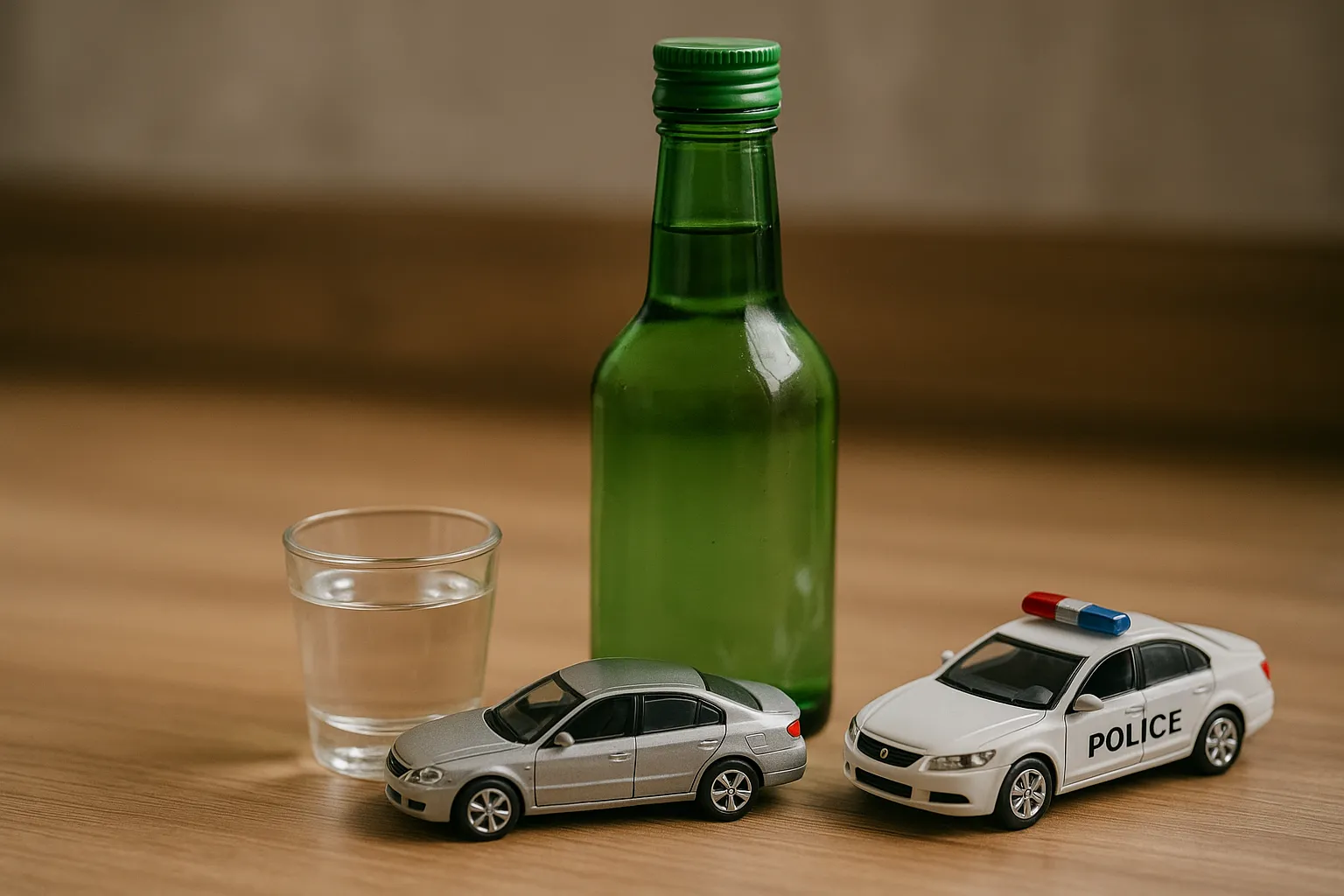
3. Successful Defense Against Punishment for Failure to Take Measures After an Accident, Non-Referral of All Charges Including Drunk Driving
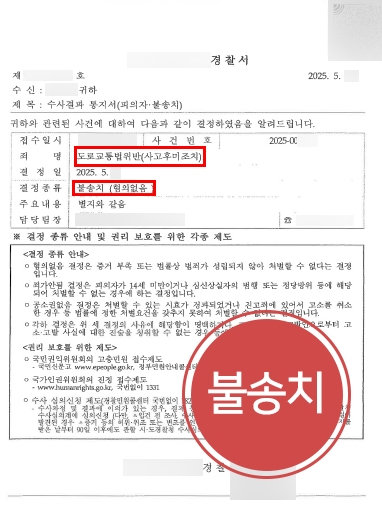
As a result of the drunk driving attorney's scientific analysis and submission of specific supporting evidence to defend against the application of the charges of failure to take measures after an accident and drunk driving, the police acknowledged that the client's conduct did not constitute ‘failure to take measures after an accident’ and that he was not intoxicated at the time of the accident.
Accordingly, a non-referral (no suspicion of crime) decision was rendered on all of the client's charges of violating the Road Traffic Act.
∙ It was clearly confirmed that the client provided his personal information to the victim immediately after the accident
∙ Statement consistency was maintained through preparation for and accompaniment to the investigation
As a result, the client avoided the disadvantages of criminal proceedings and was able to conclude the case without administrative sanctions such as a license suspension.
This case is a representative example of how important the organization of the facts and legal analysis at the initial response stage can be.
Standards and Levels of Punishment for Failure to Take Measures After an Accident
Under Article 54 of the Road Traffic Act, a driver who has caused a traffic accident must immediately stop and take the following measures.
2. Providing the victim with personal information, such as name, telephone number, and address
If a driver leaves the scene of an accident without taking such measures, the driver is subject to the following punishment.
Level of Punishment
Statutory Provision | Level of Punishment |
Article 148 of the Road Traffic Act | Imprisonment for up to 5 years or a fine of up to 15 million won |
Standards and Levels of Punishment for Drunk Driving
According to Article 44 of the 「Road Traffic Act」, a driver must not operate a motor vehicle or similar vehicle while intoxicated.
Here, a ‘state of intoxication’ means a blood alcohol concentration of 0.03% or higher, and the level of punishment is divided according to the measured value as follows.
Level of Punishment
Blood Alcohol Concentration | Level of Punishment |
0.2% or higher | Imprisonment for 2 to 5 years or a fine of 10 million to 20 million won |
0.08% or higher, up to less than 0.2% | Imprisonment for 1 to 2 years or a fine of 5 million to 10 million won |
0.03% or higher, up to less than 0.08% | Imprisonment for up to 1 year or a fine of up to 5 million won |
In drunk driving cases, the precise distinction between the time of the blood alcohol concentration measurement and the time of drinking is very important.
In particular, as in this case, where the matter involves ‘drinking after the accident,’ drunk driving is not established by the measurement result alone, and a defense can be made on scientific grounds, such as a calculation using the Widmark formula.
What Is the Widmark Formula?
The Assistance Points of Daeryun Law Firm
As in this case, a complex matter to which both failure to take measures after an accident and drunk driving are applied can produce greatly differing results depending on the direction of the initial statement and the interpretation of the law.
Daeryun Law Firm provides assistance tailored to each case through the following system.
▷ Establishment of a tailored response strategy through a system that assigns a dedicated attorney suited to the type of case
▷ Provision of a list of anticipated questions and a written set of answers, and support by accompanying the client to the investigation
▷ Securing scientific grounds through a collaborative system with evidence examination experts, including dashcam analysis, collection of accident materials, and use of the Widmark formula
▷ Establishment of a strategy for settlement with the victim and reduction of sentence
If you have an investigation scheduled or have already received a request to appear, please consult through 🔗Legal Consultation Reservation.
Frequently Asked Questions About the Case
A. Cases such as reporting immediately after the accident or providing aid to the victim at once may be taken into account as circumstances that make it difficult to regard the conduct as an intentional flight. Q. Are there cases in which punishment for failure to take measures after an accident can be avoided?
However, it is difficult to be exempted merely on the ground that one “fled out of panic.”
A. A case involving failure to take measures after an accident is one in which the outcome varies depending on factors such as intent, the circumstances at the scene, and the extent of the damage.Q. Is an attorney's assistance necessary in a case involving failure to take measures after an accident?
Because organizing the evidence, such as footage, communication records, and the time of reporting, and establishing the facts are essential, an attorney's assistance is very important.
This content is based on actual case studies of Daeryun Law LLC with some adaptations, and the copyright belongs to our firm.
Unauthorized reproduction, duplication, or distribution and other copyright infringements may result in legal action under applicable laws.