
CONTENTS
- 1. The Client Whose Traffic Accident Case Was Referred to the Prosecutors' Office

- - Background of the Traffic Accident Case
- 2. Statutes Relevant to the Traffic Accident Referral to the Prosecutors' Office Case
- - Issues in the Case and Strategy
- 3. Assistance for Concluding the Traffic Accident Referral to the Prosecutors' Office Case
- - Traffic Accident Lawyer's Assistance 1: Organizing the Facts
- - Traffic Accident Lawyer's Assistance 2: Explaining Whether the Client Was Aware of the Accident
- - Traffic Accident Lawyer's Assistance 3: Presenting Legal Issues and an Opposing Interpretation
- - Traffic Accident Lawyer's Assistance 4: Supplementing Statements on Mitigating Circumstances and Living Environment
- 4. The Traffic Accident Referral Client: “Non-Prosecution”
- - How to Respond to a Traffic Accident

1. The Client Whose Traffic Accident Case Was Referred to the Prosecutors' Office

This is a case in which a client whose traffic accident case was referred to the prosecutors' office received a non-prosecution decision with the assistance of a traffic accident attorney and was able to conclude the matter at the prosecution stage.
 Background of the Traffic Accident Case
The client made a living working in delivery on a motorcycle.
On the day of the incident, while making a delivery on a rainy evening, the client got into a dispute with another motorcycle rider. After the argument, while following the other party, the other party slipped and fell on the wet road.
However, because there had been no physical contact, the client assumed the other party had fallen on his own and left the scene without taking any particular measures.
The other party then filed a complaint against the client on a charge of ‘failure to take measures after an accident (hit-and-run),’ and the case was referred to the prosecutors’ office.
Fearing license revocation, the client came to a traffic accident attorney to request assistance.


2. Statutes Relevant to the Traffic Accident Referral to the Prosecutors' Office Case
The charge against the client, whose case had been referred to the prosecutors' office in a traffic accident matter, was "failure to take measures after an accident."
Failure to take measures after an accident refers to a person who caused a traffic accident leaving the scene of the accident without taking the necessary measures.
Under the Road Traffic Act, when an accident occurs, the driver must immediately stop and provide aid to the casualties or provide their personal information to the victim, and a failure to do so may result in punishment for failure to take measures after an accident.
Level of Punishment
Article 54 (1) of the Road Traffic Act | Level of Punishment |
Failure to take measures after an accident | Imprisonment for up to 5 years or a fine of up to 15 million won |
In addition, failure to take measures after an accident entails not only criminal punishment but also an administrative disposition of license revocation.
Taking into account the client's situation, in which he made his living through delivery work, a strategy was established to defend against the punishment.
Issues in the Case and Strategy
The traffic accident attorney closely reviewed the investigation records and video materials, and focused on the following issues in the case.
Issues in the Case
▷ Whether the suspect could have "recognized the accident"
▷ Whether a "duty to take measures" arose under the circumstances at the scene
Having weighed the above issues, the traffic accident attorney determined that it would be difficult for the client's allegation of "failure to take measures after an accident" to be established.
In particular, by comprehensively reviewing whether the accident had been recognized and the circumstances at the scene, the attorney focused on the point that no duty to take measures had arisen for the client.
Accordingly, the traffic accident attorney established a strategy of contesting the allegation itself.
3. Assistance for Concluding the Traffic Accident Referral to the Prosecutors' Office Case

After analyzing the situation the client faced upon referral to the prosecutors' office in the traffic accident case and the factors considered by the investigative authorities, the traffic accident attorney pursued an active defense strategy centered on contesting the charge itself.
Through this, the following assistance was carried out.
Traffic Accident Lawyer's Assistance 1: Organizing the Facts
The traffic accident attorney closely analyzed the surrounding CCTV footage and dashcam data from the time of the accident.
Through this, the attorney secured evidence capable of proving that there had been no physical contact between the client's motorcycle and the victim's motorcycle.
In addition, the attorney pointed out the contradictions between the collision situation claimed by the victim and the movements in the actual footage, thereby rebutting the credibility of the victim's statement.
Traffic Accident Lawyer's Assistance 2: Explaining Whether the Client Was Aware of the Accident
In the written opinion submitted to the investigative agency, the reasonable grounds on which the client did not recognize the incident as an accident were emphasized.
Considering the rainy evening, the surrounding noise, and the road conditions, it was strongly argued that the client had simply recognized the dispute as having ended and left the scene, and had not fled after recognizing an accident.
Traffic Accident Lawyer's Assistance 3: Presenting Legal Issues and an Opposing Interpretation
The traffic accident attorney conducted a detailed analysis of the legal principles regarding the requirements for applying Article 54, Paragraph 1 of the Road Traffic Act, including the 'awareness of the accident', the 'existence of a traffic hazard', and the 'necessity of measures'.
The attorney then logically organized the point that this case involved no contact at all and that it was difficult to find that a traffic hazard had been created, and submitted this to the investigative authorities.
Traffic Accident Lawyer's Assistance 4: Supplementing Statements on Mitigating Circumstances and Living Environment
In the event that the investigative authorities were to find the charges established, we also actively presented the client's mitigating circumstances so that the level of punishment could be reduced.
∙ Efforts to reach an amicable settlement with the victim after the incident
∙ A first-time offender with no prior criminal punishment and clear social ties
∙ Submission of a handwritten letter of reflection and a pledge to prevent recurrence
4. The Traffic Accident Referral Client: “Non-Prosecution”

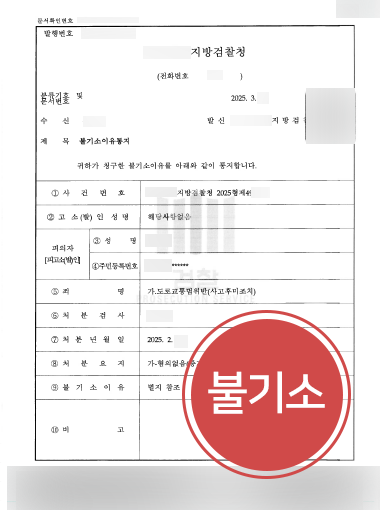
For the client whose traffic accident case had been referred to the prosecutors' office, the traffic accident attorney clearly clarified the essence of the case and the legal issues, and as a result, the prosecution issued a disposition of "no suspicion of crime" (non-prosecution) to the client.
The prosecution, taking into account the overall circumstances, including the video material secured during the investigation, the written opinion submitted by counsel, and the client's mitigating circumstances, accepted that it was difficult to find the charges established.
Through this, the client in this traffic accident case escaped not only the anticipated criminal punishment but also the risk of license revocation, and was able to maintain his family's livelihood stably.
How to Respond to a Traffic Accident
The above is a case in which a client, facing the risk of punishment after a traffic accident case was referred to the prosecutors' office, obtained a non-prosecution disposition by responding strategically from the prosecutorial investigation stage.
Daeryun LLC has many specialist attorneys with extensive experience in traffic accident cases.
The firm provides one-stop legal services covering not only the criminal procedures related to traffic accidents but also insurance claim matters and the civil litigation stage.
If you are in a situation requiring legal assistance due to a traffic accident, please request a consultation on your case at any time through a 🔗legal consultation booking.

This content is based on actual case studies of Daeryun Law LLC with some adaptations, and the copyright belongs to our firm.
Unauthorized reproduction, duplication, or distribution and other copyright infringements may result in legal action under applicable laws.