
CONTENTS
- 1. Telecommunications-Based Financial Fraud | Case Details

- 2. Telecommunications-Based Financial Fraud | Assistance Provided by the Criminal Law Specialist Attorney
- - Analysis of the Case Structure
- - Argument of the Absence of Intent to Conspire or Aid and Abet
- - Emphasis on Voluntary Reporting and the Absence of Intent
- - Response at the Prosecution Stage
- 3. Telecommunications-Based Financial Fraud | Case Outcome
- - Concept and Legal Definition of Telecommunications-Based Financial Fraud
- - Main Types of Telecommunications-Based Financial Fraud
- - Response Points for Telecommunications-Based Financial Fraud
- 4. Telecommunications-Based Financial Fraud | Daeryun Law Firm's One-Stop Assistance System

1. Telecommunications-Based Financial Fraud | Case Details

The client, who faced the risk of punishment on charges of telecommunications-based financial fraud, ran his own business and was experiencing financial difficulty due to mounting debt when he came across a posting for a “coin exchange part-time job” on an online job board.
The work seemed simple. The terms were that he would “be paid a commission for purchasing coins on an overseas exchange and sending them to a domestic exchange,” and the client, who had prior experience with cryptocurrency transactions, applied in the belief that this was a legitimate exchange-brokerage job.
As instructed, the client received transfers totaling tens of millions of won through an exchange account, and he used part of that amount to actually purchase coins.
During the transfer process, however, he grew suspicious that the transaction structure was unusual and stopped the work.
Afterward, the voice phishing group threatened him, demanding that he “retransfer the full amount received,” and he transferred only part of the amount due to a transfer limit before ending the transaction.
A few days later, the client learned that he had become involved in a case of telecommunications-based financial fraud (as a voice phishing fund delivery agent), and he immediately went to the police station on his own and gave a statement about the circumstances.
The police, stating that the client was identified as the “final recipient of the criminal funds” in the flow of money, applied the charge of telecommunications-based financial fraud and commenced an investigation.
2. Telecommunications-Based Financial Fraud | Assistance Provided by the Criminal Law Specialist Attorney
The criminal law specialist attorney assisted with the client's case as follows.
 Analysis of the Case Structure
The criminal law specialist attorney first analyzed the structure of the case.
In the past, the predominant method was for voice phishing organizations to recruit “in-person delivery agents” to collect cash, but recently a new method has emerged in which money laundering is carried out in the form of “cryptocurrency purchase agency” work.
The criminal law specialist attorney argued that the client was not even aware of the existence of this new type of crime, that he had gone through a legitimate coin purchase process through an actual exchange, and that he had obtained no financial benefit, and that the client was therefore himself a victim deceived by the voice phishing organization.
Argument of the Absence of Intent to Conspire or Aid and Abet
According to Supreme Court precedent (Supreme Court 1998Do1832), for joint principal liability to be established, there must be an intent of joint commission and functional control over the act.
Accordingly, the mere fact that a person was unaware of another's offense or simply followed instructions makes it difficult to treat that person as an accomplice.
The criminal law specialist attorney emphasized that the client had never actively cooperated in the offense or shown any intent to obtain financial gain on even a single occasion.
In particular, by analyzing the messenger conversation records, transfer records, and transaction records, the attorney submitted evidence showing the client's understanding that this was a “cryptocurrency purchase agency part-time job.”
Emphasis on Voluntary Reporting and the Absence of Intent
The criminal law specialist attorney emphasized that the client went to the police station on his own and reported the case as soon as he became aware of the criminal facts.
In addition, the attorney established that the client was a first-time offender and had merely expected short-term lawful income amid financial hardship, with no intent whatsoever to participate in unlawful conduct.
Response at the Prosecution Stage
After the client was referred to the prosecution at the police stage, the criminal law specialist attorney submitted a written opinion of defense counsel to the prosecution and organized, on a legal basis, the point that there were no circumstances whatsoever indicating that the client had controlled or been aware of the flow of the criminal funds.
The attorney also emphasized the ground of insufficient evidence, namely that “it is difficult to conclude that the suspect's conduct functioned as part of the voice phishing organization.”


3. Telecommunications-Based Financial Fraud | Case Outcome

The prosecution accepted the criminal law specialist attorney's legal arguments and acknowledged that the client had not merely carried out the instructions of the voice phishing organization but had instead been in a position closer to that of a victim.
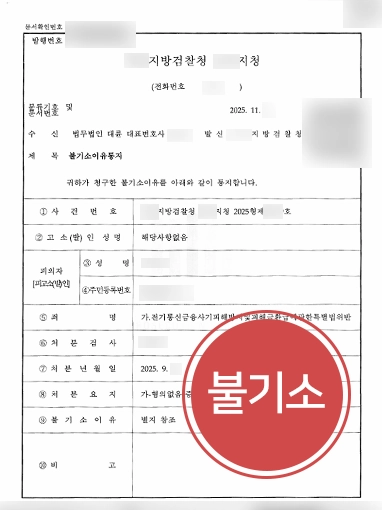
In the end, the prosecution issued a decision of non-prosecution on the ground of no suspicion of crime (insufficient evidence), stating that “there was no awareness of the offense or intent to conspire, and there was no clear evidence to support the alleged facts.”
Concept and Legal Definition of Telecommunications-Based Financial Fraud
Telecommunications-based financial fraud refers to the act of deceiving or extorting another person by using telecommunications under the Framework Act on Telecommunications, thereby acquiring funds or property benefits or causing a third party to obtain such benefits.
This commonly appears in the forms of voice phishing, smishing, phishing sites, messenger phishing, pharming, video chat phishing, and loan fraud.
Requirement Category | Specific Content | Standard of Determination |
Subject Requirement | A person who induces another to remit, transfer, or hand over funds, or who directly carries this out | Whether there was awareness of the offense and intent |
Conduct Requirement | Acquisition of property benefits through deception or extortion using telecommunications | Includes the act of delivering or transferring money |
Causation | A direct connection between the conduct and the occurrence of harm | Clarity of the flow of criminal proceeds |
Intent | Awareness of the structure of the offense and intent to obtain benefit | Liability may be denied depending on the absence of intent |
Article 15-2 of the Special Act on Telecommunications-based Financial Fraud provides that a person who commits telecommunications-based financial fraud may be subject to imprisonment for at least one year or a fine of at least three times but not more than five times the criminal proceeds, or both may be imposed concurrently.
In other words, even simple participation, if conspiracy is acknowledged, carries a high likelihood of an actual custodial sentence, and in particular, where a person is determined to be a fund delivery or withdrawal agent (a so-called “collection agent”), the risk of an imprisonment sentence is very high.
Main Types of Telecommunications-Based Financial Fraud
Type | Main Method | Characteristics |
Voice Phishing | Leaking personal information and account numbers by telephone | Impersonating financial or investigative institutions |
Smishing | Spreading malware through text message links | Payment harm after stealing personal information |
Messenger Phishing | Requesting remittance through conversations impersonating an acquaintance | The victim remits the money directly |
Phishing Site | Creating fake financial websites | Stealing login information |
Video Chat Phishing | Filming obscene video and making threats | Demanding money, threatening to distribute to acquaintances |
Loan Fraud | False loan advertisements and demands for fees | Inducing advance payment, using illegally obtained bank accounts |
Response Points for Telecommunications-Based Financial Fraud
1. Securing Prompt Legal Assistance at the Initial Statement Stage
Cases involving voice phishing are easily classified as those of an “accomplice” at an early stage.
Because even a single misstatement can lead to criminal punishment, the presence of a criminal law specialist attorney is needed immediately.
2. Proving the Structure of the Offense and the Absence of Awareness
To prove that the suspect was a “mere worker carrying out a task,” objective materials such as transaction records and conversation logs must be secured.
3. Emphasizing Voluntary Reporting and a Cooperative Attitude
Where a person voluntarily reports to the investigative authorities first, there is a high likelihood that the absence of intent and good faith will be acknowledged.
4. Asserting the Position of a Victim
Given the structure of voice phishing, the suspect may in substance also be a victim.
Submitting circumstances showing harm from the recovery of funds strengthens the defense argument.
4. Telecommunications-Based Financial Fraud | Daeryun Law Firm's One-Stop Assistance System
Daeryun Law Firm operates a dedicated telecommunications-based financial fraud system in which criminal case specialist attorneys, financial specialist attorneys, and the Digital Forensics Center work together.
From the early stage of a case, it can provide one-stop support as a single integrated process, covering the response to the investigation, legal review at the prosecution stage, preparation of a written opinion for non-prosecution, and the harm recovery procedures (account tracing and applications for refund of harmed funds).
It also has branch offices in major cities nationwide, enabling prompt consultation and on-site response anywhere, including Seoul, Busan, Daejeon, Daegu, Gwangju, and Jeju.
Because telecommunications-based financial fraud is an offense carrying a high risk of criminal punishment, it is most important, as soon as one is suspected, to consult with an attorney and design the direction of statements and the gathering of evidence.
If one responds by accurately distinguishing the law from the facts, it is entirely possible to clear oneself of a false accusation.
If you need assistance, you may make a 🔗legal consultation reservation with Daeryun, which provides tailored legal services.
This content is based on actual case studies of Daeryun Law LLC with some adaptations, and the copyright belongs to our firm.
Unauthorized reproduction, duplication, or distribution and other copyright infringements may result in legal action under applicable laws.