
CONTENTS
- 1. The Contents of the Case of a Client Seeking a Judgment Dismissing the Divorce Claim

- 2. The Divorce Attorney's Assistance for the Dismissal of the Divorce Claim
- - Establishing That the Unilateral Desertion and Blocking of Contact Were the Direct Cause of the Marital Breakdown
- - Arguing That the Claim of ‘Improper Treatment’ of the Mother-in-Law Was Without Basis
- - Clarifying the Circumstances of the Spouse's Infidelity and the Responsibility for the Marital Breakdown
- 3. The Divorce Attorney Who Obtained the Judgment Dismissing the Divorce Claim
- - Grounds for Filing a Divorce Suit
- 4. Key Response Points for Obtaining a Judgment Dismissing a Divorce Claim
- - The Need for Daeryun Law Firm

1. The Contents of the Case of a Client Seeking a Judgment Dismissing the Divorce Claim
This is the account of a client who sought the assistance of a divorce attorney in obtaining a judgment dismissing a divorce claim.
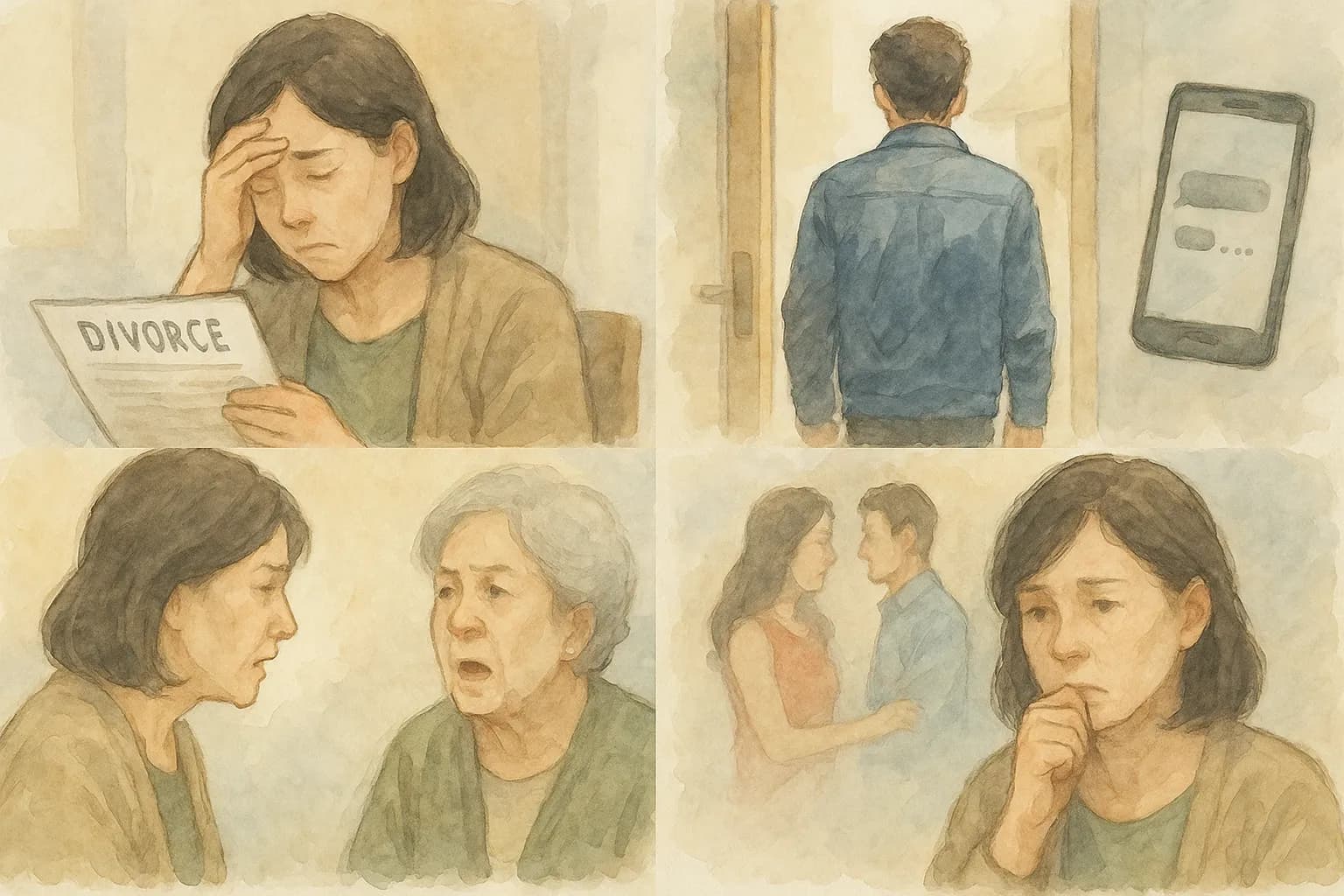
The client received a divorce complaint from a spouse with whom she had maintained a marriage for approximately twenty years.
About a year earlier, the spouse had left the home unilaterally without any explanation, and thereafter had blocked all communication, including phone calls, text messages, and messenger services.
Even so, the spouse, in the complaint, claimed divorce and consolation money on the ground that the client had failed to show courtesy to her mother-in-law and had not kept in contact, invoking Article 840, Item 4 of the Civil Act (improper treatment of a lineal ascendant).
The client's account, however, was entirely different.
The mother-in-law had repeatedly directed insulting remarks at the client for years, and the client, who had endured this, found it difficult to continue contact once the severe verbal abuse persisted. The client further stated that, to the contrary, the circumstances of the husband's infidelity were clear and that he was likely still living with the woman with whom he had committed adultery.
The client could not accept a demand for divorce based on such one-sided assertions, and she sought a judgment dismissing the divorce claim that would deny all of the spouse's claims.
2. The Divorce Attorney's Assistance for the Dismissal of the Divorce Claim
The central issues in this case were whether the "improper treatment" alleged by the spouse had any substance, who bore responsibility for the breakdown of the marriage, and whether the divorce claim could be permitted under the fault-based principle.
The divorce attorney structured the evidence and legal reasoning in the following manner.
 Establishing That the Unilateral Desertion and Blocking of Contact Were the Direct Cause of the Marital Breakdown
The divorce attorney prepared and submitted a detailed account of the fact that, immediately after deserting the home, the spouse had left only a single note before departing, the record showing that he had blocked the client's contact and messenger access, and the fact that the client suffered a severe shock as a result and came to receive psychiatric treatment.
Through this, the divorce attorney emphasized that it was, on the contrary, the husband who had no intention of maintaining the marriage, and that the filing of the divorce suit was likely intended to conceal his own infidelity following his desertion.
Arguing That the Claim of ‘Improper Treatment’ of the Mother-in-Law Was Without Basis
Although the spouse claimed that the client "had subjected the mother-in-law to improper treatment," in reality the client had for years repeatedly received verbal abuse and insults from the mother-in-law, and there existed the fact that, as the resulting mental suffering accumulated, the client had received psychiatric counseling and pharmacological treatment.
The Supreme Court (97Meu612, 2020Meu14763) has held that "improper treatment refers to assault, abuse, or insult of a degree such that maintaining the marriage would be assessed as harsh."
On this basis, the divorce attorney established that the client's conduct did not constitute improper treatment, but that, on the contrary, the client was the injured party who had been subjected to improper treatment by the mother-in-law, and that the structure of the spouse's claim did not hold at all.
Clarifying the Circumstances of the Spouse's Infidelity and the Responsibility for the Marital Breakdown
Taking together the communication records, photographs, and statements of acquaintances secured by the client, it emerged that the spouse was very likely to have had a long-term relationship with another person, and there were indications that he had continued living with that person even after deserting the home.
The divorce attorney emphasized that because it was clear that the spouse had provided the principal cause of the marital breakdown, the spouse's fault, including his infidelity, was an important reason why the divorce claim in this case should be rejected.
Taking all of this together, the divorce attorney strongly argued for dismissal of the divorce and consolation money claims on the grounds that the principal cause of the marital breakdown was the spouse's desertion and infidelity, that there was no legal basis whatsoever for the claim of improper treatment, that the client's mental injury arose from the conduct of the mother-in-law and the spouse, and that, under the fault-based principle, a spouse at fault cannot claim divorce.


3. The Divorce Attorney Who Obtained the Judgment Dismissing the Divorce Claim
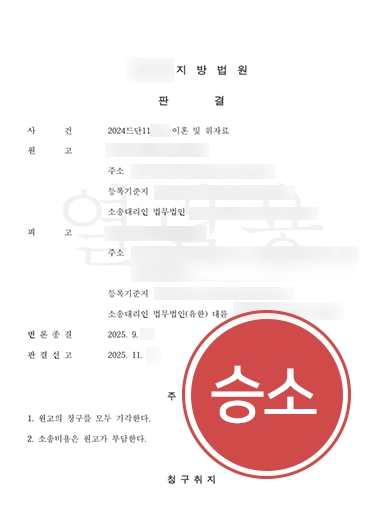
The court found that there was no objective evidence sufficient to recognize the "improper treatment" alleged by the spouse, and that, on the contrary, when considering the circumstances of the spouse's desertion and infidelity, the blocking of contact, and his fault, responsibility for the breakdown of the marriage lay with the spouse.
Accordingly, the court dismissed all of the spouse's claims for divorce and consolation money.
A divorce suit generally proceeds as follows.
2. Filing of the answer
3. Pleading date
4. Fact-finding and submission of evidence
5. Closing of pleadings
6. Pronouncement of judgment
Divorce is governed by the fault-based principle, under which a spouse responsible for the breakdown of the marriage cannot claim divorce.
Grounds for Filing a Divorce Suit
Article 840 of the Civil Act provides that a divorce suit may be filed where the following grounds exist.
2. Malicious desertion
3. Improper treatment by the spouse or a lineal ascendant
4. Where one's own lineal ascendant has received improper treatment from the spouse
5. The spouse's whereabouts being unknown for three years or more
6. Any other serious ground that makes it impossible to continue the marriage
A divorce claim may be dismissed in the following situations.
2. Where grounds such as improper treatment or assault are not objectively established
3. Where the plaintiff's fault, such as separation, desertion, or infidelity, is significant
4. Where the spouse's intent to divorce is to evade responsibility or serves an economic purpose
4. Key Response Points for Obtaining a Judgment Dismissing a Divorce Claim

As with the client in this case, in order to obtain a judgment of dismissal after receiving a divorce complaint, the following response points should be kept in mind.
2. Organizing the opposing spouse's grounds of fault, such as desertion, infidelity, and verbal abuse, is essential
3. Securing objective evidence is decisive (psychiatric treatment records, communication records, circumstances of the mother-in-law's verbal abuse, conversation messages, and the like)
4. Reviewing the legal standard for whether improper treatment exists (mere conflict or differences of opinion do not constitute improper treatment)
5. Expressing the intent to maintain the marriage is important
6. Submitting rebuttal materials in response to the spouse's assertions is necessary
The Need for Daeryun Law Firm
A dismissal of a divorce claim is a matter that requires the comprehensive design of legal reasoning, the structuring of evidence, and a rebuttal strategy.
Daeryun maintains a one-stop response system in which divorce attorneys, the evidence examination center, the digital forensics center, and others collaborate, and it has strengths in establishing the impropriety of a divorce claim and obtaining a judgment of dismissal.
In particular, the firm provides active assistance so that clients can be protected from improper divorce claims, by integrally carrying out analysis of the structure of the spouse's fault, the construction of reasoning to rebut claims of improper treatment, the organization and submission of evidence, and the preparation of strategies for consolation money and adultery-partner suits that may proceed in parallel.
If you are in a situation where you must obtain a judgment dismissing a divorce claim, you may book a 🔗legal consultation.
This content is based on actual case studies of Daeryun Law LLC with some adaptations, and the copyright belongs to our firm.
Unauthorized reproduction, duplication, or distribution and other copyright infringements may result in legal action under applicable laws.