
CONTENTS
- 1. The Account of a Client Against Whom Divorce Litigation Was Filed

- - Divorce Litigation: When Can It Be Filed?
- - Methods of Divorce and the Costs of Child Support Litigation?
- 2. Divorce litigation | The concept of divorce litigation
- - Divorce Method Child Support Litigation Cost
- 3. The Arguments of the Plaintiff (the Wife) Who Filed the Divorce Litigation, and the Rebuttal
- - The Divorce Attorney's Detailed Assistance
- - Result of the Divorce Litigation and Child Support Claim Litigation
- 4. Frequently Asked Questions Before Filing Divorce Litigation

1. The Account of a Client Against Whom Divorce Litigation Was Filed
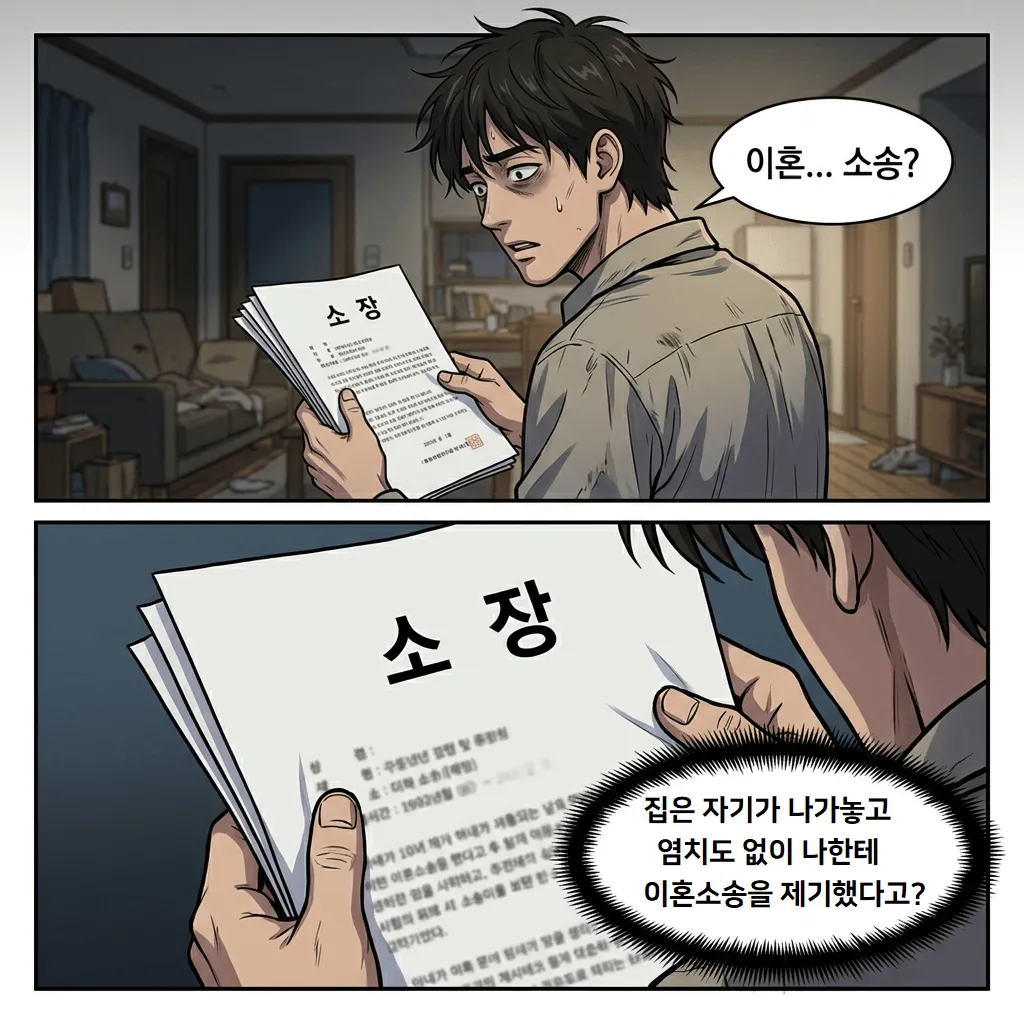
This is the account of a client who sought out an attorney, stating that he needed a consultation regarding divorce litigation.
The client was in a situation in which his wife had filed divorce litigation against him.
The client and his wife had been living separately for several years, and in filing the litigation the wife claimed that “she had been treated unfairly by the client and his parents-in-law.”
In addition, in filing the divorce litigation, the wife claimed 30 million won in divorce consolation money and approximately 30 million won in past child support.
In reality, however, it was the wife who had begun the separation by taking the children and effectively leaving home, and the client had shown a will to restore the relationship by steadily sending living expenses to the wife even in financially difficult circumstances.
In these respects, this case was a divorce dispute in which it was difficult to conclude that the cause lay in the client's fault.
The client had no objection to the divorce itself, but in order to objectively prove and contest matters such as the claims for consolation money and past child support, he sought assistance through a consultation with Daeryun's divorce attorney.
 Divorce Litigation: When Can It Be Filed?
Divorce litigation refers to a procedure in which one spouse files with the court in order to dissolve the marital relationship, and where no agreement is reached between the parties, the family court decides the dissolution of the marriage by judgment.
The Civil Act sets forth the grounds for judicial divorce, providing that a person may petition the court for divorce when there exist circumstances such as the spouse's act of infidelity, malicious desertion, grievously unfair treatment, three or more years of unknown whereabouts as to whether the spouse is alive or dead, and any other serious cause making it difficult to continue the marriage.
Because this involves judging not only ‘whether to divorce’ but also ancillary claims such as divorce litigation consolation money, division of marital property, custody, and child support, a legal basis and the securing of evidence are very important.
Methods of Divorce and the Costs of Child Support Litigation?
Category | Procedure | Key Features | Whether the Court Is Involved |
Divorce by Agreement | The spouses reach an agreement and then report it to the court | Can be done quickly by agreement between the parties | Confirmation by the family court is required |
Divorce by Conciliation | An agreement is reached before the conciliation committee | Resolved through court conciliation when divorce by agreement is difficult | A court conciliation procedure is conducted |
Divorce by Trial | A suit is filed with the family court | Conducted when agreement is impossible or when disputes over matters such as divorce litigation consolation money, child support, and parental authority become complex | The marriage is dissolved by a court judgment |
As with the present client, where the spouses' respective views on the cause of divorce differ and the agreement has completely broken down, a contested divorce by trial must be pursued.
In particular, because this was a situation in which consolation money and a past child support claim litigation had also been filed, the divorce attorney quickly proceeded to respond to the divorce-by-trial procedure.
2. Divorce litigation | The concept of divorce litigation
What is a divorce lawsuit?A procedure filed by one spouse to the court to dissolve the marriage. If no agreement is reached between the parties, the Family Court decides on the dissolution of the marriage through a ruling.It says.
Civil law stipulates grounds for divorce in court.Spouse's unfaithfulness, malicious abandonment, grossly unfair treatment, uncertainty of life or death for more than 3 years, or other serious reasons that make it difficult to continue the marriageIt is stipulated that a divorce can be filed with the court when such circumstances arise.
This isIt does not only determine ‘whether or not to divorce’, but also claims for divorce litigation alimony, property division, custody, child support, etc.Since it is also covered, securing legal basis and evidence is very important.
Divorce Method Child Support Litigation Cost
division | procedure | Key Features | Court involvement? |
Divorce by agreement | Report to court after couple agrees | Possible quickly through agreement between parties | Family court confirmation required |
mediation divorce | Reach agreement in the mediation committee | When divorce by agreement is difficult, it is resolved through court mediation. | Court mediation process underway |
trial divorce | File a lawsuit in family court | Held when agreement is impossible or when there are major issues such as alimony and child support in divorce litigation. | Dissolution of marriage by judgment |
In this case, the agreement between the couple had completely broken down, and a divorce suit for alimony and past child support claims had also been filed, so it was proceeded through trial divorce proceedings.


3. The Arguments of the Plaintiff (the Wife) Who Filed the Divorce Litigation, and the Rebuttal
The wife claimed that “the client and his parents had treated her with grievously unfair treatment,” and asserted this as a ground for divorce.
She also stated that “she had been solely responsible for nursing her father-in-law and had been treated unfairly by her parents-in-law.”
However, contrary to the wife's claims, the attorney proved by evidence that all of the nursing care had been carried out by a professional caregiver and the mother-in-law.
In addition, the attorney secured statements showing that the wife had not so much as made a single telephone call to her parents-in-law and had, on the contrary, treated the client's parents rudely.
Moreover, it was confirmed that, after the wife unilaterally left the home with the children, she had even withdrawn and used the deposit for the residence in which they had lived together.
Nevertheless, the client had kept records of remitting living expenses and child support from time to time.
In the end, the wife's claims as to the grounds for divorce were not supported by objective evidence, and it was determined that, on the contrary, the cause of the breakdown of the marriage originated in the wife's arbitrary conduct.
The Divorce Attorney's Detailed Assistance
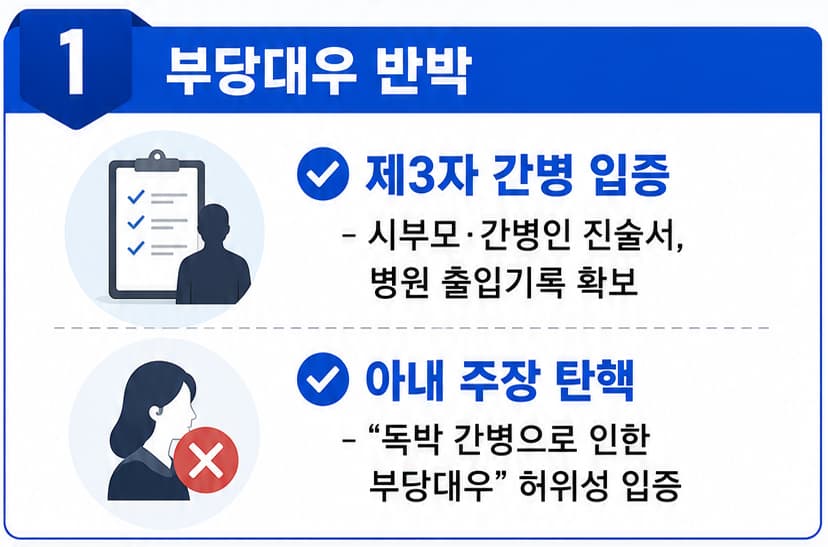
① Securing Evidence to Rebut the Claim of Unfair Treatment
The attorney secured the statements of the parents-in-law, the statement of the caregiver, and hospital entry records, and thereby proved that the nursing care of the father-in-law had been provided not by the wife, as she claimed, but with the help of a third party.
Through this, the wife's claim of “unfair treatment arising from nursing the parents-in-law” lost its persuasiveness.
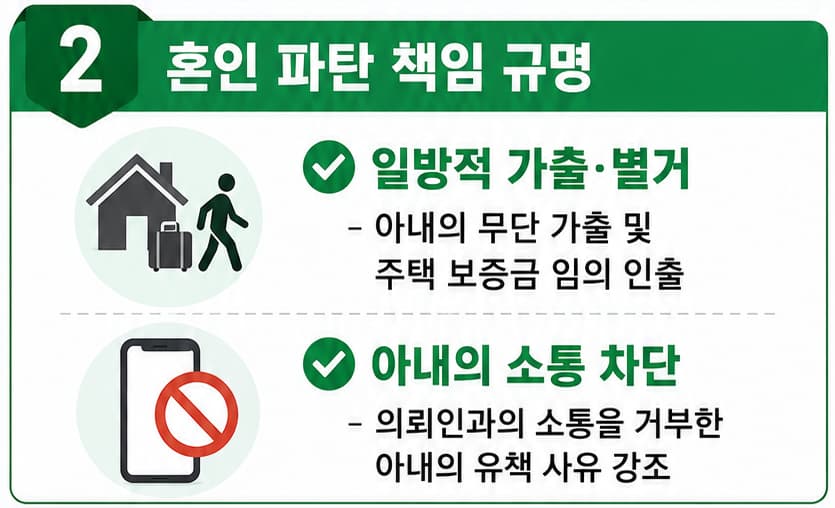
② Establishing the Real Cause of the Breakdown of the Marriage
The attorney argued that the primary responsibility for the breakdown of the marriage lay with the wife, citing the points that she had unilaterally begun the separation and withdrawn the housing deposit, and that she had not given the client an opportunity to confer at the time she moved out.
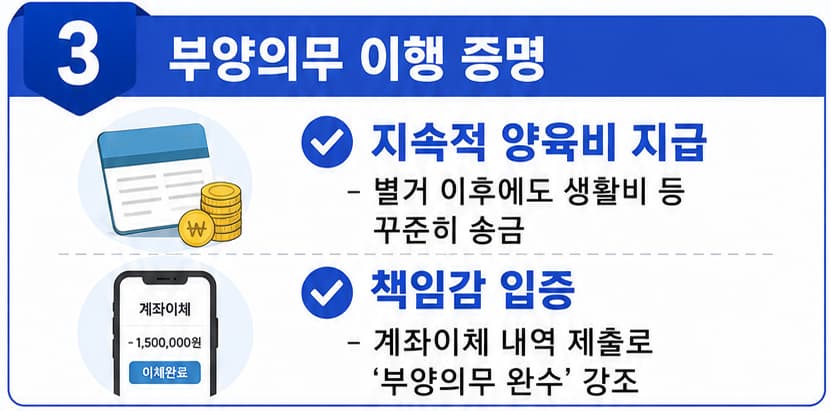
③ Submitting Records of Remittances of Living Expenses and Child Support
Even after the separation, the client had continuously paid living expenses for the children.
The attorney submitted the relevant remittance records and bank transfer records as evidence and emphasized that the client had been fulfilling his duty of support toward the children.
Result of the Divorce Litigation and Child Support Claim Litigation
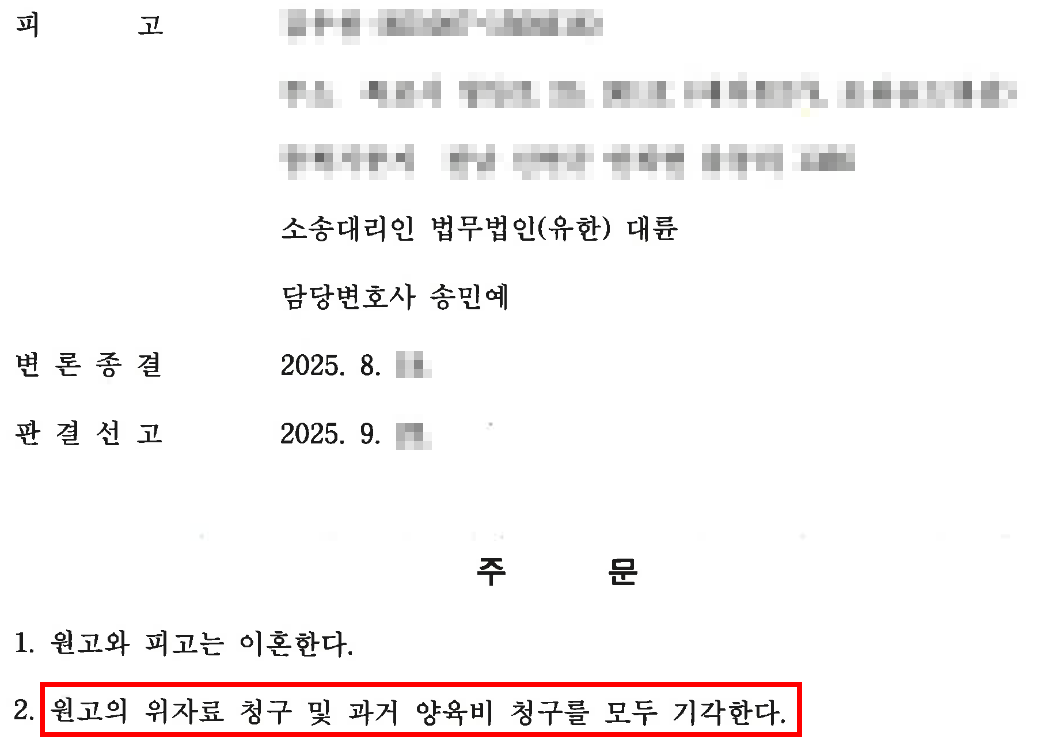
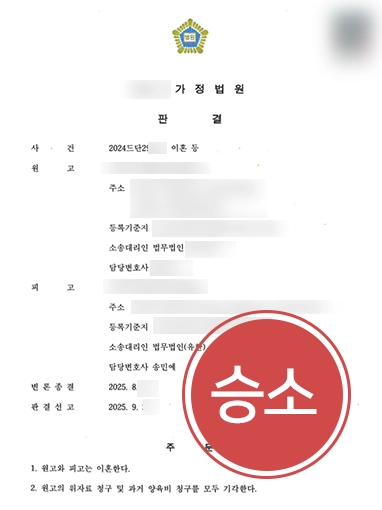
The court rendered a judgment dismissing all of the plaintiff's (the wife's) claims for divorce consolation money and past child support, granting only the divorce and not accepting the financial claims.
This case was an example in which, beyond an emotional dispute between the spouses, the locus of responsibility for the breakdown of the marriage and the legal basis for the financial claims became the issues.
The divorce attorney's systematic analysis of the facts and presentation of evidence led to the result of having both the divorce litigation consolation money and the child support claim litigation dismissed.
In divorce litigation, clearly proving the facts through the assistance of a specialist from the outset is the first step.
If you are in a situation in which you need help with a divorce-related matter, we invite you to make a 🔗legal consultation reservation with Daeryun, ranked the ninth-largest law firm in Korea (based on 2025 National Tax Service value-added tax filings).
4. Frequently Asked Questions Before Filing Divorce Litigation
Q. When filing divorce litigation, is an attorney absolutely necessary? A. Retaining an attorney is not legally mandatory. It is also possible to conduct the litigation on your own by personally preparing and submitting a complaint or an answer to the family court. However, if the matters are complex, involving issues such as division of marital property, custody, and consolation money, we recommend that you obtain the help of an attorney. In particular, if the other party has retained an attorney, responding without legal support may place you at a disadvantage.
A. You must make use of the compulsory execution application and the property inquiry system. If the other party fails to comply with the judgment, the court may confine that party, and further pressure is also possible pursuant to the court's order to comply directly. Consolation money and child support are not money that one may decline to pay simply because one does not wish to. With the judgment alone, legal means are in place to compulsorily recover wages, bank accounts, and real estate. However, since the execution procedure is not simple, we recommend that you obtain the help of an attorney.Q. If, after divorce litigation, the other party refuses to pay the child support that has been ordered, what should be done?
This content is based on actual case studies of Daeryun Law LLC with some adaptations, and the copyright belongs to our firm.
Unauthorized reproduction, duplication, or distribution and other copyright infringements may result in legal action under applicable laws.